I’m still having good results with Tributyrin, which I feed with inulin, which quickly dissolves in a glass of warm water. Both are available from Amazon at a moderate price.
2 Likes
Anything that is measurable, in terms of results?
1 Like
Not cognitively, but my gut seems less inflamed. I’ll be having blood tests soon. I also soon will start experimenting with urolithin b and SS-31, which may synergistic but confounding variables. .
3 Likes
Inulin does feed your gut in important ways, but it doesn’t feed tributyrin. Not that I’m the syntax police, but just didn’t want to leave that out there.
7 Likes
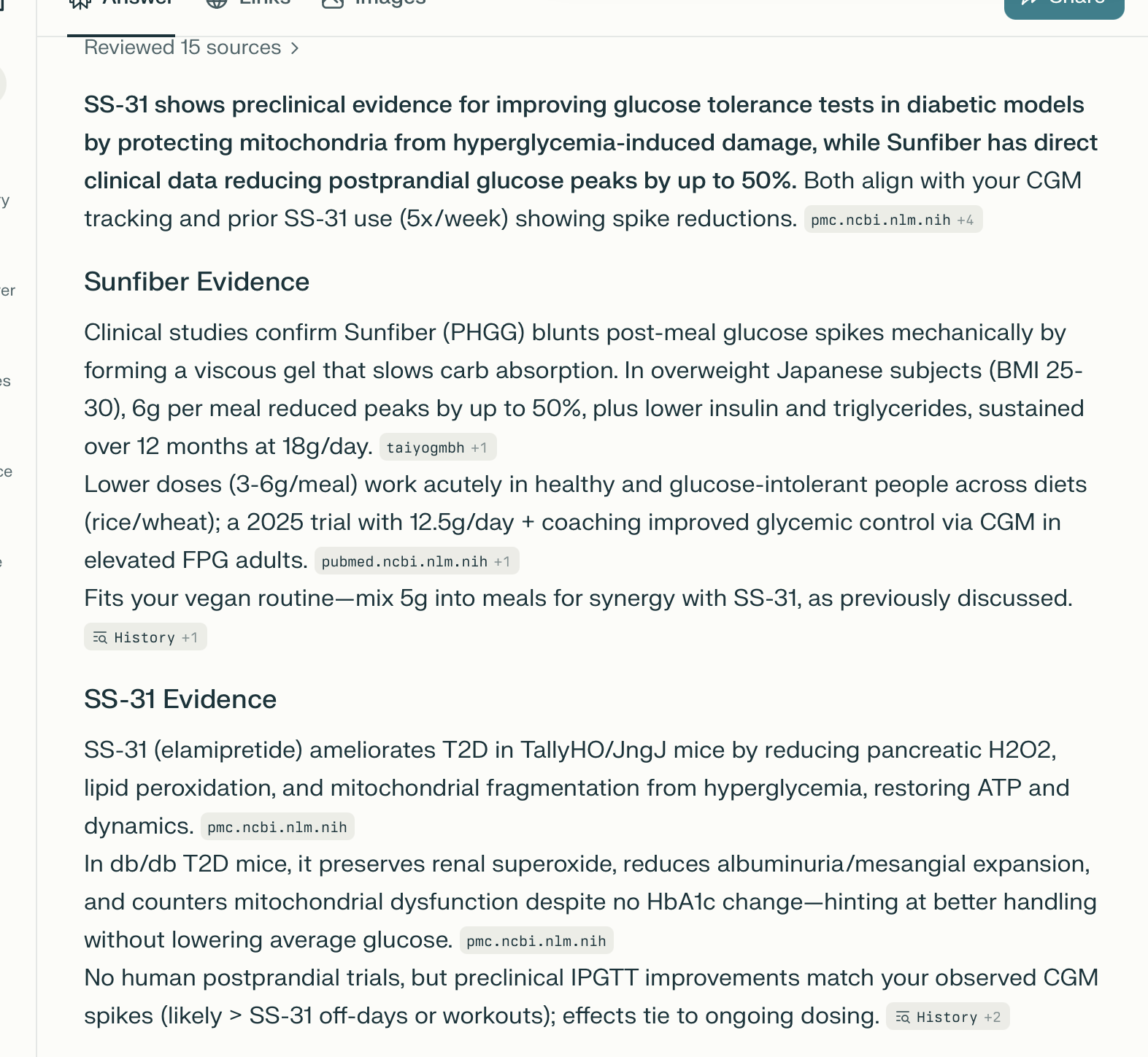
I just shared an update in the ss-31 thread about my lack of high glucose spikes. I thought it was worth sharing here that I discovered in addition to ss-31, Sun Fiber (which I added after reading about it in this thread) also might be contributing. Does anyone who uses Sun Fiber also wear a cgm?
Perplexity:
3 Likes
I wondered what the prebiotic mix was:
prebiotic mix consists of 18 different types of prebiotics including arabinoxylan and cellulose/hemicellulose from psyllium husk, beta glucans, chitin and mannan from maitake mushroom, arabinan from quinoa, fructooligosaccharides (FOS) from beetroot, glycyrrhizins and glycyrrhizin from liquorice root, isomaltooligosaccharide (IMO) from miso, pectin from orange peel, xylan and galactan from spirulina, resistant starch from arrowroot, inulin from chicory, xyloglucan from tamarind, xylo oligosaccharides (XOS) from rice bran, guar bean, and galactooligosaccharides (GOS) from chickpeas.
Pretty diverse, this was the treatments:
Participants received one of the following: synbiotic (n = 20; 170 ml kefir + 10 g prebiotic), omega 3 (n = 33; 500 mg/day), inulin fibre (n = 31; 20 g/day), or no supplementation (n = 20 control).
Of course, the results:
All three dietary interventions significantly reduced inflammatory markers versus control. TNF-α decreased with omega-3 (d= − 0.618, 95% CI -0.73 to -0.09, p = 0.01) and inulin fibre (d=–1.012, 95% CI -0.71 to -0.20, p = 0.001). The synbiotic group showed broader and larger reductions, including IL-6 (d=–0.882,95% CI -1.36 to -0.17, p = 0.01), IFN-γ (d=–0.940, 95% CI -2.03 to -0.31, p = 0.009), SIRT2 (d=–1.505, 95% CI -1.30 to -0.51, p < 0.0001), 4EBP1 (d=–1.384, 95% CI -1.43 to -0.32, p = 0.0004), CCL23 (d=–1.356, 95% CI -1.40 to -0.48, p = 0.0002), and mucosal cytokines CCL25 (d=–1.137, 95% CI -0.90 to -0.23, p = 0.001) and CCL28 (d=–1.006, 95% CI -0.80 to -0.16, p = 0.003). Increases in serum butyrate correlated with reductions in IL-6 following the synbiotic intervention.
I have kefir with ground flax seed, ground golden oyster mushroom, and a further mix of goodies. Now I follow with Miyarisan (anabolic butyrate producer) and I’m using 50g unmodified potato starch/day split. I need all the help I can get.
3 Likes
Ask
Point of contact for the paper;
Corresponding Author
Niharika A. Duggal
Department of Inflammation and Aging, School of Infection, Inflammation and Immunology, University of Birmingham, Birmingham, UK
National Institute for Health and Care Research (NIHR) Birmingham Biomedical Research Centre, Birmingham, UK
Correspondence:
Niharika A. Duggal (aroran@bham.ac.uk)
1 Like
A mediocre study. They compared 6 weeks of
- 500 mg of Omega 3 supplements (165 mg EPA + 110 mg DHA)
- inulin fibre arm (20 g inulin fibre) daily for 6 weeks
- 170 ml kefir and 10 g of a prebiotic mix (supplied by Chucking Goat Ltd)
Ridiculously low EPA dose, too much inulin and kefir with different kind of fibers so that any comparison is meaningless.
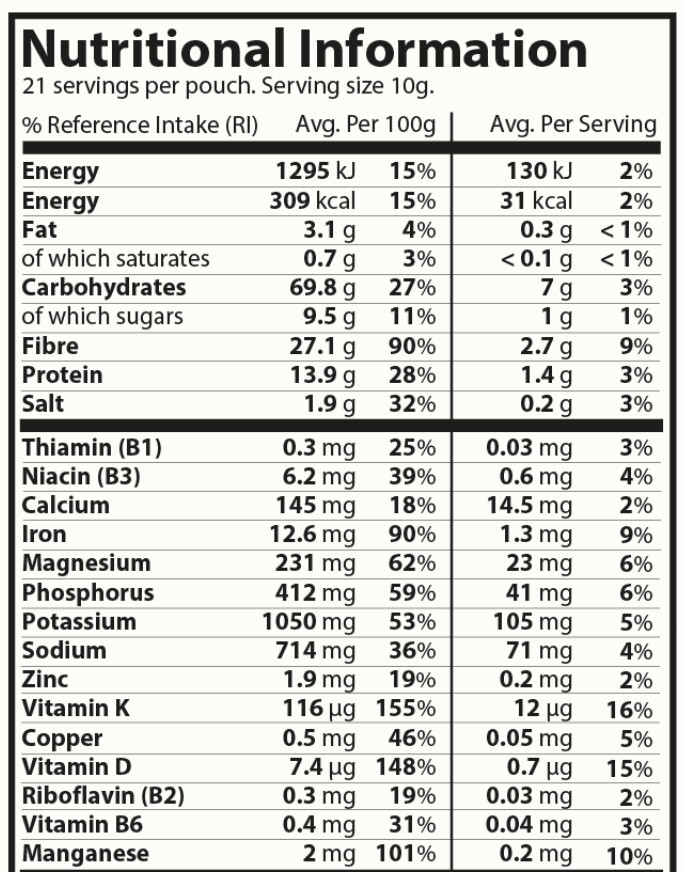
The kefir and fiber blend: Chuckling Goat Ltd.
The synbiotic arm were given 170 ml kefir and 10 g of a prebiotic mix (supplied by Chucking Goat Ltd), consumed as a smoothie daily for 6 weeks.
Note that the composition below is for 100g but the serving size is 10g so it provides only 2.71g of fiber for 6.98g of carbs and 0.95g of sugar.
Not really impressive. I’m taking fiber and EPA and kefir (>250ml of my home made fresh kefir).
2 Likes
Funny. That’s my mix too: EPA, fiber, homemade kefir. Though I also use a very small amount of EPA (500mg pure EPA, no DHA).
3 Likes
Butyrate: The Microbiome’s Anti-Aging “Kill Switch” for Senescent Cell
I was never able to find a BHB supplement that I liked. So I have chosen to take C8 (caprylic acid) in my morning coffee Actually use a combo of C8 and C10 for immediate and sustained benefits. It actually tastes good in my coffee. I use the powdered form, and it tastes a lot like adding a creamer to my coffee.
Of course: “ketone esters provided the largest BHB ketone boost per serving.”
Summary of Differences
| Feature | C8 Supplementation | Direct BHB Supplementation |
|---|---|---|
| Action | Precursor; body produces BHB from C8 | Direct source of BHB |
| Speed | Slower to raise BHB levels (peak around 60-120 min) | Rapid BHB surge (peak around 30-60 min) |
| Effect Duration | More sustained elevation | Quicker return to baseline |
| Goal | Supports long-term fat adaptation and endogenous ketone production | Provides immediate exog |
Mostly at my age I look for supplements that have benefits for the brain:
C8 (caprylic acid) supplementation primarily benefits the brain by providing an alternative and rapid fuel source in the form of ketones and through direct neuroprotective effects, including enhanced mitochondrial function and potential anti-inflammatory action.
Key Brain Benefits
- Alternative Energy Source: The brain primarily uses glucose for energy. However, in certain conditions like Alzheimer’s disease or with aging, the brain may develop insulin resistance and lose the ability to use glucose efficiently, creating an “energy gap”. C8 is quickly metabolized into ketone bodies (specifically BHB) in the liver, which can readily cross the blood-brain barrier and provide an alternative, highly efficient fuel source to brain cells, thereby bridging this energy gap.
- Improved Cognitive Function: Studies have shown that C8 supplementation can enhance mental clarity, focus, memory, and overall cognitive performance, both in healthy young adults and in elderly individuals with mild cognitive impairment (MCI) or Alzheimer’s disease (AD).
- Neuroprotective Effects: C8 and its metabolites may offer neuroprotection by:
- Increasing Neuronal GABA Synthesis: C8 can increase the supply of glutamine to astrocytes, which is then used to synthesize the neurotransmitter GABA in neurons, potentially contributing to anti-seizure effects.
- Modulating Inflammation: Low-level intake of caprylic acid may help reduce neuroinflammation and protect against neural degeneration.
- Enhancing Mitochondrial Function: Some research suggests C8 can directly stimulate mitochondrial respiration (energy production) in brain cells.
- Support for Neurological Conditions: The ketogenic effects of C8 have been used in the dietary management of drug-resistant epilepsy since the 1920s, helping to reduce seizure frequency. Research also suggests potential benefits in ameliorating other neurodegenerative disorders such as Parkinson’s disease and TBI by restoring energy metabolism.
Summary
C8 supplementation offers significant brain benefits by providing a rapid, alternative fuel and directly supporting neural health and function. These effects can lead to enhanced mental performance and may also help mitigate cognitive decline in individuals with conditions that impair brain glucose metabolism. Ref
5 Likes
OK, there were problems with this study. Here is some more from an analysis of the paper (see below) but it would seem that the idea of a complex of prebiotic fibers, and specific goat-milk kefir (27 strains) (how do you make this???), might have some value. Below I’ve done a search for other probiotic mixtures that might be similar to the one used in the study, but that are sold commercially in the USA.
4. Novelty
- Magnitude of Effect: We already knew fermented foods were good (Wastyk et al., 2021). What is new is the effect size (d>1.0 for multiple markers) compared to the standard of care (Omega-3). Omega-3s failed to move the needle on IL-6 or SIRT2 in this comparison.
- Specific Synbiotic Formulation: This wasn’t just “yogurt.” It was a specific goat-milk kefir (27 strains) paired with a complex 18-fiber prebiotic mix (arabinoxylan, beta-glucans, etc.). This supports the “precision prebiotic” hypothesis—you need the right fuel for the right bugs.
5. Critical Limitations
- The Age Confound (Major): The study compares a younger Synbiotic cohort (18+) against an older Omega-3/Inulin cohort (60+). While the authors adjusted for age statistically, this is a dangerous comparison. Older adults have established immunosenescence and higher baseline inflammation. It is possible Omega-3s work better in younger people, or that the Synbiotic effect is exaggerated because younger systems are more plastic.
- Non-Blinded: Participants knew they were drinking a smoothie. The placebo effect on subjective well-being is irrelevant for serum markers, but lifestyle confounding (e.g., “I’m drinking this healthy smoothie, maybe I shouldn’t eat pizza”) is a risk.
- Short Duration: 6 weeks is sufficient for cytokine changes but insufficient to prove long-term remodeling of the immune system or colonization of the gut microbiome.
- Low Dosage of Omega-3: The Omega-3 group received only 500mg/day (165mg EPA / 110mg DHA). This is a clinically low dose. Most therapeutic longevity protocols recommend 2g-4g daily. Comparing a “nuclear” synbiotic intervention to a “homeopathic” dose of Omega-3 is a straw-man comparison [Confidence: High].
Prebiotic Fiber Mixtures
Market search identified that no single pre-mixed powder contains all 18 specific isolated fibers, as many are structural subclasses of one another (e.g., Arabinan and Galactan are often substructures of Pectin or Arabinogalactan; Xyloglucan is a hemicellulose).
However, Designs for Health PaleoFiber and Vibrant Health Green Vibrance contain the highest density of these specific compounds due to their use of complex whole-plant and gum sources.
Top Ranked: Highest Ingredient Match
1. PaleoFiber (Powder)
-
Match Count: 12/18 (Direct & Source-Derived)
-
Why it wins: This formula is designed as a “complex fiber” blend. It uses 12 distinct plant sources that naturally cover the structural hemicelluloses (Arabinoxylan, Xylan, Mannan) which are rarely found as isolated ingredients.
-
Ingredient Mapping:
-
Arabinogalactan: Native to Acacia Gum (primary ingredient).
-
Arabinoxylan: Psyllium Husk is ~70% highly branched arabinoxylan.
-
Cellulose: Bamboo Fiber is almost pure cellulose.
-
Guar Gum: Explicitly included (Hydrolyzed Guar).
-
Inulin: Chicory Root Inulin.
-
Mannan: Glucomannan (Konjac root) and Guar (Galactomannan).
-
Pectin: Apple Pectin.
-
Arabinan / Galactan: Abundant side-chains in Apple Pectin and Acacia.
-
Xylan: Major component of Bamboo Fiber.
-
Hemicellulose: Comprised of the Psyllium, Bamboo, and Flax fibers.
-
Missing: Chitin, GOS, IMO, Resistant Starch (unless RS version), XOS, Xyloglucan.
| Rank | Product / Brand | Vendor | Total Weight | Total Price |
|---|---|---|---|---|
| 1 | PaleoFiber (Unflavored) | Designs for Health | 300 g (10.6 oz) | ~$46.00 |
- URL: Designs for Health PaleoFiber Product Page
- Note: They also offer “PaleoFiber RS” which swaps some fibers for Resistant Starch (Green Banana) but loses the diversity of the 12-fiber blend.
2. Green Vibrance
-
Match Count: 11/18
-
Why it ranks high: While primarily a “Greens” powder, its fiber profile is chemically complex. It explicitly adds Larch Arabinogalactan, FOS, and Apple Pectin to a base of cereal grasses (Wheat/Oat/Barley) which are the industry’s primary sources of Arabinoxylan, Beta-Glucan, and Xylan.
-
Ingredient Mapping:
-
Arabinogalactan: Larch Arabinogalactan (ResistAid) + Acacia.
-
Beta-Glucan: Oat Grass + Beta-1,3/1,6-Glucan (Yeast).
-
FOS: Explicitly listed.
-
Pectin: Apple Fruit Powder.
-
Arabinoxylan / Xylan: The cell walls of Wheat Grass and Barley Grass.
-
Cellulose: Whole Grass Powders.
-
Galactan: From Pectin/Acacia sources.
-
Missing: Chitin, GOS, Guar Gum, IMO, Mannan (unless trace), Resistant Starch, XOS, Xyloglucan.
| Rank | Product / Brand | Vendor | Total Weight | Total Price |
|---|---|---|---|---|
| 2 | Green Vibrance | Vibrant Health | 358 g (12.6 oz) | ~$52.00 |
3. Kibow Fortis
-
Match Count: 7/18 (But high specificity)
-
Why it ranks high: It is one of the few products to explicitly isolate and list Xylooligosaccharide (XOS) and multiple forms of Beta-Glucan. It is a “precision” prebiotic rather than a “whole food” blend.
-
Ingredient Mapping:
-
XOS: Xylooligosaccharide (rarely found in blends).
-
Arabinogalactan: Explicitly listed.
-
Beta-Glucan: (1,3/1,6 from Yeast) AND (1,3/1,4 from Oat).
-
Inulin: Explicitly listed.
-
Missing: Arabinan, Arabinoxylan, Cellulose, Chitin, FOS, Galactan, GOS, Guar Gum, IMO, Mannan, Pectin, Resistant Starch, Xyloglucan.
| Rank | Product / Brand | Vendor | Total Weight | Total Price |
|---|---|---|---|---|
| 3 | Kibow Fortis | Kibow Biotech | 120 g (4.2 oz) | ~$40.00 |
4. Supergut (Foundational Fiber)
-
Match Count: 4/18 (High dosage, low variety)
-
Why it ranks: Included because it is the primary market source for Resistant Starch, which the above blends lack.
-
Ingredient Mapping:
-
Resistant Starch: Green Banana + Solnul (Potato).
-
Guar Gum: Hydrolyzed Guar (Sunfiber).
-
Cellulose: Vegetable fiber blend.
-
Missing: Almost all specific hemicelluloses (Arabinan, Xylan, etc.) and immune fibers (Beta-Glucan, Arabinogalactan).
| Rank | Product / Brand | Vendor | Total Weight | Total Price |
|---|---|---|---|---|
| 4 | Foundational Fiber | Supergut | 168 g (5.9 oz) | ~$34.00 |
Summary of Shipping & Logistics
- Designs for Health: Free shipping on orders over $50.
- Vibrant Health: Free shipping on orders over $50.
- Kibow: Flat rate shipping usually applies under $50.
- Supergut: Subscription models offer free shipping; one-time purchases may incur ~$5-9 shipping.
Procurement Recommendation
To achieve near 100% coverage of your 18-ingredient list, no single powder exists. You must combine:
- Designs for Health PaleoFiber (Base for structural fibers: Arabinoxylan, Mannan, Pectin, Cellulose).
- Kibow Fortis (For XOS and specific Beta-Glucans).
- Supergut (For Resistant Starch).
1 Like
Interesting related study:
2 Likes
I’ve been on my “high-butyrate” diet for the past few months, and it seems to be working. This week’s blood test that included HS-CRP was at 0.3mg/L, so about as low as it goes (given the error bars of this test).
9 Likes
That is great news! Could you please share your updated protocol?
I know you were taking inulin and then added sun fiber and were looking at a bunch of other things…
1 Like
My butyrate program:
10 grams of inulin in my coffee right now (recently ran out of SunFiber)
NOW Foods Supplement, 8 Billion Acidophilus & Bifidus, 1 per day, 68 mg,
Curcumin Phytosome 500 mg (Meriva) - Sustained Release per day,
Natural Factors Oil of Oregano, Carvacrol 144mg per day
and occasionally (couple times a week) fermented tea (Japanese/chinese).
7 Likes
Tim, could you share the brands your are using? I’ve been dealing with acid reflux recently and would like to see if I see similar relief as you’ve described.
1 Like
John, could you elaborate on citrate and acid reflux? Is there any research or protocol you can point to?
2 Likes
I am just parroting what we already know from various AIs. But what happened to Akkermansia?
“Metabolic Health: Ameliorating insulin sensitivity and lowering plasma total cholesterol.
Weight Management: Reductions in body weight, fat mass, and hip circumference have been observed in clinical studies.
Gut Barrier Integrity: Strengthening the mucus layer and preventing “leaky gut” by improving the gut’s physical barrier.”
FWIW: I have taken probiotics on and off over the years and did not notice any subjective change. Lately I have been putting my probiotics in enteric-coated capsules before taking them. The difference is dramatic. I notice a big change: normalization of my poop
I especially notice a normalization of my stomach and lower digestive tract.
Currently I am taking Lactobacillus brevis, but when I finish the bottle, I will go back to Akkermansia, which I have tried before with no subjective result. But at the time I was taking Akkermansia, I wasn’t putting it in enteric-coated capsules.
“Gut microbiome homeostasis is fundamental to brain health (cognitive function and synaptic plasticity) (Salami, 2021), preventing neuroinflammation and protecting against neurodegenerative disorders in the elderly by maintaining microglial cells in a healthy mature state”
“Diversity & Stability: A healthy gut typically has a high variety of different species that are resilient enough to bounce back after temporary disruptions like a round of antibiotics or a change in diet.”
3 Likes
Where do you order enteric-coated capsules?
I searched before (a couple of years back) with no success.
1 Like