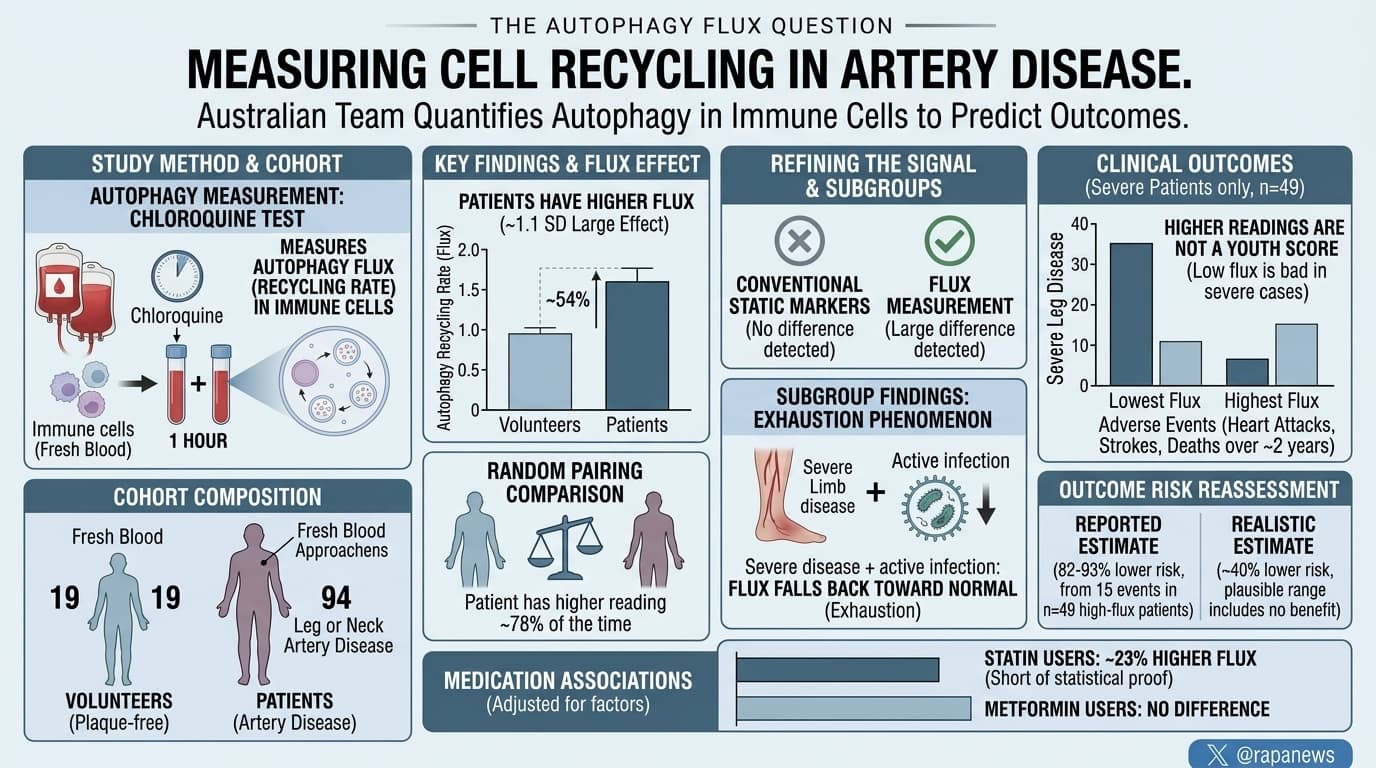
An Australian team measured how fast autophagy, the cell’s self-recycling system, was running in immune cells from 94 patients with leg or neck artery disease and 19 plaque-free volunteers. They used a one-hour chloroquine test on fresh blood. Recycling rate (flux) was about 54 percent higher in patients, and conventional static markers could not detect the difference. Flux fell back toward normal in patients with severe limb disease plus active infection, which the authors read as exhaustion. Among 49 patients with the most severe leg disease, those with the lowest flux had more heart attacks, strokes and deaths over about two years.
The longevity world treats autophagy, the cell’s self-recycling system, as an unambiguous good. More is younger, less is older, and a long list of compounds and fasting protocols are sold on their ability to turn it up. A new study from Adelaide suggests the picture in human blood is messier, and more interesting.
Researchers at the South Australian Health and Medical Research Institute, Flinders University and Adelaide University took fresh blood from 94 people with serious artery disease and from 19 healthy volunteers. The patients had either narrowed leg arteries (peripheral arterial disease) or narrowed neck arteries (carotid stenosis). The volunteers’ heart scans showed no plaque at all. Most earlier studies took a single snapshot of autophagy markers. This team instead measured how fast the process was running. They split each blood sample in two and used the antimalarial drug chloroquine to block the final digestion step in one half for an hour. Then they measured how much of the autophagy marker LC3B-II piled up in the immune cells. The faster it piles up, the faster the recycling line is moving.
The result ran against expectations. Immune cells from patients with artery disease recycled about 54 percent faster than those from healthy controls. The difference held after the researchers statistically accounted for age, sex, diabetes, smoking, cholesterol and medication. The standard snapshot measurement found no meaningful difference at all, a reminder that static markers can miss what dynamic ones catch. Earlier snapshot studies had concluded that autophagy is reduced in artery disease.
The team’s interpretation is that chronic inflammation, oxidative stress and excess blood fats push immune cells to step up their housekeeping as a defense. That response appears to have limits. In patients with the most severe leg disease who also had an active foot or leg infection, the recycling rate had dropped back toward the level seen in healthy people. The authors read this as exhaustion rather than recovery.
The most eye-catching result comes from following patients for a median of about two and a quarter years. Among the 49 patients with chronic limb-threatening ischemia, those in the lowest quarter of recycling rates had far more heart attacks, strokes and deaths than those in the other three quarters. On paper, the higher groups had between 82 and 93 percent lower risk.
Those numbers need a large pinch of salt. They rest on just 15 events, spread across four groups and adjusted for six other factors. Statisticians know that set-up tends to inflate effects dramatically. The paper is also a preprint that has not been peer reviewed, and the healthy volunteers were on average 18 years younger than the patients.
The bigger idea survives the caveats. If a one-hour blood test can read how hard immune cells are working to cope with stress, it could offer a window into systemic disease that no cholesterol panel provides.
Actionable Insights
- A high blood autophagy reading is not a youth score. People with artery disease had immune-cell recycling rates about 54 percent higher than healthy controls. That is a large effect, about 1.1 standard deviations. Pick one patient and one healthy person at random, and the patient has the higher reading about 78 percent of the time.
- The reported 82 to 93 percent lower risk of heart attack, stroke or death for patients with higher readings comes from 15 events in 49 people with severe leg disease. Pulled back toward what blood biomarkers usually achieve, a more realistic estimate is roughly 40 percent lower risk, with a plausible range that includes no benefit at all.
- Statin users had about 23 percent higher readings after adjustment, short of statistical proof. Metformin users showed no difference (about 1 percent lower).
- Diabetes carried the largest risk signal in the severe-disease group, though that estimate is very imprecise.
Context and Source
- Open Access Paper: Autophagic flux is increased in peripheral blood mononuclear cells in atherosclerotic vascular disease and associates inversely with adverse cardiovascular events, September 27, 2026.
- Institutions: Flinders University; South Australian Health and Medical Research Institute (Lysosomal Health in Ageing laboratory and Vascular Research Centre); Adelaide University; Southern Adelaide and Central Adelaide Local Health Networks (Flinders Medical Centre, Royal Adelaide Hospital). Senior authors are Timothy Sargeant and Peter Psaltis.
- Country: Australia
- Journal: bioRxiv (preprint server)
Related Reading:
- Measuring Autophagy in Body and Brain, Comparing Autophagy Activators
- Autophagy: The Universal Translator of Longevity
- The Cellular Incinerator: How Interventions like Rapamycin Hijack Autophagy to Hack Aging
- Japanese Fermented Tea Boosts Autophagy
- What’s autophagy? It’s the ultimate detox that doesn’t yet live up to the hype
- Preservation of Autophagy May Be a Mechanism Behind Healthy Aging