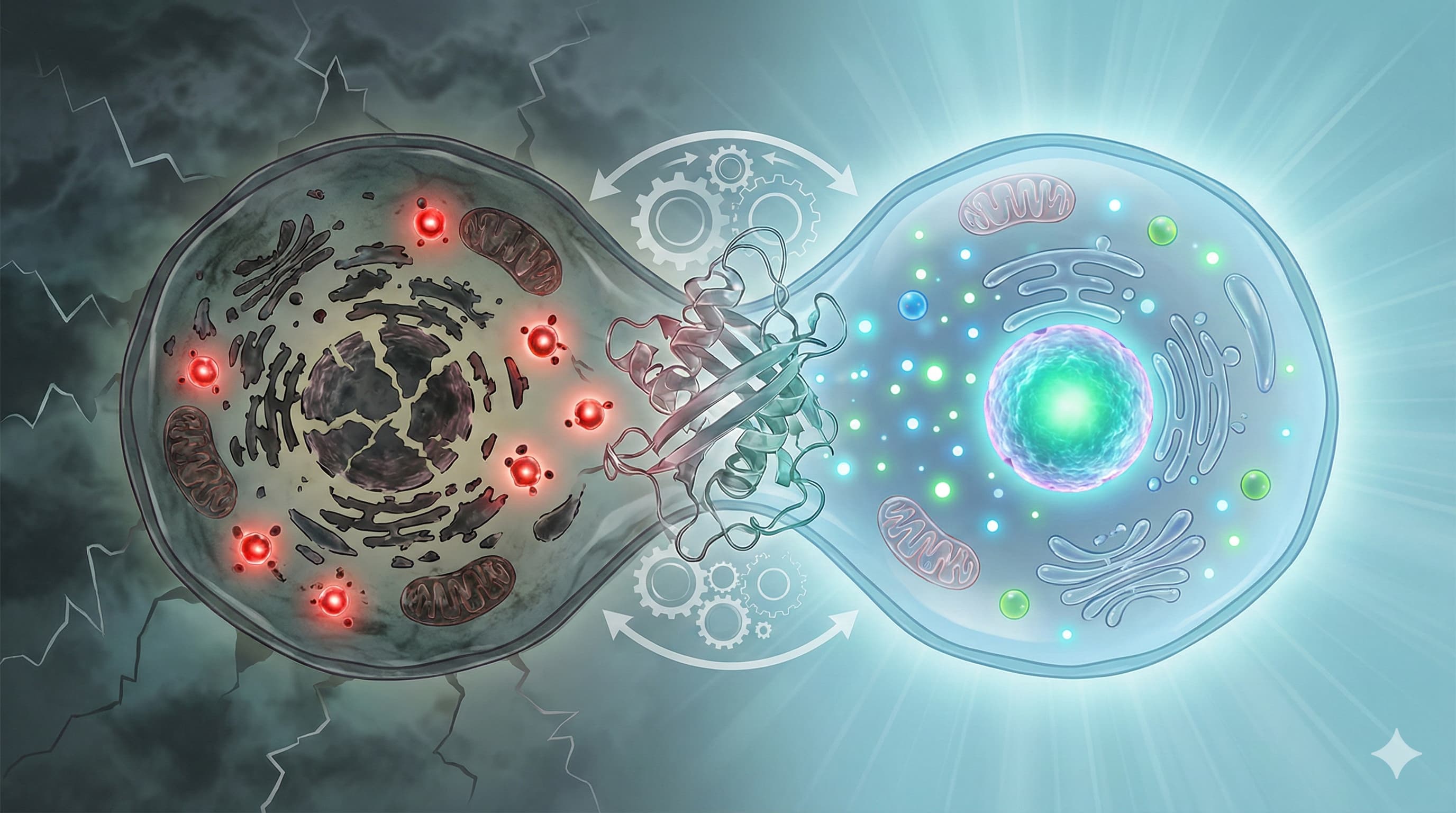
For decades, the longevity community has fragmented lifestyle interventions into isolated silos: biohackers debate the merits of saunas versus cold plunges, while clinicians argue over the optimal fasting window. In this comprehensive review, researchers from the Buck Institute for Research on Aging unify these disparate inputs under a single, non-negotiable cellular mechanism: autophagy. The authors argue that autophagy—the cell’s waste-disposal and recycling system—is not merely a passive maintenance process but the universal translator that converts environmental stress into biological youth.
The narrative shifts the focus from “lifespan” to “healthspan,” positing that the failure of autophagy is a primary driver of the functional decline seen in aging tissues. The review rigorously details how diverse stressors—from the thermal shock of a sauna to the mechanical strain of weightlifting—converge on the same molecular machinery to clear toxic protein aggregates and renew organelles. Crucially, the authors distinguish between “macromanagement” (general autophagy triggered by fasting or endurance cardio) and specialized “micromanagement” (such as Chaperone-Assisted Selective Autophagy, or CASA, which is specifically activated by resistance training to repair muscle architecture).
However, the report delivers a sobering reality check for the human longevity field: we are flying blind. While we have mapped these pathways with exquisite precision in yeast and nematodes, our ability to measure autophagic flux (the actual rate of cleaning) in humans is virtually non-existent. Most human studies rely on static snapshots of proteins like LC3, which can be misleading—high levels might mean active cleaning, or they might mean the garbage truck is broken and trash is piling up. Until we solve this “flux bottleneck,” translating biohacks into verified clinical protocols remains an educated guess rather than precision medicine.
Source:
-
Open Access Paper: Links Between Autophagy and Healthy Aging
-
Institution: Buck Institute for Research on Aging, USA
-
Journal: Journal of Molecular Biology, March 2026 Issue
-
Impact Evaluation: The impact score of this journal is 4.7 (2023 JIF), evaluated against a typical high-end range of 0–60+ for top general science, therefore this is a Medium impact journal.
Part 2: The Biohacker Analysis
Study Design Specifications
-
Type: Literature Review (Systematic analysis of genetic, pharmacological, and lifestyle interventions).
-
Subjects: Review covers data from Saccharomyces cerevisiae (Yeast), Caenorhabditis elegans (Nematodes), Drosophila melanogaster (Fruit Flies), Mus musculus (Mice), and limited Human clinical data.
-
Note: As this is a review article, there is no single experimental cohort to evaluate for “short-lived” control bias. The efficacy claims cited are derived from previously published literature.
Mechanistic Deep Dive & Priorities
The paper moves beyond generic “autophagy induction” to identify specific sub-routines triggered by distinct biohacks.
-
mTOR & AMPK (The Energy Sensors):
-
Action: Nutrient scarcity (fasting) and energy expenditure (endurance exercise) inhibit mTORC1 and activate AMPK.
-
Result: Unlocks the ULK1 complex, initiating the formation of the phagophore (the “trash bag”).
-
Biohacker Takeaway: Caloric restriction and Zone 2 cardio hit the same upstream targets.
-
CASA (The Muscle Specialist):
-
Action: Resistance training engages a mechanosensitive pathway called Chaperone-Assisted Selective Autophagy (CASA).
-
Distinct Mechanism: Unlike starvation-induced autophagy, CASA relies on the BAG3-HSC70-HSPB8 complex to degrade damaged cytoskeletal components (filamins) under mechanical stress.
-
Biohacker Takeaway: Fasting alone will not repair structural muscle damage; you need mechanical load (lifting heavy) to activate CASA.
-
Circadian Gating (The Timer):
-
Action: Autophagy genes are under strict circadian control.
-
Findings: In Drosophila, “night-biased” time-restricted feeding extended lifespan, while “day-biased” did not. Disrupted sleep inhibits the glymphatic system, preventing the clearance of amyloid-beta and tau.
-
Biohacker Takeaway: Aligning feeding windows with your circadian rhythm is likely more critical than the duration of the fast itself.
-
Temperature Stress (The Shock):
-
Heat: Hormetic heat stress (40∘C+) upregulates p62/SQSTM1, a cargo receptor essential for clearing protein aggregates.
-
Cold: Cold exposure triggers lipophagy (breakdown of fat droplets) in Brown Adipose Tissue (BAT) to generate heat. Note: This effect is blunted in older adults.
Novelty
-
Differentiation of Exercise Modalities: The explicit distinction between endurance exercise (Macroautophagy) and resistance exercise (CASA) provides a biological basis for concurrent training (doing both cardio and weights) rather than viewing them as redundant.
-
The “Flux” Problem: The authors aggressively highlight that static biomarkers (like LC3-II levels) are often misinterpreted in human trials. A “buildup” of markers can indicate failed autophagy (clogged filter) rather than enhanced autophagy (active cleaning).
-
Age-Dependent Resistance: The review synthesizes data showing that older organisms (and humans) become resistant to hormetic triggers. For example, cold plunging raises autophagy markers in young men but fails to do so in older men (60s), suggesting that “maintenance” biohacks may stop working once damage crosses a threshold.
Critical Limitations
-
Translational Gap [Confidence: High]: The causal link between autophagy and longevity is proven only in short-lived models (worms/flies). In humans, the data is correlative. We assume autophagy is the driver, but it could be a passenger.
-
Measurement Blindness [Confidence: High]: There is currently no non-invasive way to measure autophagic flux in a living human brain or liver. Biohackers relying on serum biomarkers (like plasma LC3) are likely getting a noise-heavy signal that does not reflect tissue-specific activity.
-
Specificity of Inducers [Confidence: Medium]: Pharmacological agents like Rapamycin and Spermidine are “dirty”—they affect multiple pathways. Attributing their success solely to autophagy is reductionist.
-
Missing Data: The review notes a lack of longitudinal studies tracking autophagy “competence” over a human lifetime. We do not know if “autophagy exhaustion” is a cause or consequence of aging.
4 Likes
Part 4: Actionable Intelligence
The Translational Protocol (Rigorous Extrapolation)
1. Rapamycin (Sirolimus)
-
Animal Dose: The ITP standard is 14 ppm in chow (approx. 2.24 mg/kg/day).
-
HED Calculation (FDA Guidance):
-
Formula: HED (mg/kg) = Animal Dose (mg/kg) x (Animal Km / Human Km)
-
Variables: Mouse Km = 3; Human Km = 37.
-
Math: 2.24 mg/kg x (3 / 37) = 0.18 mg/kg/day.
-
For a 70kg human: 0.18 x 70 = 12.6 mg/day.
-
CRITICAL ADJUSTMENT: Human half-life is significantly longer (~60 hours) than mouse half-life. Continuous daily dosing at this level is immunosuppressive (transplant protocol). Longevity protocols typically pulse this weekly to avoid mTORC2 inhibition. A common extrapolated “pulsed” dose is 5–8 mg once weekly.
-
Pharmacokinetics:
-
Bioavailability: Low (~14%) and variable due to CYP3A4 metabolism. Compounded capsules often have 30% lower bioavailability than commercial (e.g., Rapamune) tablets.
-
Half-Life: ~62 hours (Range: 46–78 hours).
-
Safety & Toxicity:
-
NOAEL: Not established for longevity; transplant NOAEL is lower due to daily dosing.
-
Toxicity: Stomatitis (mouth ulcers), hyperlipidemia, and potential glucose intolerance.
-
Interactions: Major CYP3A4 Substrate. Avoid grapefruit juice (increases levels 300%+).
-
Feasibility: Prescription only (Schedule IV in some regions, non-controlled Rx in US).
-
Cost: ~$5/mg (US Pharma) vs. ~$1/mg (Generic/Compounded). Monthly (6mg/week): ~$30–$120.
2. Spermidine
-
Animal Dose: Efficacy in mice seen at ~3–5 mg/kg/day via water/chow.
-
HED Calculation:
-
Math: 4 mg/kg x (3 / 37) = ~0.32 mg/kg.
-
For a 70kg human: ~22 mg/day.
-
Pharmacokinetics:
-
Bioavailability: High absorption but rapid metabolism. Plasma levels do not rise significantly even with 15mg/day doses; it is converted to spermine or taken up by tissues immediately.
-
Half-Life: Short in plasma; tissue half-life is longer but undefined in humans.
-
Safety & Toxicity:
-
NOAEL: Human trials have used up to 15 mg/day safely.
-
Toxicity: Generally GRAS (Generally Recognized As Safe) from food sources. High-dose synthetic safety is less characterized.
-
Feasibility: Available as supplement (wheat germ extract) or synthetic.
-
Cost: High for effective dose. To get 20mg+ from wheat germ extract is expensive (~$100+/month).
3. Urolithin A
-
Animal Dose: ~50 mg/kg/day in mice for muscle function.
-
HED Calculation:
-
Math: 50 x (3 / 37) = ~4.05 mg/kg.
-
For a 70kg human: ~280 mg/day.
-
Note: Clinical trials show efficacy (muscle strength) at 500mg–1000mg daily.
-
Pharmacokinetics:
-
Bioavailability: Synthetic urolithin A (Mitopure) is highly bioavailable compared to relying on gut conversion from pomegranate (which only ~30% of people can do).
-
Half-Life: Requires daily dosing to maintain levels; glucuronidated rapidly.
-
Safety & Toxicity:
-
NOAEL: 5% of diet in rats (~3400 mg/kg), indicating a very high safety ceiling.
-
Toxicity: No significant adverse events in human trials up to 1000mg/day.
-
Feasibility: Proprietary supplement (Mitopure).
-
Cost: Expensive. ~$100–$130/month for 500mg/day.
Biomarker Verification
-
Autophagy Flux: Direct measurement is impossible in clinic.
-
Surrogate: PBMC (white blood cell) LC3-II/LC3-I ratio (requires specialized lab, not standard LabCorp/Quest).
-
Target Engagement:
-
Rapamycin: Lower Phospho-S6 Ribosomal Protein (pS6) in PBMCs.
-
Spermidine: Increased Spermine levels in plasma (indirect).
-
Urolithin A: Improved VO2 Max or 6-minute walk test (functional); decreased CRP (inflammatory).
Part 5: The Strategic FAQ
1. “We see lifespan extension in mice with Rapamycin, but isn’t that just because they die of cancer and Rapamycin is anti-neoplastic?”
-
Answer: Valid critique. 80-90% of lab mice die of lymphoma/carcinoma. Rapamycin slows these cancers. However, the ITP (Interventions Testing Program) shows it also delays age-related decline in tendon, heart, and liver function, suggesting a broader anti-aging effect beyond just “chemotherapy for mice.”
2. “If I take Rapamycin, do I need to cycle off to allow for mTORC1-dependent muscle growth?”
-
Answer: Theoretically, yes. mTORC1 is required for protein synthesis. Chronic high-dose suppression could cause sarcopenia (muscle loss). The “Pulsed” protocol (once weekly) is designed to allow a rebound period for anabolic activity (muscle building) while still clearing senescent cells, but human data on this specific balance is anecdotal.
3. “Does Spermidine actually work if I can’t measure it in my blood?”
-
Answer: The lack of plasma spikes is a pharmacokinetic feature, not a bug—it is rapidly uptaken by cells. However, this makes dosing tricky. If you rely on “wheat germ extract,” you are likely underdosing (1-2mg). The mouse equivalent is ~20mg. You simply cannot get this from standard supplements without massive pills.
4. “Is Urolithin A worth the money if I already drink pomegranate juice?”
-
Answer: Statistical probability says no. Only ~30-40% of humans have the specific gut microbiome (Gordonibacter species) to convert ellagitannins from juice into Urolithin A. If you are a “non-producer,” juice is just expensive sugar water. Direct supplementation bypasses the gut microbiome requirement.
5. “Will fasting for 16 hours (16:8) trigger the autophagy described in this paper?”
-
Answer: Likely not significantly. The paper emphasizes deep cleaning. In humans, significant autophagy likely requires 24-48+ hours of glycogen depletion or intense exercise. 16:8 is good for insulin sensitivity (lowering “noise”), but likely insufficient for deep organelle recycling.
6. “Can I combine Rapamycin and Metformin?”
-
Answer: Yes, and mouse data suggests they might be synergistic. Metformin may counteract the glucose intolerance sometimes caused by Rapamycin. Interaction Check: Metformin does not inhibit CYP3A4, so it won’t spike Rapamycin levels.
7. “What about Rapamycin and Berberine?”
-
Answer: DANGER. Berberine is a CYP3A4 inhibitor. Taking them together could unpredictably spike Rapamycin blood levels, pushing you into the immunosuppression zone. Separate them by 12+ hours or avoid the combo.
8. “Does protein intake block the autophagy I’m trying to induce?”
-
Answer: Yes. Amino acids (specifically Leucine) are the strongest activators of mTORC1. If you consume protein, you shut down autophagy. To maximize the “clean,” you must separate protein intake from your fasting/autophagy window.
9. “Is there a gender difference in these protocols?”
-
Answer: Huge one. ITP data shows females often respond differently to Rapamycin (higher blood levels required for same lifespan extension in some cohorts). Women may need higher doses of Rapamycin to achieve the same effect as men due to different metabolism, though female mice actually saw bettersurvival benefits at equivalent blood levels in some ITP cohorts.
10. “If I exercise hard (CASA) and take Rapamycin (Autophagy), am I doubling the benefit?”
-
Answer: Timing is everything. Exercise activates mTOR briefly to build muscle after the workout. Taking Rapamycin immediately post-workout might blunt your gains. The “Biohacker” consensus is to take Rapamycin on a rest day or far away from your heavy lifting session.
Interaction Check (Stack Analysis)
-
Rapamycin + Metformin: Safe / Synergistic (Metformin mitigates Rapa-induced hyperglycemia).
-
Rapamycin + Acarbose: Safe / Synergistic (ITP confirmed lifespan extension).
-
Rapamycin + 17-alpha Estradiol: Safe (ITP confirmed).
-
Rapamycin + PDE5 Inhibitors (Cialis/Viagra): generally safe, no major CYP overlap affecting Rapa toxicity, but check blood pressure (both can lower it).
Safety Data Absent:
- Long-term human safety of high-dose synthetic Spermidine (>10mg/day).
- “Pulsed” Rapamycin side-effect profile in healthy humans >5 years (only transplant data exists for long duration).
3 Likes