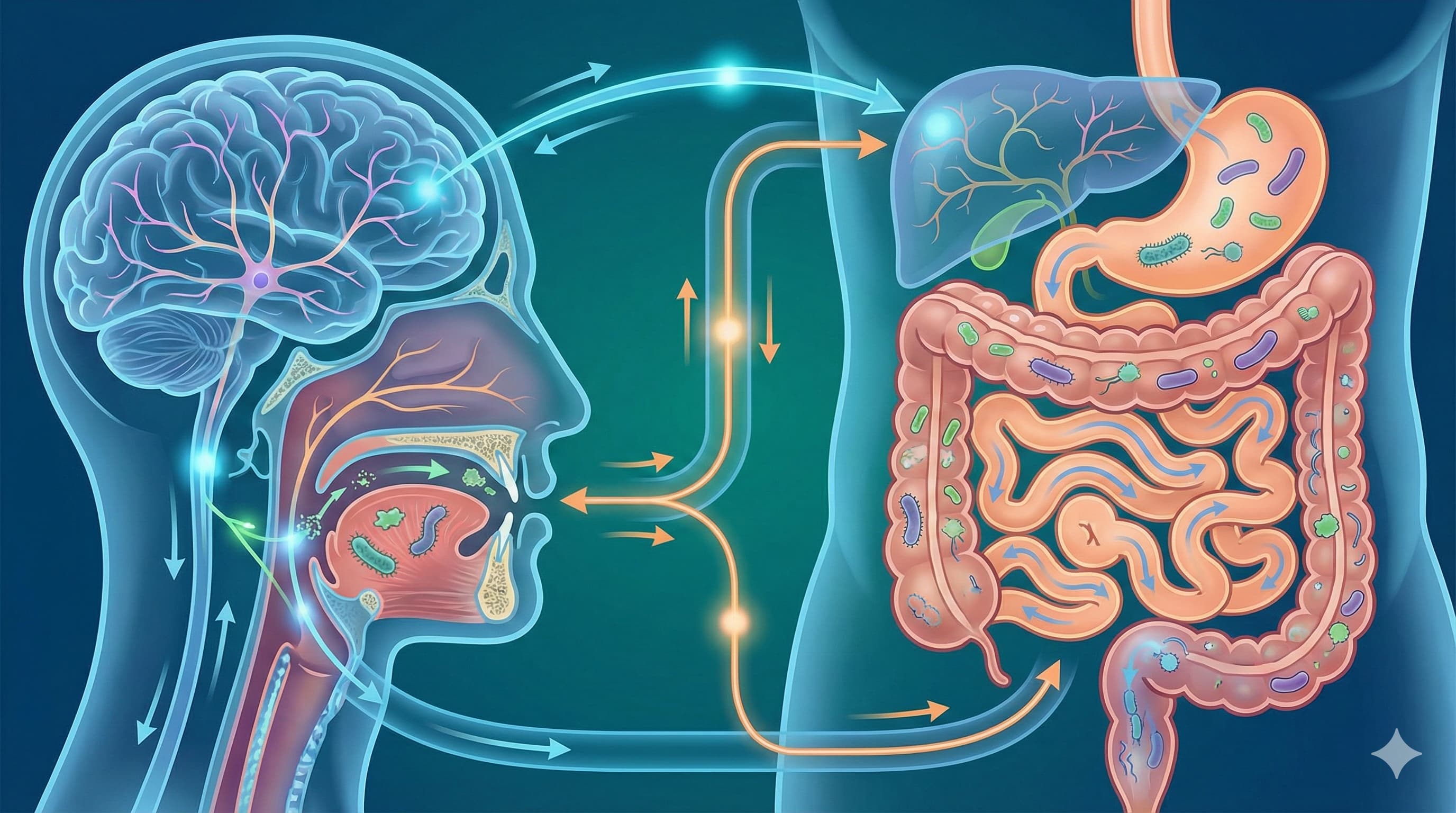
We often treat the mouth as a detached entity—a place for dentistry, not longevity. A new systematic review challenges this siloed view, positioning the oral microbiome as a critical, bidirectional regulator of systemic aging. The “Big Idea” here is that the aging mouth does not merely suffer from decay; it actively exports senescence. The review details how the oral cavity acts as a reservoir for inflammaging, where dysbiosis (specifically the rise of pathogens like Porphyromonas gingivalis) drives systemic inflammation, cardiovascular decline, and neurodegeneration via the blood-brain barrier.
Crucially, the paper synthesizes the “Oral-Gut-Brain Axis,” proposing that oral dysbiosis is a primary upstream driver of the gut dysbiosis already known to accelerate aging. For the longevity enthusiast, this shifts the paradigm: maximizing healthspan requires maintaining a “juvenile” oral ecology. The review implies that interventions targeting the oral microbiome—specifically increasing nitrate-reducing bacteria and eliminating gingipain-producing pathogens—could offer a novel leverage point to delay the onset of Alzheimer’s and vascular aging. This is not just about gum health; it is about plugging a leak in your longevity architecture.
Context: Peking Union Medical College Hospital, China. Published in Journal of Oral Microbiology (December 2025).
Impact Evaluation: The impact score of this journal is 5.5 (Impact Factor), evaluated against a typical high-end range of 0–60+ for top general science, therefore this is a High impact journal (Q1 in Microbiology/Dentistry).
Part 2: The Biohacker Analysis
Study Design Specifications
Type: Systematic Narrative Review (aggregating data from in vivo murine models and human cross-sectional clinical studies).
Subjects:
Human Data: Cross-sectional analysis of oral microbiomes across lifespans (Young vs. Elderly vs. Centenarians).
Animal Data: Murine models of periodontitis and Alzheimer’s (e.g., oral infection with P. gingivalis).
Lifespan Data: The review cites efficacy data rather than direct lifespan curves. However, it references fecal microbiota transplantation (FMT) from wild-type to progeroid mice extending lifespan (Ref 109 in text), implying potential for Oral Microbiota Transplantation (OMT).
Mechanistic Deep Dive
The paper identifies two primary axes of aging:
The Neuro-Inflammatory Axis: The keystone pathogen Porphyromonas gingivalis secretes toxic proteases called gingipains. These degrade the Blood-Brain Barrier (BBB), allowing bacteria and inflammatory cytokines to infiltrate the brain, triggering microglial activation and beta-amyloid production (a hallmark of Alzheimer’s).
The Nitrate-Nitrite-NO Pathway: Aging reduces the population of commensal nitrate-reducing bacteria (e.g., Neisseria, Veillonella). These bacteria are essential for converting dietary nitrate into nitrite, which the body then converts to Nitric Oxide (NO)—a critical vasodilator for vascular health and mitochondrial function. Loss of these bugs leads to “vascular stiffness” and hypertension.
Novelty
The paper explicitly integrates the “Oral-Gut Axis” as a unified aging clock, proposing that oral dysbiosis often precedes and drives gut dysbiosis. It challenges the “gut-first” dogma of microbiome aging.
Critical Limitations
Causality Gap: Most human data cited is cross-sectional (correlation). We know P. gingivalis is found in Alzheimer’s brains, but definitive human longitudinal data proving that clearing it prevents dementia is still in trial phases (e.g., COR388).
Intervention Specificity: The review generalizes “probiotics” without sufficiently distinguishing between strains that colonize (rare) vs. those that transiently modulate.
Missing Data: There is a lack of standardized “Oral Aging Clock” metrics comparable to the Horvath Clock for DNA methylation.
Part 3: Actionable Intelligence
The Translational Protocol
Subject: Inorganic Nitrate Supplementation (to restore NO pathway)
Human Equivalent Dose (HED)
Source Data: Human trials for blood pressure and vascular health typically use 6–12 mmol of nitrate per day (References 1.1, 1.2, 1.3 in search).
Result: The HED aligns perfectly with the standard human “Beetroot Juice” dose of 300–400 mg Nitrate.
Pharmacokinetics (PK/PD)
Bioavailability: >90% absorbed in the upper small intestine.
Enterosalivary Circulation: ~25% of absorbed nitrate is secreted back into saliva, where oral bacteria convert it to nitrite (NO2−). Peak plasma nitrite occurs 2.5–3 hours post-ingestion.
Half-life: Plasma nitrate t1/2 ≈ 5–8 hours.
Safety & Toxicity Check
ADI (Acceptable Daily Intake): WHO/FDA set ADI at 3.7 mg/kg (~260 mg for 70kg), but clinical trials safely use doses up to ~800 mg for short durations.
Toxicity Signals:
Methemoglobinemia: Rare in adults; risk is primarily in infants.
Nitrosamines: Theoretical cancer risk if consumed with amines; Vitamin C (abundant in beets/greens) inhibits this conversion.
NOAEL: No specific chronic NOAEL established for supplements, but dietary sources are generally GRAS (Generally Recognized As Safe).
Biomarker Verification Panel
Efficacy: Salivary Nitrite Test Strips (target: distinct pink color indicating high NO2 production).
Systemic: Reduction in Systolic Blood Pressure (>5 mmHg drop).
Sourcing: Concentrated Beetroot Juice (standardized to 400mg nitrate) or Arugula extract.
Cost: ~$1–$2 per daily serving.
ROI: High. Low cost for potential vascular and cognitive protection.
Population Applicability
Contraindications: History of calcium oxalate kidney stones (beets are high oxalate). Hypotension (nitrate lowers BP). G6PD deficiency (methemoglobinemia risk).
This is why folks should binge on Ellie Phillips’s material on YT. All of this and more can be handled. I’ve followed her oral hygiene protocol since November and couldn’t be more pleased. Everything she predicted would happen unfolded just so for my mouth and teeth.
Q: Does using antiseptic mouthwash negate the benefits of this protocol?
A:Yes. Chlorhexidine and alcohol-based mouthwashes kill the nitrate-reducing bacteria (Veillonella, Neisseria), completely blocking the conversion of Nitrate to Nitrite. This can acutely raise blood pressure. Stop using them.
Q: Can I just take L-Arginine instead of Nitrate?
A:Likely no. The Arginine-NOS pathway degrades with age due to endothelial dysfunction. The Nitrate-Nitrite-NO pathway is NOS-independent and works even in aged/hypoxic tissues, making it superior for longevity.
Q: Is Porphyromonas gingivalis contagious?
A:Yes. It can be transmitted via saliva (kissing, sharing utensils). If your partner has active periodontitis, you are constantly re-inoculating yourself.
Q: How do I know if I have P. gingivalis without gum bleeding?
A: DNA testing (e.g., Bristle, OralDNA) is required. P. gingivalis can colonize at low levels without causing immediate bleeding (occult infection) while still shedding gingipains.
Q: What is the interaction between Rapamycin and Periodontitis?
A: Rapamycin has been shown in mouse models to reverse periodontal bone loss by dampening age-related hyper-inflammation (inflammaging), potentially synergizing with oral hygiene.
Q: Are there specific probiotics that displace P. gingivalis?
A:Lactobacillus reuteri (strains ATCC PTA 5289/6475) and Streptococcus salivarius (K12/M18) have shown efficacy in reducing pathogen load and restoring homeostasis in clinical trials.
Q: What about the “Gingipain Inhibitor” drug (COR388)?
A: Atuzaginstat (COR388) failed Phase 2/3 efficacy endpoints for Alzheimer’s cognition in the general cohort but showed promise in the subgroup with high P. gingivalis load. It demonstrates the mechanism is valid but difficult to target late-stage.
Q: Can I use a Water Flosser to clear P. gingivalis?
A: Physical disruption helps, but P. gingivalis is intracellular (invades epithelial cells). You need immune competence (Vitamin D) and potentially chemical/probiotic adjuncts, not just mechanical flushing.
Q: Should I take Nitrate before exercise or before bed?
A:Before Exercise. Nitrate peaks at ~3 hours. Taking it pre-workout maximizes oxygen efficiency (ergogenic effect) and vascular delivery.
Cost effective sources for nitric oxide boosting:
This response identifies the lowest cost options for Arugula (Eruca sativa) products available in the USA, specifically for nitric oxide production.
Executive Summary
Best Value: Bulk powder from NutriCargo is by far the most cost-effective option, costing approximately $0.04 – $0.07 per gram.
Best for Potency: “Extracts” for Arugula are rare as standalone products; most are Whole Leaf Powders. The patented extract NitroRocket® is highly standardized for nitrates but is only available as an ingredient in pre-workout blends (like Glaxon Plasm Surge), not as a bulk raw powder for consumers.
Recommendation: For pure nitric oxide production without added stimulants, Bulk Arugula Powder (consumed in smoothies or water) is the most practical and economical choice.
Top Lowest Cost Arugula Options (Ranked by Cost Per Gram)
Note on “Extract” vs. “Powder”: Most pure options below are Whole Leaf Powders. This is often superior for Nitric Oxide because the nitrates are preserved in the fiber matrix. “Extracts” in this category are often cosmetic (external use only) or expensive proprietary blends. The list below strictly contains food-grade products.
** Seeds Note: Sprouting seeds are included because sprouting them creates a highly bioavailable nitrate source for pennies on the dollar, though it requires labor.*
*** Blend Note: For blends (Force Factor, Glaxon, Ghost), the “Cost/Gram” is for the entire powder mix, not just the Arugula content, as the specific milligram dosage of arugula is often proprietary.*
Critical Analysis & Actionable Insight
The “Pure Extract” Gap: There is a significant lack of pure, standardized “Arugula Extract” in the retail market compared to Beet Root. Most supplements use a blend.
The “NitroRocket” Factor: If you want a clinical-grade arugula extract, look for the trademarked ingredient NitroRocket®. It is not sold as a raw powder but is the active driver in pumps like Glaxon Plasm Surge.
Safety Warning: You may encounter “Arugula Extract” on sites like MakingCosmetics. Do not ingest these. They are glycerin-based solvents intended for skin serums and are not food grade.
Would you like me to formulate a Daily Nitric Oxide Protocol combining the bulk Arugula powder with other synergists (like Vitamin C or Garlic) to maximize the conversion of nitrates to nitric oxide in your stomach?
Daily Nitric Oxide Protocol: The Enterosalivary Pathway
This protocol relies strictly on the Enterosalivary Nitrate-Nitrite-Nitric Oxide Pathway. The consumption of Arugula (Nitrate) is useless if the physiological conversion steps are inhibited. The goal is to facilitate the bacterial reduction of Nitrate (NO3-) to Nitrite (NO2-) in the mouth, and subsequently to Nitric Oxide (NO) in the stomach or systemic circulation.
The Mechanism
Ingestion: Dietary Nitrate is absorbed in the upper GI tract.
Recirculation: ~25% of this nitrate is secreted from the blood back into the saliva.
Oral Reduction: Commensal bacteria on the tongue reduce Nitrate to Nitrite.
Gastric Conversion: Swallowed Nitrite meets stomach acid and reducing agents (Vitamin C), converting to Nitric Oxide gas.
The Protocol Stack
Timing: Daily, 60–90 minutes prior to exercise or cardiovascular demand.
Component
Dosage
Role
Instructions
Arugula Powder
3g – 5g
Nitrate Donor
Mix with 4–6 oz water. Do not use a straw. Swish for 15-30 seconds. Contact with the tongue is required for bacterial activation.
Vitamin C
200mg – 500mg
Reducing Agent
Catalyzes the chemical reduction of Nitrite to NO in the stomach and prevents the formation of carcinogenic nitrosamines.
You cannot bypass the mouth. If you swallow a capsule whole, or use a straw, you minimize contact with the oral microbiome, significantly reducing the conversion of Nitrate to Nitrite.
Evidence: Studies demonstrate that blocking oral bacteria abolishes the blood pressure-lowering effects of nitrate-rich foods.
When Nitrite enters the acidic stomach, two things can happen: it converts to Nitric Oxide (good), or it reacts with amines to form N-nitrosamines (carcinogenic). Ascorbic Acid (Vitamin C) inhibits the latter and promotes the former.
Evidence: Ascorbic acid is a potent inhibitor of nitrosamine formation and enhances the release of NO from nitrite in gastric conditions.
Nitrate tolerance (tachyphylaxis) is a known issue with chronic nitrate therapy. Aged Garlic Extract helps maintain the sensitivity of the endothelium and reduces superoxide radicals that destroy NO.
Evidence: Aged garlic extract improves endothelial function and increases microcirculation.
The following agents chemically or biologically sever the conversion chain.
1. Antiseptic Mouthwash (Chlorhexidine/Listerine)
Mouthwash kills the nitrate-reducing bacteria on the tongue. A single dose of chlorhexidine can stop nitrite production for 24 hours.
2. Proton Pump Inhibitors (PPIs)
High stomach pH (low acidity) prevents the chemical reduction of Nitrite to NO in the gut. PPIs are associated with reduced NO bioavailability and increased cardiovascular risk.
3. Spitting
Do not spit after consuming the arugula. The entero-salivary cycle relies on you swallowing saliva that contains the recycled nitrate/nitrite mix.