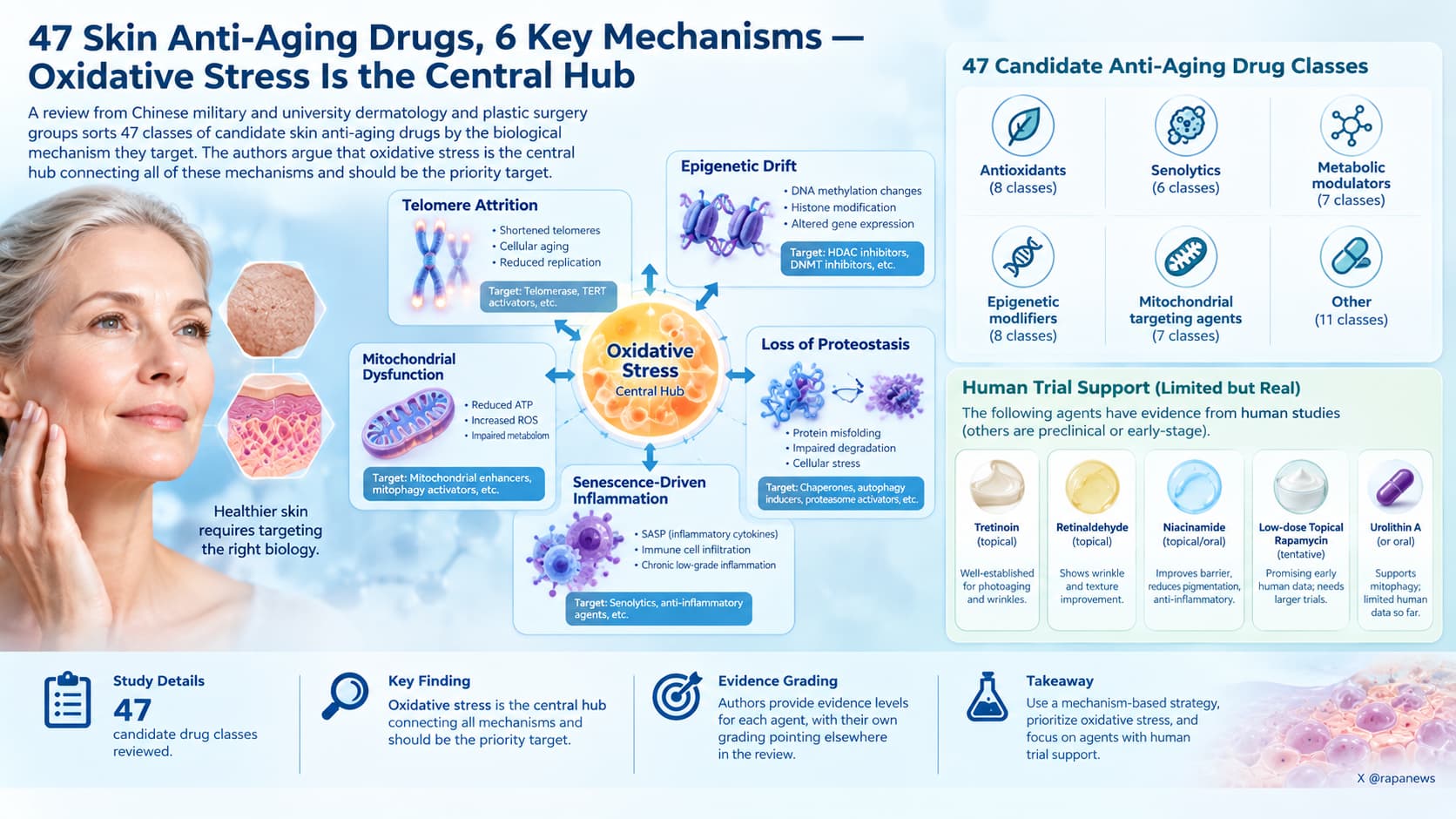
This review from Chinese military and university dermatology and plastic surgery groups sorts 47 classes of candidate skin anti-aging drugs by the biological mechanism they target: oxidative stress, telomere attrition, epigenetic drift, mitochondrial dysfunction, loss of proteostasis, and senescence-driven inflammation. The authors argue that oxidative stress is the central hub connecting all of these and should be the priority target. Their own evidence grading points elsewhere. The agents with real human trial support are topical tretinoin, retinaldehyde, niacinamide and, tentatively, low-dose topical rapamycin and urolithin A.
Skin is the one organ where anyone can watch aging happen, and the market for slowing it is enormous. A new review in Ageing Research Reviews tries to bring order to the field by asking what the candidate drugs actually act on, instead of simply listing them.
The authors searched PubMed and ClinicalTrials.gov through June 2026, started with 7,973 records, and ended with 91 reports covering 47 intervention classes. They organized these into six mechanistic domains and graded each on a five-level scale, from randomized human skin trials at the top to non-skin extrapolation at the bottom.
Their big idea is that oxidative stress sits at the center of the network. Reactive oxygen species damage telomeres and mitochondrial DNA, switch on the MAPK and NF-kB pathways that drive collagen-degrading enzymes and inflammation, and push cells into senescence. Senescent cells and failing mitochondria then generate more oxidants. On this view, oxidative stress is at once a trigger, an amplifier and a consequence, which makes it the logical place to intervene.
The catalogue is wide. It runs from familiar antioxidants such as vitamin C and N-acetylcysteine through Nrf2 activators like sulforaphane, NAD precursors, the mitophagy inducer urolithin A, sirtuin activators, telomerase activators, the mTOR inhibitor rapamycin, and senolytics such as navitoclax and dasatinib plus quercetin.
The compounds reaching the top evidence tier are mostly not antioxidants. Topical tretinoin, studied since the early 1990s, remains the benchmark: in a 24-week trial, 79 percent of users improved versus 48 percent on a dummy cream. Retinaldehyde and 5 percent niacinamide have smaller randomized trials behind them. Topical rapamycin has one small study showing fewer senescence markers in hand skin. Urolithin A cream cut wrinkle depth by about 6 percent in eight weeks.
Below that tier, the evidence thins quickly. NMN and NR raise NAD in blood, but no human trial has shown they improve wrinkles, elasticity or skin structure. Senolytics clear senescent cells in grafted human skin on mice, but they have no human skin-aging data and carry real toxicity, including platelet loss with navitoclax. The authors flag cancer concerns for telomerase activators and for sustained Nrf2 activation in sun-damaged skin.
The paper closes with a forward look: skin organoids for more realistic testing, microneedles and nanoparticle carriers to get drugs into the dermis, and AI-driven target discovery. These are plausible directions, but none has yet delivered a validated skin anti-aging drug.
The review is best read as a useful map, with clearly marked safety hazards, and not as proof of its central thesis. The oxidative stress hub is presented as a testable hypothesis, and the authors state what would falsify it. For now, the evidence-backed options are mostly the same ones dermatologists have recommended for years.
Actionable Insights
The practical message is that the proven options are old and inexpensive.
- Tretinoin: in the main trial, 79 of every 100 users improved versus 48 of 100 on plain cream. That is 31 extra responders per 100, or roughly one extra person helped for every three treated. The 0.025 percent strength worked about as well as 0.1 percent with less redness and peeling. It is not for use in pregnancy.
- Retinaldehyde: a gentler alternative. Wrinkle depth fell about 7.6 percent in eight weeks, a modest change.
- Niacinamide 5 percent, twice daily: improved lines, texture and pigmentation over 12 weeks in 50 women, but the trial was industry funded and reported no numerical effect sizes.
- Urolithin A cream: about a 6 percent reduction in wrinkle depth. This is measurable by instruments but probably hard to see in a mirror, and the data come from a manufacturer-run preprint.
- Topical rapamycin: The research is still early. Promising but unproven.
- Oral NMN, NR, sulforaphane, TA-65 and senolytics: no demonstrated human skin benefit.
The review barely discusses sunscreen, though ultraviolet light is the main trigger of the damage it describes.
Context/Source
- Paywalled Paper: Research progress in skin anti-aging drugs based on core pathological drivers
- Institutions: Yanbian University Hospital (Yanji); Fourth and Third Medical Centers of the Chinese PLA General Hospital (Beijing); Inner Mongolia Medical University (Hohhot); Beth Israel Deaconess Medical Center (Boston)
- Countries: China, with one US co-author
- Journal: Ageing Research Reviews, online 23 September 2026
- Impact: The impact score of this journal is 12.4, evaluated against a typical high-end range of 0–60+ for top general science, therefore this is a High impact journal.