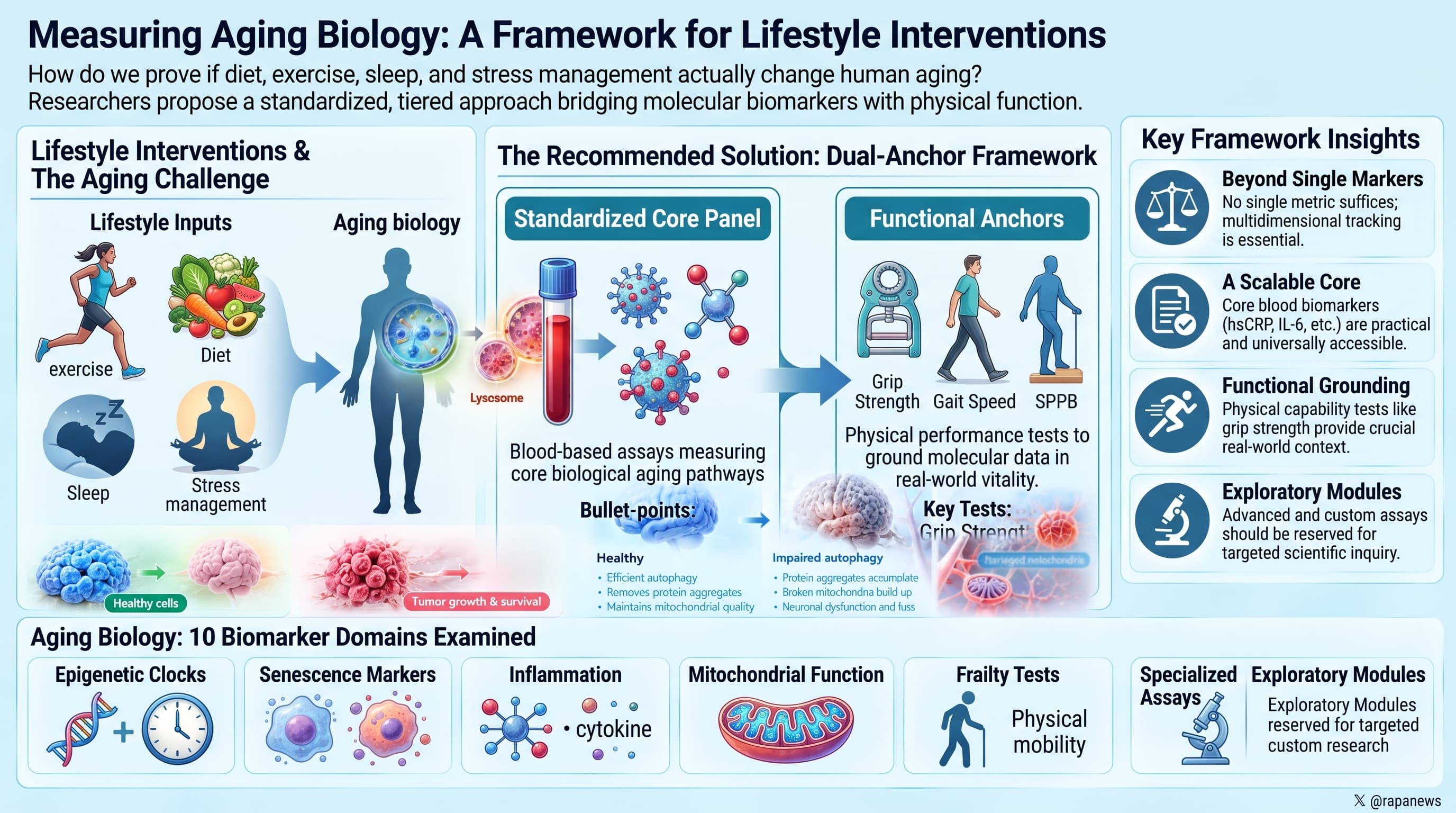
This narrative review proposes a framework for measuring whether lifestyle interventions such as exercise, diet, sleep and stress management actually change human aging biology. The authors survey ten biomarker domains, from epigenetic clocks and senescence markers to inflammation, mitochondrial function and frailty tests, and argue that no single marker is enough. Their recommendation is a small, standardized core panel (hsCRP, IL-6, GDF-15, glucose, HbA1c, lipids) anchored to functional tests (grip strength, gait speed, SPPB), with specialized assays reserved for clearly labeled exploratory modules. They also argue that pre-existing organ damage can blunt measurable responses.
For two decades the longevity field has had a measurement problem. Anyone can claim a supplement, diet or exercise routine “slows aging,” but proving it in humans means waiting decades for death or disease to show up. Most trials last weeks or months. The obvious workaround is biomarkers: blood tests, cell assays and physical measures that shift early and predict long-term outcomes. The catch is that the field has produced dozens of them, often measured inconsistently, and frequently interpreted far beyond what they can support.
This review, from an international group spanning Hungary, Russia, the United States, the United Kingdom and South Korea, tries to impose order. The authors’ central argument is restraint. Rather than throwing every available assay at a trial, investigators should define what question each marker answers, choose a small core set that every study site can measure identically, and tie molecular changes to things patients actually experience, like walking speed and grip strength.
The paper is unusually blunt about the limits of popular tools. Epigenetic clocks such as PhenoAge, GrimAge and DunedinPACE are not interchangeable: each was trained on a different target, so they can disagree without either being wrong. A younger clock score, the authors stress, is not evidence of rejuvenation or extended lifespan. Blood p16INK4a levels do not tell you how many senescent cells sit in your muscle or blood vessels. Mitochondrial DNA copy number is not mitochondrial function. Popular antioxidant capacity kits and TBARS assays should not be used as evidence of reduced oxidative damage.
Their proposed structure has three tiers. A common core includes inflammatory and stress markers (hsCRP, IL-6, GDF-15, soluble TNF receptors) and standard metabolic labs. Functional anchors include grip strength, gait speed and the Short Physical Performance Battery. Mechanism-specific modules, such as senescence panels, mass-spectrometry redox markers or immune-cell respirometry, are added only when the intervention plausibly targets that pathway.
The most original idea concerns baseline damage. Using long-term survivors of sulfur-mustard exposure as an extreme example, the authors show that blood inflammatory markers and lung function can move independently. Older trial participants often carry slow-to-reverse injuries from heart disease, lung disease or past cancer treatment, which may cap how much an organ can improve within a trial. A flat functional result might reflect limited capacity to respond rather than a failed intervention.
They also borrow a concept from military medicine: if one intervention benefits several biologically distinct conditions, that strengthens the case that it acts on a shared aging pathway rather than a single disease.
The framework is sensible and largely consistent with existing consensus from the TAME biomarker workgroup and the Biomarkers of Aging Consortium. Its weaknesses lie elsewhere. It is a narrative review with no systematic search, no effect-size synthesis and no tested design. Some sections lean heavily on the authors’ own prior work, including a herbal preparation linked to one coauthor’s hospital. For readers, the take-home is practical skepticism: biomarkers are useful tools, not verdicts, and functional measures remain the most interpretable signal of whether an intervention is helping.
Actionable Insights
The review itself reports no new results, but the human trials it cites give usable magnitudes.
Physical function is the most meaningful thing you can track. Each 0.1 m/s faster usual walking speed is associated with about 12% lower mortality risk in older adults, and people in the weakest grip-strength group have roughly 1.7 times the death rate of the strongest.
Diet pattern matters for the heart. In CORDIOPREV, over seven years, 1,002 coronary patients on a Mediterranean diet had fewer major cardiovascular events than those on a low-fat diet: about 17.3% versus 22.2%. That is roughly 5 fewer events per 100 people, meaning about 21 people must follow the diet for 7 years to prevent one event. The benefit was concentrated in men; women showed no difference.
Omega-3 and calorie restriction move epigenetic clocks, modestly. In DO-HEALTH, 1 g/day omega-3 slowed three clocks over 3 years by standardized effects of 0.16 to 0.32, equal to 2.9 to 3.8 months, about 8 to 11% of elapsed time. These are small effects.
Practical rule: test function (grip, gait, chair rise) and standard labs (hsCRP, HbA1c, lipids, fasting insulin) under consistent conditions, and treat any single “biological age” number as a rough signal.
Context and Source
- Open Access Paper: Lifestyle-Associated Biomarkers of Cellular and Whole-Organism Aging: A Practical Roadmap for Human Geroscience Trials
- Lead Institutions: Department of Science and Engineering, College of Nanotechnology, SUNY Albany, Albany,NY, USA; Institute of Fundamental Medicine and Biology, Kazan Federal University, Kazan, Russia; Advanced Biotherapeutics Ltd., London, UK; Uppsala Inc., Colora, MD, USA; Preventive Medicine Center, Hartford, CT,USA; Pyunkang Korean Medicine Hospital, Seoul, Republic of Korea; Department of Pharmacology, Faculty of Pharmacy, University of Debrecen, Debrecen, Hungary.
- Countries of Origin: United States, Russia, United Kingdom, Republic of Korea, Hungary.
- Journal Name: Biomolecules (MDPI)
- Impact Evaluation: The impact score of this journal is 4.8 (Journal Impact Factor, with a CiteScore of 8.2),evaluated against a typical high-end range of 0 to 60+ for top general science, therefore this is a Medium impact journal.
Related Reading:
- What are your top 10 biomarkers to track for improving healthspan and longevity? - #70 by RapAdmin
- What grip strength can tell you about how well you’re aging (WaPo)
- Muscle as Mind: Grip Strength Validated as the "Neural Reserve" Biomarker
- Hormone Therapy Linked to Stronger Grip in Women Over 65, With the Gap Widening Into the 80s
- The "Stress Siren": GDF-15 Flashing Red Before the Brain Shrinks
- Blood Biomarker GDF15: The Protein That Sees Dementia Coming Fourteen Years Early
- GDF15: The Blood Marker That Warns of Dementia 20 Years Early, and Why It May Not Be Alzheimer's
- The Inflammatory Paradox: Why Blocking the IL-6 Pathway Could Be a Lifespan Game-Changer