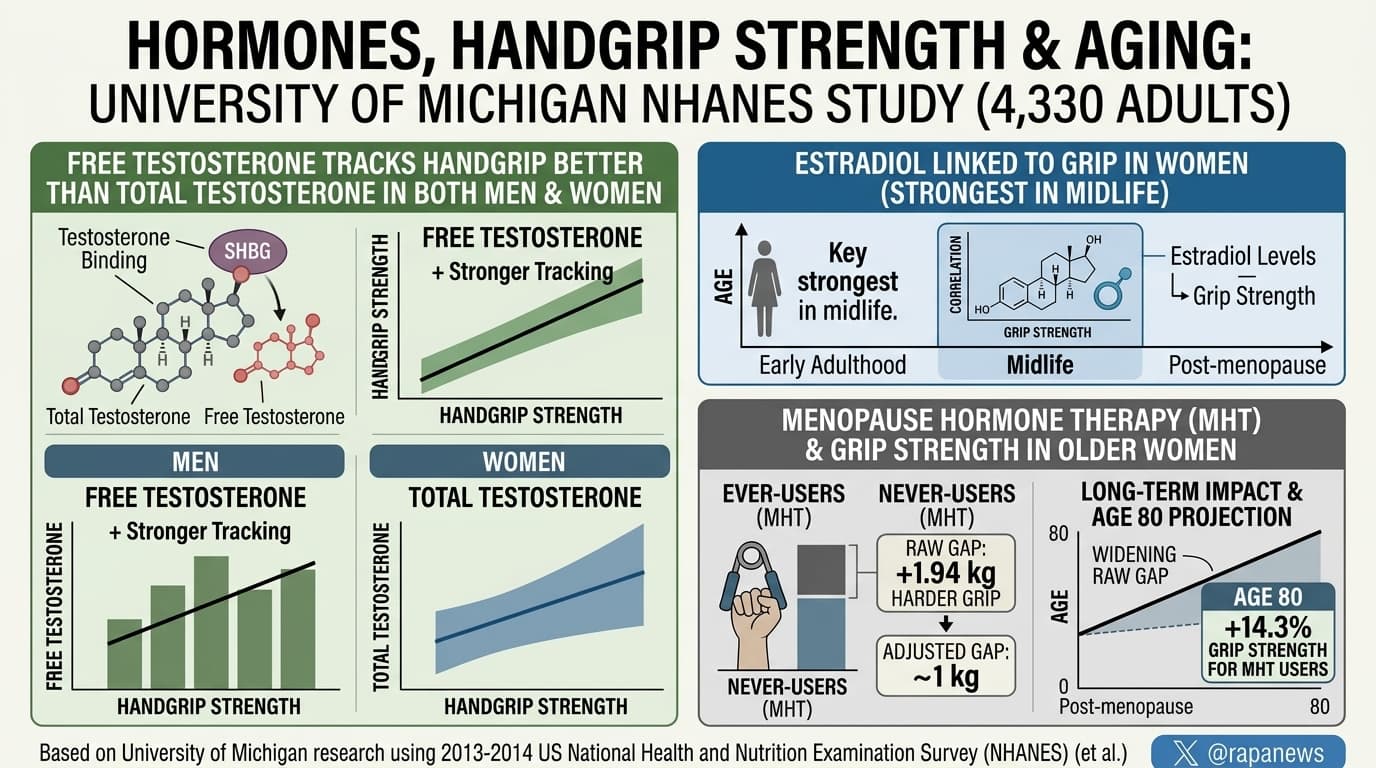
Using 4,330 adults from the 2013-2014 US National Health and Nutrition Examination Survey (NHANES), University of Michigan researchers report three things. First, the free fraction of testosterone, the part not bound to its carrier protein SHBG, tracks handgrip strength better than total testosterone in both men and women. Second, estradiol is linked to grip in women, most clearly in midlife. Third, older women who had ever used menopause hormone therapy (MHT) gripped 1.94 kg harder than never-users. That gap shrinks to about 1 kg after adjustment, and the raw gap widens to 14.3 percent by age 80.
Grip strength is one of the cheapest and most informative measurements in medicine. Squeeze a dynamometer and the number tracks far more than forearm strength: it predicts disability, hospital admission and early death. It also falls with age, and in women it falls faster after about 55. This study asks whether the hormones that separate male and female bodies help explain that trajectory.
Rachel Logue Cook, Sandra Hunter and colleagues at the University of Michigan used the 2013-2014 cycle of NHANES. It is the most recent round to combine grip testing, gold-standard mass spectrometry measurements of sex hormones and activity questionnaires in the same people. Their 4,330 adults, aged 18 to over 80, were weighted to represent about 178 million Americans.
The first result is familiar. Grip peaked in the early to mid 30s for both sexes, then slipped by about 0.6 to 0.7 percent a year. After 70 the loss sped up to 1.5 percent a year in women and 1.1 percent in men. Women were about 36 percent weaker than men in early adulthood and 40 percent weaker by old age.
The more interesting finding concerns which form of a hormone matters. Much of the testosterone in blood is bound to sex hormone-binding globulin (SHBG), which rises with age. The team divided testosterone by SHBG to estimate the free, usable fraction. That index tracked grip in both sexes far better than total testosterone. In men, the free index explained about 8 percent of the person-to-person variation in grip, while total testosterone explained 0.2 percent.
In women, estradiol stood out. It falls by more than 90 percent across menopause, and in midlife women it still predicted grip after accounting for age, height, race, obesity and activity. The authors describe the same independent link in women over 65. Their own regression table, however, shows it slipping below statistical significance in that group once other factors are included.
Hormone therapy produced the headline. Women aged 65 and over who had ever used MHT gripped 1.94 kg harder than never-users, a gap that shrank to about 1 kg after adjustment. The unadjusted gap grew with age, from about 2 percent in the early 60s to 14.3 percent in women 80 and older. In that oldest group, average grip in never-users sat close to the clinical threshold for weakness. The advantage also showed up among the most sedentary women.
These numbers need careful handling. The data are a single snapshot, so they cannot show that hormones or hormone therapy cause strength. Women who took hormone therapy decades ago may have differed in wealth, health and access to care. That same pattern misled observational research on hormone therapy and heart disease until randomized trials corrected it. The striking correlations in the abstract, above 0.8, come from averaging people by year of age. For individuals, hormones account for roughly 5 to 11 percent of strength differences.
Still, the direction fits animal work showing that estrogen supports muscle quality. It also fits an earlier meta-analysis of trials that found about a 5 percent strength benefit from hormone therapy. The case for measuring free rather than total hormones gets stronger. The case for taking hormones to stay strong has not been made.
Actionable Insights
- Measure your grip. It is cheap, repeatable, and linked to survival and independence. Clinical weakness thresholds are below 16 kg for women and 27 kg for men. In a large international cohort, each 5 kg of lower grip went with about 16 percent higher risk of death, so 1 kg is worth roughly 3 percent. [Confidence: Medium]
- Test the right hormone. If you get testosterone checked, also ask for SHBG and a calculated free testosterone. In men here, total testosterone explained 0.2 percent of the variation in grip, while the free fraction explained about 8 percent. [Confidence: Medium-High]
- Women considering MHT: after adjustment, older women who had ever used it were about 1 kg (about 5 percent) stronger.
- That is a small effect (Cohen’s d about 0.2), roughly two and a half years of typical grip loss after 65.
- The raw gap reached 2.5 kg (14 percent) at 80 and over, but that is the least reliable number in the paper.
- This is an association, not proof. Strength alone is not a recognized reason to start MHT, but it is reasonable to raise with a clinician weighing symptoms, bone health and risks. [Confidence: Low-Medium]
- Lift. Resistance training is the intervention with trial evidence for building strength. Sitting less showed only a small, poorly measured link in this study. [Confidence: High for training; Low for the sitting estimate]
Context and Source
- Open Paper: Sex hormones and menopause hormone therapy predict muscle strength across the lifespan
- Institution: University of Michigan, Ann Arbor (School of Kinesiology; Department of Internal Medicine, Michigan Medicine; School of Public Health)
- Country: United States
- Journal: Journal of Applied Physiology (American Physiological Society)
- Impact evaluation: The impact score of this journal is 3.3 (Journal Impact Factor; CiteScore 5.9), evaluated against a typical high-end range of 0-60+ for top general science, therefore this is a Medium impact journal.