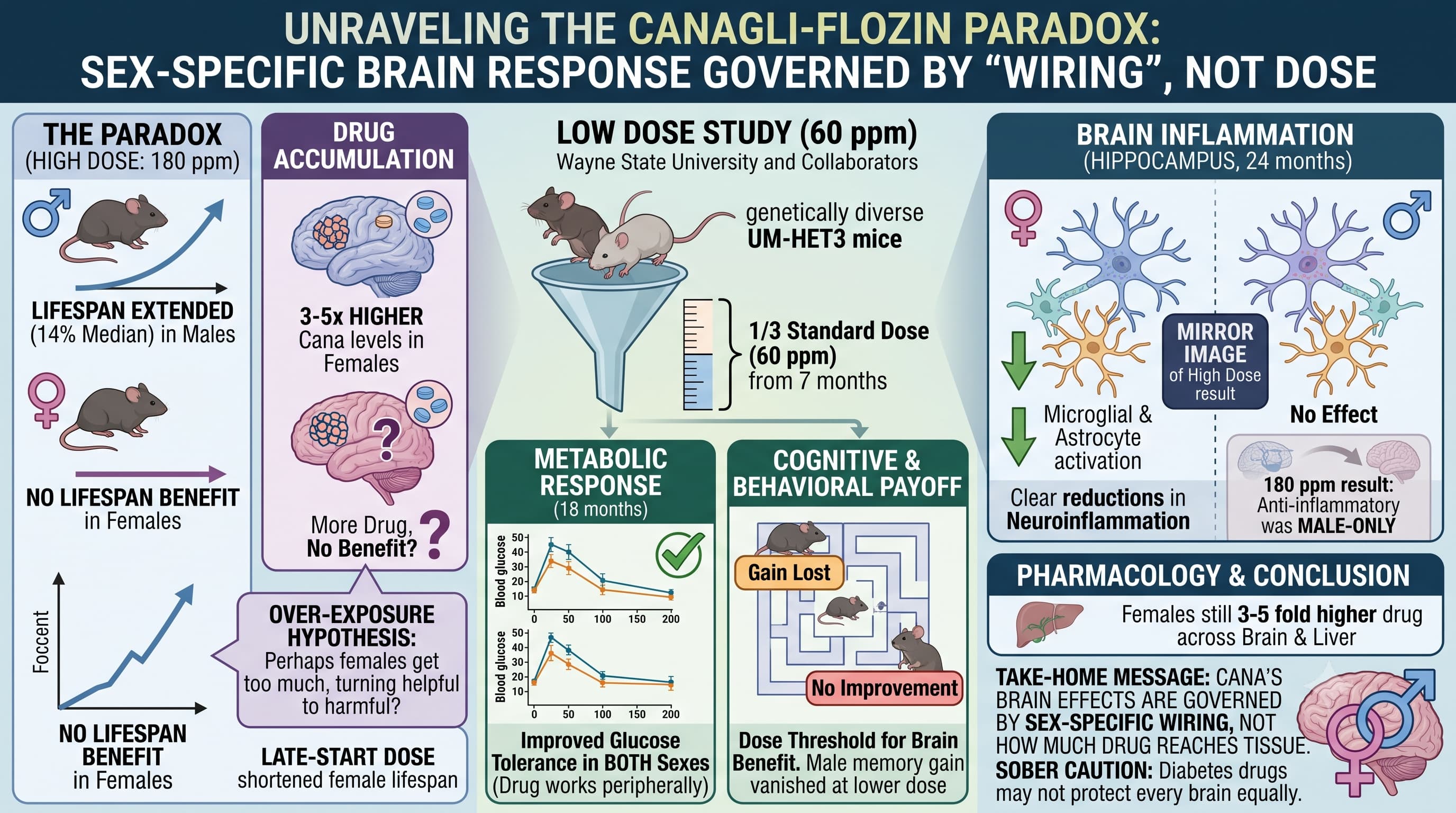
Canagliflozin (Cana), a common type-2-diabetes drug, is one of the few compounds shown to extend lifespan in mice — but only in males, and only at the standard 180 ppm dose. This study asked a simple question: if females accumulate more of the drug and still get no benefit, would cutting the dose to one-third (60 ppm) protect the female brain by reducing over-exposure? The answer is a qualified “no, but something unexpected happened.” At 60 ppm, the drug improved blood-sugar handling in both sexes but produced no cognitive or motor benefit in either. Yet females — not males — showed reduced age-related inflammation in the hippocampus, the reverse of the male-specific pattern seen at the higher dose. The authors conclude that the sex differences in how Cana acts on the brain are not explained by dose or drug accumulation, but by intrinsic differences in how male and female brains respond.
For years, canagliflozin has been a poster child of geroscience: a widely prescribed diabetes pill that, in the NIA’s rigorous Interventions Testing Program, extended the median lifespan of male mice by 14% — while doing nothing for females. The paradox deepened when researchers discovered that female mice actually accumulate more of the drug in their blood and brains than males. More drug, no benefit. Why?
The prevailing hypothesis was over-exposure: perhaps females were getting too much drug, tipping a helpful intervention into a harmful one (an idea reinforced by a separate finding that starting the full dose late in life actually shortened female lifespan by 6%). If that were true, dialing the dose down should unmask a hidden benefit in females.
This team from Wayne State University, with collaborators at Michigan and UT San Antonio, put that logic to the test. They fed genetically diverse UM-HET3 mice a subclinical 60 ppm dose — one-third of the standard — from 7 months of age, then tracked metabolism, behavior, brain inflammation, and drug levels out to 24 months.
The metabolic story was clean and encouraging: at 18 months, glucose tolerance improved in both sexes, confirming the drug was working peripherally even at a low dose. But the promised cognitive payoff never materialized. Across a full behavioral battery — memory, learning, coordination, anxiety — neither males nor females improved. The robust memory gains previously seen in males at 180 ppm simply vanished at the lower dose, pointing to a dose threshold for brain benefit.
The twist came in the hippocampus. At 60 ppm, female mice showed clear reductions in microglial and astrocyte activation — markers of the “neuroinflammation” that accompanies brain aging. Males showed none. This is the mirror image of the 180 ppm result, where the anti-inflammatory effect was male-only.
Pharmacology confirmed females still carried 3-to-5-fold higher drug concentrations across brain regions and liver. So neither lowering the dose nor the higher female drug load explains the pattern. The take-home: Cana’s brain effects are governed by sex-specific wiring, not simply how much drug reaches the tissue — a sobering caution for anyone assuming a diabetes drug will protect every brain equally.
Actionable Insights
Honest bottom line for the self-experimenter: Canagliflozin’s brain and lifespan benefits in mice are strongly sex- and dose-dependent, and the effects do not scale intuitively with how much drug you take.
Quantified magnitudes worth internalizing:
- Lifespan (males, 180 ppm, from the ITP — not this study): +14% median lifespan extension. In absolute terms, a male-control median of roughly 830 days rises to roughly 945 days — about +115 days, or ~3.8 extra “mouse months.”
- Lifespan (females, full dose, started late): −6% — a net harm signal, illustrating that more is not better and timing matters.
- Drug accumulation: females carry 3–5x higher brain and liver concentrations than males at the same dietary dose, yet derive no cognitive benefit — decoupling exposure from efficacy.
- Glycemic benefit at low dose: real in both sexes at 18 months, but dissociated from weight loss (no sustained body-weight change) and, critically, dissociated from cognitive benefit.
Practical translation: improved glucose tolerance is not a reliable proxy for brain protection. For humans, there is no dosing, sex-adjustment, or timing guidance you can responsibly extract from a mouse study that did not even measure lifespan. The defensible take-home is directional: SGLT2 inhibitors deserve serious study as brain-aging interventions, but their effects are sexually dimorphic, and one-size-fits-all extrapolation is unjustified.
Context / Source and Impact Evaluation
- Full title: Dose and sex-specificity in Canagliflozin-mediated neuroprotection in aging mice.
- Access: Open access preprint
- Venue: bioRxiv preprint
- Institution / Country: Wayne State University, Detroit, Michigan, USA (lead), with University of Michigan (Ann Arbor) and UT Health San Antonio. Corresponding author: Marianna Sadagurski, PhD.
- Impact evaluation: bioRxiv is a preprint server, not a journal, and therefore has no Journal Impact Factor