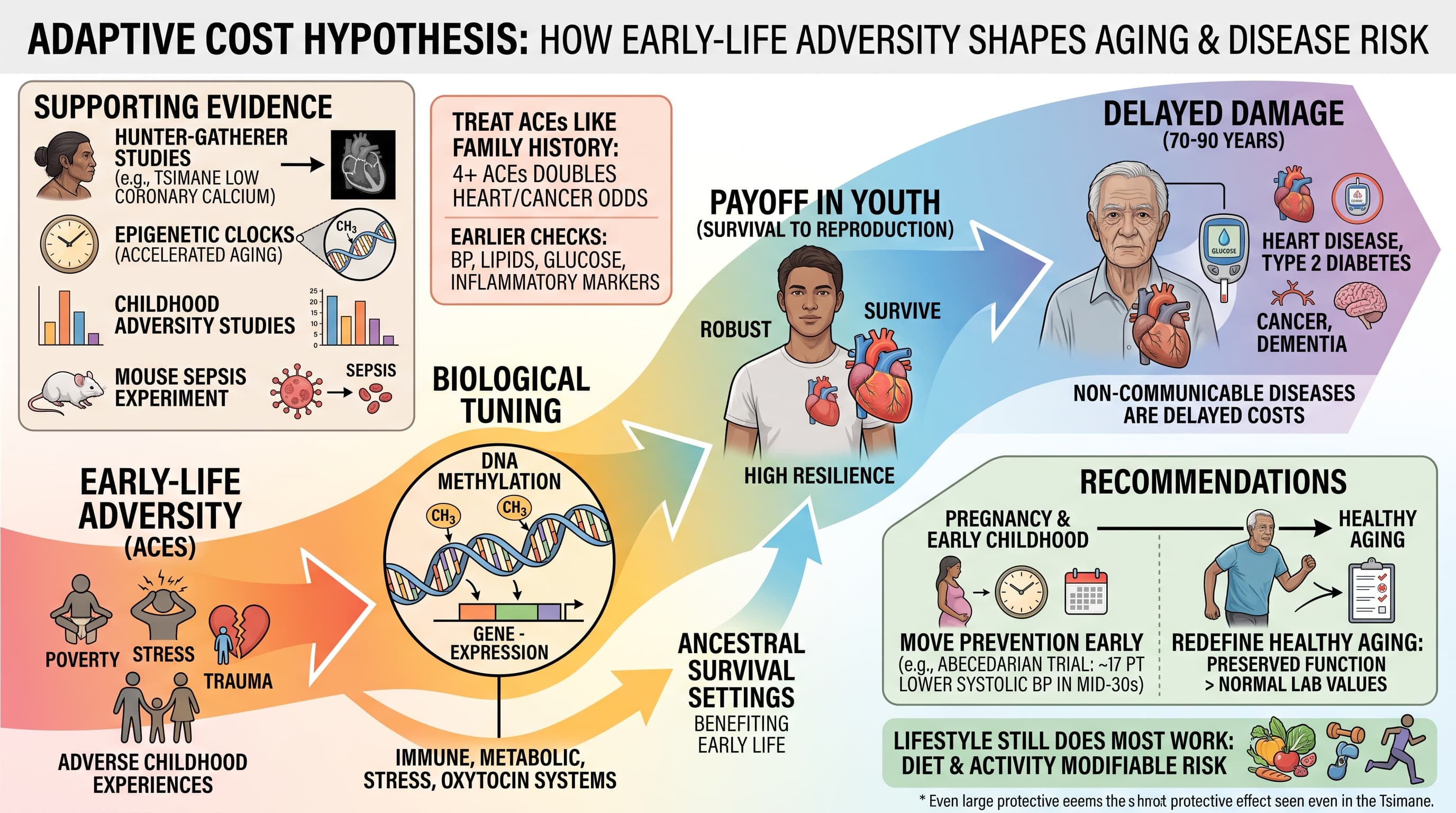
This review proposes the “Adaptive Cost Hypothesis”: many non-communicable diseases (heart disease, type 2 diabetes, cancer, dementia) are not mainly lifestyle-mismatch diseases but the delayed costs of biological settings that helped our ancestors survive to reproduce. Early-life adversity is argued to tune immune, metabolic, stress and oxytocin systems through DNA methylation. These settings pay off in youth and do damage when they run for 70 to 90 years. The authors support the idea with evidence from hunter-gatherer populations, epigenetic clocks, childhood adversity studies and a 2026 mouse sepsis experiment. They recommend moving prevention toward pregnancy and early childhood and redefining healthy ageing as preserved function rather than normal lab values.
Why do people who do everything right still get heart disease, diabetes and dementia? A new review from the Luxembourg Institute of Health argues that the usual answer, that modern lifestyles clash with Stone Age bodies, is only half the story. The other half, say Jonathan Turner and colleagues, is that much chronic disease is the delayed bill for biological settings that helped our ancestors survive long enough to have children.
They call it the Adaptive Cost Hypothesis. It builds on an old idea from evolutionary biology. Selection cares about reproduction, so traits that help you survive to 30 are favoured even if they cause trouble at 75. The authors combine this with evidence that early experience tunes the body through chemical tags on DNA. A child who grows up with threat, hunger or neglect may develop a hair-trigger immune system, a reactive stress axis, a weaker oxytocin system and a metabolism built to store calories. In a dangerous world these settings help. Run them for eight decades and, the authors argue, you get chronic inflammation, stiff arteries, insulin resistance and overactive brain immune cells that feed dementia.
The central claim is that this is not just mismatch. Even when adult life matches what childhood programming expected, the programme itself wears the body down, because nothing selected it to run that long.
The supporting evidence is indirect and drawn from many sources. The Tsimane of Bolivia, forager-farmers who are lean and very active, have some of the cleanest arteries ever measured, yet some coronary calcium and dementia still appear with age. Epigenetic clocks track age closely even in healthy people. Adults with hard childhoods show more inflammation, altered methylation of the oxytocin receptor gene and more heart disease decades later. A 2026 Nature mouse study adds a molecular example: a heart pathway that protects young mice during sepsis kills old mice, and blocking it saved old animals while harming young ones.
The authors draw practical conclusions. Prevention should move upstream to prenatal care, support for new parents and reducing childhood adversity, and methylation clocks should be used to judge within a few years whether such programmes work. Healthy ageing, they argue, should mean keeping independence and a clear mind, not chasing perfect blood numbers. Therapies aimed at ageing itself, such as senolytics or partial reprogramming, fit the logic better than treating each disease one at a time.
The weaknesses are substantial. The paper contains no new data. Several of the studies it relies on do not test what it implies. The CALERIE diet trial never measured early-life programming, and the Look AHEAD lifestyle trial did not compare early with late intervention. Epigenetic clocks are built to predict age, so their accuracy says little about whether ageing is programmed. The authors’ own source on hunter-gatherer lifespans reports that the most common adult age at death in those groups is around 70, which undercuts the claim that human biology was “designed” for 40 to 60 years.
Even so, the paper asks a useful question in testable form: how much late-life disease can lifestyle realistically prevent, and how much is set early? The answer matters for where prevention money goes.
Actionable Insights
- Lifestyle still does most of the work you can control. The Tsimane are the paper’s best example of an intrinsic “floor,” yet about 85% of Tsimane adults had zero coronary artery calcium. That is a very large protective effect from diet and activity, and it is the modifiable part of risk.
- Treat a difficult childhood like a family history. People with four or more adverse childhood experiences have roughly twice the odds of heart disease and cancer as people with none. If your baseline heart disease risk is 6%, doubling the odds puts you at about 11 to 12%. That justifies earlier checks of blood pressure, lipids, glucose and inflammatory markers.
- For parents and policymakers, early investment may have unusually large returns. In the small Abecedarian early-childhood trial, men who received the program had systolic blood pressure about 17 points lower in their mid-30s. The sample was small, so treat this figure as optimistic.
- Do not expect midlife weight loss alone to erase cardiovascular risk. In Look AHEAD, sustained weight loss improved blood sugar and fitness but did not measurably reduce heart attacks or strokes over about 10 years.
- Aim for function (strength, cognition, independence) over perfect lab numbers.
Context and Source
- Open Access Paper: Living beyond our evolutionary warranty: Why non-communicable diseases may be the inevitable costs of an extended lifespan, November 2026.
- Institutions: Luxembourg Institute of Health, Department of Infection and Immunity (Luxembourg); Swedish University of Agricultural Sciences, Department of Animal Environment and Health (Sweden)
- Countries: Luxembourg and Sweden
- Journal: Ageing Research Reviews
- Impact evaluation: In the 2026 Journal Citation Reports release, based on 2025 citation data, the journal’s impact factor is 15.5, it ranks third of 72 journals in Geriatrics and Gerontology, and its Elsevier CiteScore is 20.6 therefore this is a High impact journal.