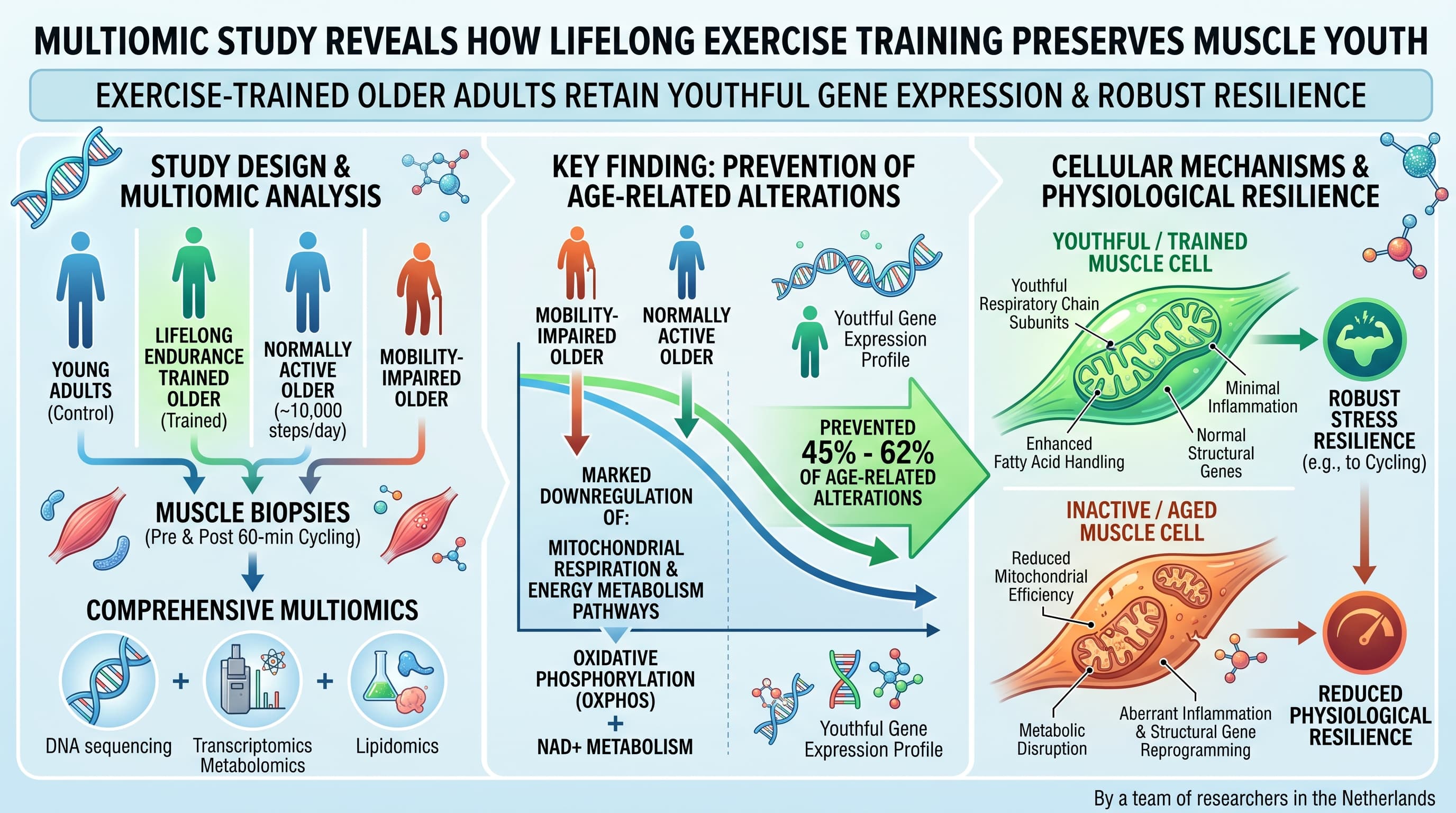
**A Dutch multiomics study of 47 muscle biopsies reports that roughly 56 percent of the gene expression changes that distinguish old muscle from young muscle are simply absent in older adults who have trained consistently for years. The preventable fraction is dominated by mitochondrial energy metabolism, including electron transport chain subunits, mitochondrial ribosomal proteins, and NAD+ pathway metabolites. The fraction that persists regardless of training clusters instead around synaptic transmission and WNT signalling, with no dominant pathway. A second finding is that trained older adults do not merely age more slowly at rest, they also respond to an acute exercise bout in a pattern that resembles young adults. **
For decades the standard picture of muscle aging has been a slow, uniform slide. Mitochondria falter, energy metabolism drifts, strength goes. A Dutch team has now taken that picture apart and found that it is really two pictures stacked on top of each other, and only one of them responds to exercise.
Georges Janssens, Riekelt Houtkooper and colleagues at Amsterdam UMC and Maastricht University recruited 47 people and took muscle biopsies from the thigh. Eleven were in their twenties. The other 36 were over 65 and were sorted by how much they actually moved: 16 long-term exercisers averaging around 14,000 steps a day plus at least three training sessions a week, 15 people living an ordinary active life at roughly 9,600 steps, and five with measurable physical impairment. Everyone then rode a stationary bike for an hour at half their personal maximum and gave a second biopsy immediately afterwards. Every sample was run through three molecular readouts at once: more than 24,000 gene transcripts, 135 metabolites and 1,383 individual lipid species.
The headline number is the split. Comparing the young group with the ordinary older group produced a long list of genes that change with age. When the same comparison was run against the trained older group, roughly 56 percent of those changes were not there. Their muscle had not aged less in every respect. It had failed to age in a specific respect.
What falls into the preventable half is telling. It is dominated by the machinery of energy production: electron transport chain components such as NDUFS1 and COX5A, and a cluster of mitochondrial ribosomal proteins that build the respiratory apparatus itself. The metabolite data pointed the same way, with NAD+ pathway compounds among the ten most age-altered molecules, alongside triglyceride buildup inside the muscle fibre.
The unavoidable half looks nothing like it. Those genes cluster around synaptic transmission and WNT signalling, meaning the wiring between nerve and muscle and the developmental programmes that maintain tissue structure. No single pathway dominates, which the authors read as drift rather than a targetable process.
The second finding may matter more in practice. Aging did not just blunt the response to that hour on the bike, it distorted it. Ordinary older adults depleted and accumulated metabolites at four to six times the rate of the young, and accumulated four times as many altered lipid species. The trained older adults responded in a pattern closer to the young, and their inflammatory signalling genes, including IL6 and IL1B, fired harder than in their sedentary peers, not softer. Fitness bought a stronger stress response, not a quieter one.
The caveat is structural and the authors state it. Nobody was randomised. These are people who chose to train for decades, in a country where cycling is ordinary and where the sedentary comparison group still walks close to 10,000 steps a day. The trained group was also about three years younger and leaner. What the study establishes is that half of the muscle aging signature is compatible with being absent, and where the other half lives.
Actionable Insights
Maintaining regular, structured endurance training preserves cellular energy production into late life. Casual daily walking is insufficient to safeguard mitochondrial capacity; older participants logging 9,600 steps per day still experienced widespread bioenergetic decline, whereas individuals completing at least three 1-hour structured exercise sessions weekly maintained youthful muscle profiles.
The magnitude of this protective benefit is substantial. Exercise prevented 55.9% of normal age-related gene upregulations and 57.1% of age-related gene downregulations. For mitochondrial respiratory complex I and complex V gene expression, training kept median transcript counts within approximately 5% to 10% of young levels, contrasting with a 30% to 50% decrease seen in untrained older adults. Standardized effect sizes across respiration markers and clinical stamina indices between trained and untrained individuals regularly exceeded 1.2 standard deviations (Cohen’s d).
Practical guidance highlights the necessity of reaching genuine cardiovascular exertion rather than merely accumulating low-intensity steps. In addition, practitioners must be cautious with non-specific, long-term anti-inflammatory interventions: the transient inflammatory and stress response provoked by exercise is an indispensable signal that drives tissue remodeling and cellular resilience in aging muscle.
Context/Source
- Paywalled Paper: Delayed molecular aging, preservation of energy metabolism and enhanced exercise response in exercise-trained human muscle
- Principal Institutions: Amsterdam UMC, University of Amsterdam; Maastricht University Medical Center+
- Country: The Netherlands
- Journal: Nature Aging
- Impact Evaluation: The impact score of this journal is 25.0, evaluated against a typical high-end range of 0 to 60+ for top general science, therefore this is an Elite impact journal.