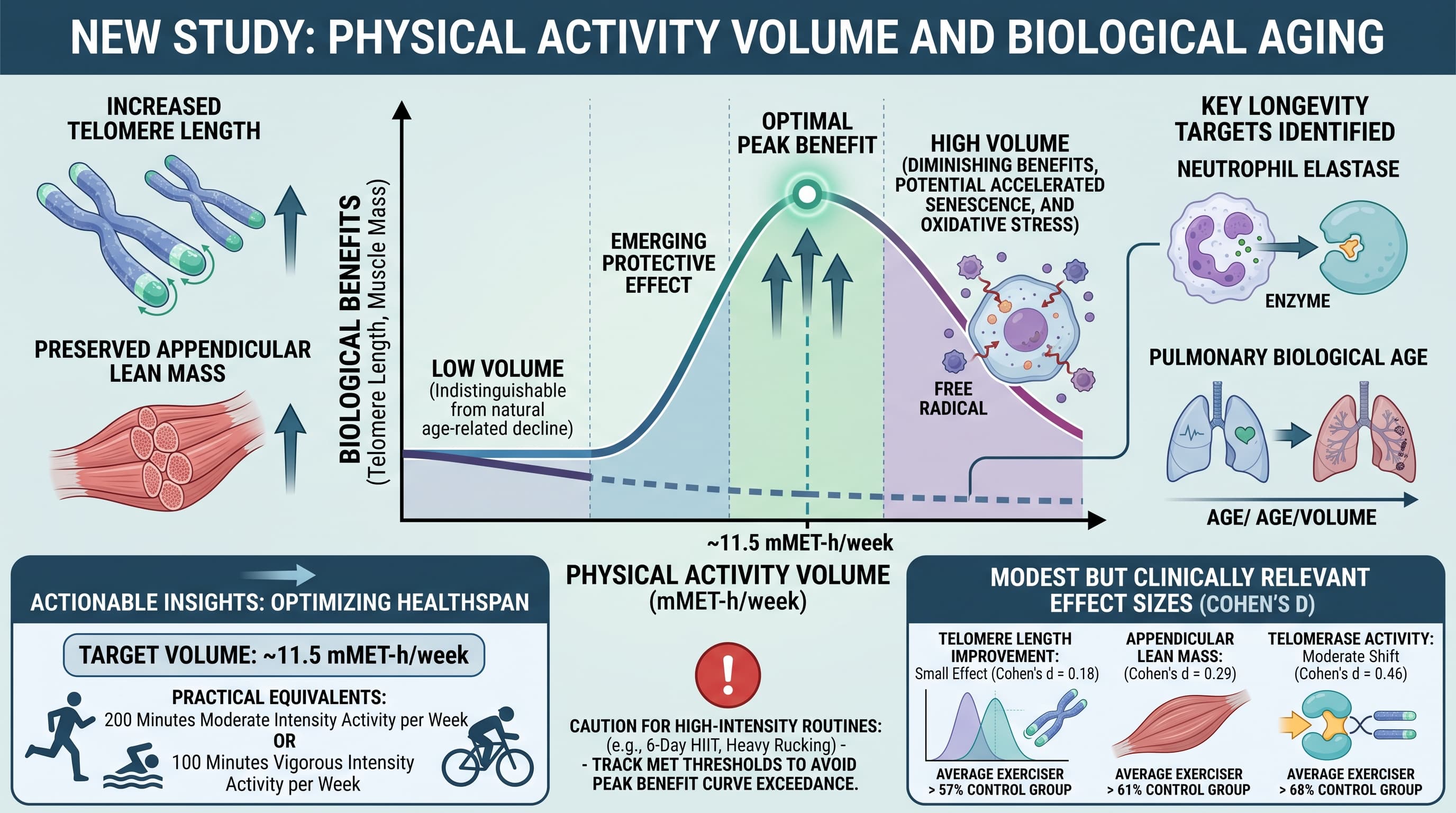
This study conducts a meta-analysis of randomized controlled trials and Mendelian randomization to evaluate how physical activity influences biological aging markers. It identifies a non-linear dose response where benefits to telomeres and muscle mass peak at a specific exercise volume, beyond which cellular benefits diminish. The research also points to neutrophil elastase and pulmonary biological age as key targets of exercise-induced longevity.
Researchers from Central South University have quantified the exact volume of exercise that maximizes anti-aging biological markers. By synthesizing data from 49 randomized controlled trials and large-scale genetic databases, the team mapped physical activity against cellular and phenotypic aging clocks. The findings challenge the persistent assumption that higher exercise volumes continuously compound longevity benefits. Instead, the data reveals a clear non-linear relationship.
At low volumes, the impact on metrics like telomere length remains indistinguishable from natural age-related decline. As volume increases, a protective effect emerges and climbs sharply, peaking at approximately 11.5 marginal metabolic equivalent task hours per week (mMET-h/week). Crucially, as exercise volume pushes past this threshold, the biological benefits to telomere length and lean mass begin to diminish. This suggests that extreme physical exertion could potentially accelerate specific facets of cellular senescence or induce diminishing returns due to accumulated oxidative stress.
The investigation also utilized Mendelian randomization to isolate causal genetic links between moderate to vigorous physical activity and epigenetic aging. The data confirmed that such activity causally decelerates multiple epigenetic clocks, including PhenoAge and GrimAge, while specifically reducing the biological age gap of the pulmonary system. Cardiovascular and brain biological ages did not show the same statistically significant genetic sensitivity to exercise volume in this specific model.
To explain these systemic benefits, the researchers identified intermediate molecular pathways. A primary mediator discovered is ELANE, a gene responsible for neutrophil elastase. In the context of immunosenescence, excessive neutrophil elastase promotes cell cycle arrest and drives cellular senescence. Physical activity appears to downregulate ELANE, effectively preserving cellular function and delaying the senescence cascade.
Actionable Insights
To optimize healthspan, the target exercise volume is roughly 11.5 mMET-h/week. In practical terms, this equates to 200 minutes of moderate intensity activity or 100 minutes of vigorous intensity activity per week.
When calculating the effect sizes of these interventions, the real world magnitude is modest but clinically relevant over a lifespan. The standardized mean difference (Cohen’s d) for telomere length improvement is 0.18. For an individual without statistical training, a Cohen’s d of 0.18 means the average person in the exercise group had longer telomeres than only about 57 percent of the control group. This is a small effect. The improvement in appendicular lean mass showed a Cohen’s d of 0.29, meaning the exercise group outperformed about 61 percent of the control group. The most substantial benefit was seen in telomerase activity with an effect size of 0.46, representing a moderate shift where the intervention group outperformed 68 percent of the non-exercising group. For individuals engaging in rigorous six day per week routines combining high intensity interval training and heavy rucking, tracking these specific MET thresholds is critical to avoid exceeding the peak benefit curve.
Context/Source
- Open Access Paper: Physical activity volume and aging indicators: a meta-analysis and genetic causality assessment.
- Institution: Central South University.
- Country: China.
- Journal Name: BMC Medicine.
- Impact Evaluation: The impact score of this journal is 9.3, evaluated against a typical high-end range of 0 to 60+ for top general science, therefore this is a High impact journal.