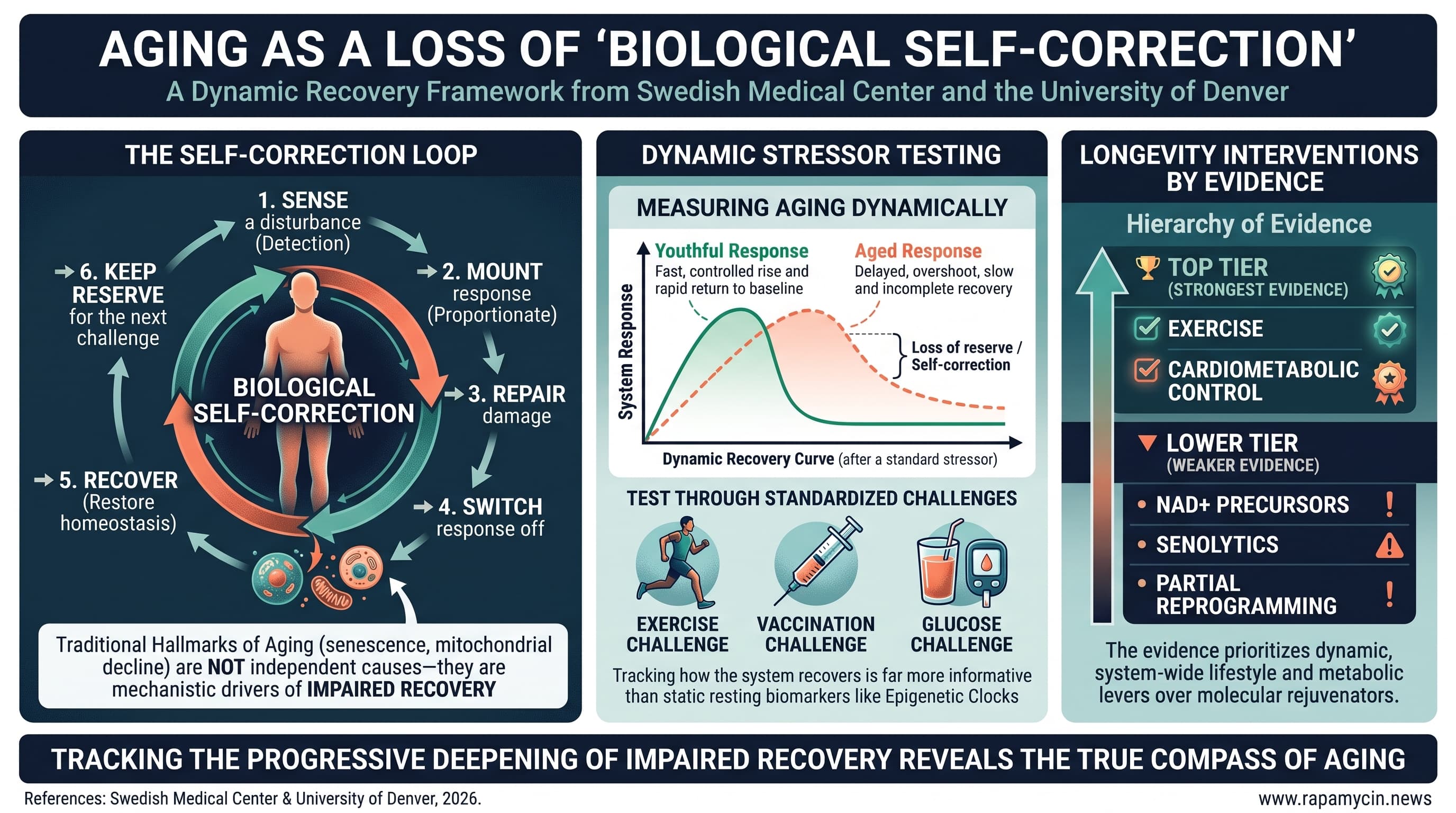
Researchers from Swedish Medical Center and the University of Denver argue that aging is best understood as a progressive loss of “biological self-correction”: the body’s ability to sense a disturbance, mount a proportionate response, repair damage, switch the response off and recover while keeping reserve for the next challenge. Rather than replacing the hallmarks of aging, the framework treats them as candidate mechanisms behind impaired recovery. The authors propose measuring aging dynamically, by tracking how people respond to and recover from standardized stressors such as exercise, vaccination or a glucose challenge, instead of relying only on resting biomarkers like epigenetic clocks. They rank longevity interventions by evidence, placing exercise and cardiometabolic control at the top and NAD+ precursors, senolytics and partial reprogramming well below.
A thermostat is judged not by the temperature in a quiet room but by how well it handles an open window. A new review argues that human aging should be judged the same way.
David Bar-Or and colleagues, writing in the journal Geriatrics, propose that aging is fundamentally a decline in “biological self-correction.” Young bodies take constant damage too, they note, but they detect it quickly, respond in proportion, repair it and then switch the response off. With age, each step can falter. Responses come late or overshoot. Repairs are incomplete. Inflammation that should end keeps smoldering. And sometimes the body settles efficiently into a worse equilibrium, such as chronically raised inflammation or blood pressure, and then defends that state as if it were normal.
This view does not discard the familiar hallmarks of aging, such as DNA damage, failing protein quality control, dysfunctional mitochondria and senescent cells. Instead it treats them as possible reasons the correction cycle breaks down. Senescence, for example, starts as a sensible defense against cancer but becomes harmful when the immune system stops clearing the arrested cells.
The practical proposal is a shift in measurement. Rather than reading biological age from a single blood draw, researchers would apply a defined stress, such as an exercise test, a vaccine or a sugary drink, and track the response over time: how far function drops, how quickly it returns, what it costs and whether reserve remains for the next challenge. The authors list ten or more trajectory features to capture.
The review is also notably sober about popular longevity strategies. NAD+ precursors reliably raise NAD+ levels in blood but have not consistently improved function in human trials. Senolytics remain preliminary in people. Partial reprogramming is still a laboratory tool with cancer risks. Even mTOR inhibition is framed carefully: the authors suggest healthy aging may depend on switching flexibly between growth and maintenance modes rather than keeping growth signaling permanently low (a position that is well known in the Longevity / rapamycin user community already).
At the top of their evidence ranking sit unglamorous interventions: physical activity, resistance training, not smoking, blood pressure and metabolic control, vaccination, sleep and diet. Exercise gets special emphasis because it is both a controlled stress and a way of training the body’s response to stress.
The weaknesses are real. The paper presents no new data, and its literature search was not systematic. The authors acknowledge that “self-correction” overlaps heavily with existing ideas such as resilience, allostasis and physiological reserve. More importantly, the review omits a body of work that has already measured recovery dynamics in humans, including analyses of blood markers showing that recovery from fluctuations slows with age. With so many possible stressors, readouts and trajectory measures, and an escape clause for “defended” unhealthy setpoints, the framework may be harder to falsify than the authors suggest.
Still, the core idea has value. A clock that reads lower after a supplement means little if you recover no better from illness, surgery or a hard week. Measuring how people bounce back, not just how they look at rest, is a reasonable next step for the field.
Actionable insights
The review generates no new data, so its practical messages rest on the human studies it cites.
- Resistance training. In a meta-analysis of cohort studies, any resistance training versus none was linked to 15 percent lower all-cause mortality (Cohen’s d approx. 0.09, small), with the largest reduction, about 26 percent, at roughly 60 minutes per week and no extra benefit beyond. Combining resistance and aerobic activity was linked to 40 percent lower mortality versus doing neither (d approx. 0.28). For a group with 10 percent ten-year mortality, that is about 4 fewer deaths per 100 people. These are observational associations.
- Lifestyle base. Adults with five low-risk habits (never smoking, regular activity, healthy weight, good diet, moderate alcohol) had projected life expectancy at age 50 that was 14.0 years longer for women and 12.2 years for men than those with none.
- Experimental agents. NAD+ precursors show target engagement without consistent functional benefit; senolytics remain preliminary in humans. Avoid indiscriminate stacking.
- Self-tracking. Recovery metrics such as heart rate variability rebound after training or glucose return-to-baseline after meals fit this framework, but none are validated as aging measures.
Context and source
- Open Access Paper: Aging as Loss of Biological Self-Correction: A Geroscience Framework for Longevity, Inflammaging, and Restored Resilience
- Institutions: Trauma Research Department, Swedish Medical Center, Englewood, Colorado; Knoebel Institute for Healthy Aging, University of Denver
- Country: USA
- Journal: Geriatrics (MDPI), published 16 September 2026.
- Impact evaluation: CiteScore 3.4, Q2 in Gerontology. The impact score of this journal is 2.4, evaluated against a typical high-end range of 0 to 60+ for top general science, therefore this is a Low impact journal.
Related Reading:
- One Man, Seven Months, One Data Point: Can Your Biology's Recovery Speed Become the New Biomarker?
- Loss of Resilience as the Key Measure of Aging, And How to Track It
- Heart Rate Recovery Time: The simple fitness test that predicts your risk of death (BBC)
- The Heart That Beats Too Evenly: Heart Rate Variability Tracks the Aging Brain
- Pregnancy Ages the Body. The Time Between Babies May Decide Whether It Sticks
- Too Hot to Sleep: Nighttime Temperatures Above 24°C Impair Autonomic Recovery in Older Adults