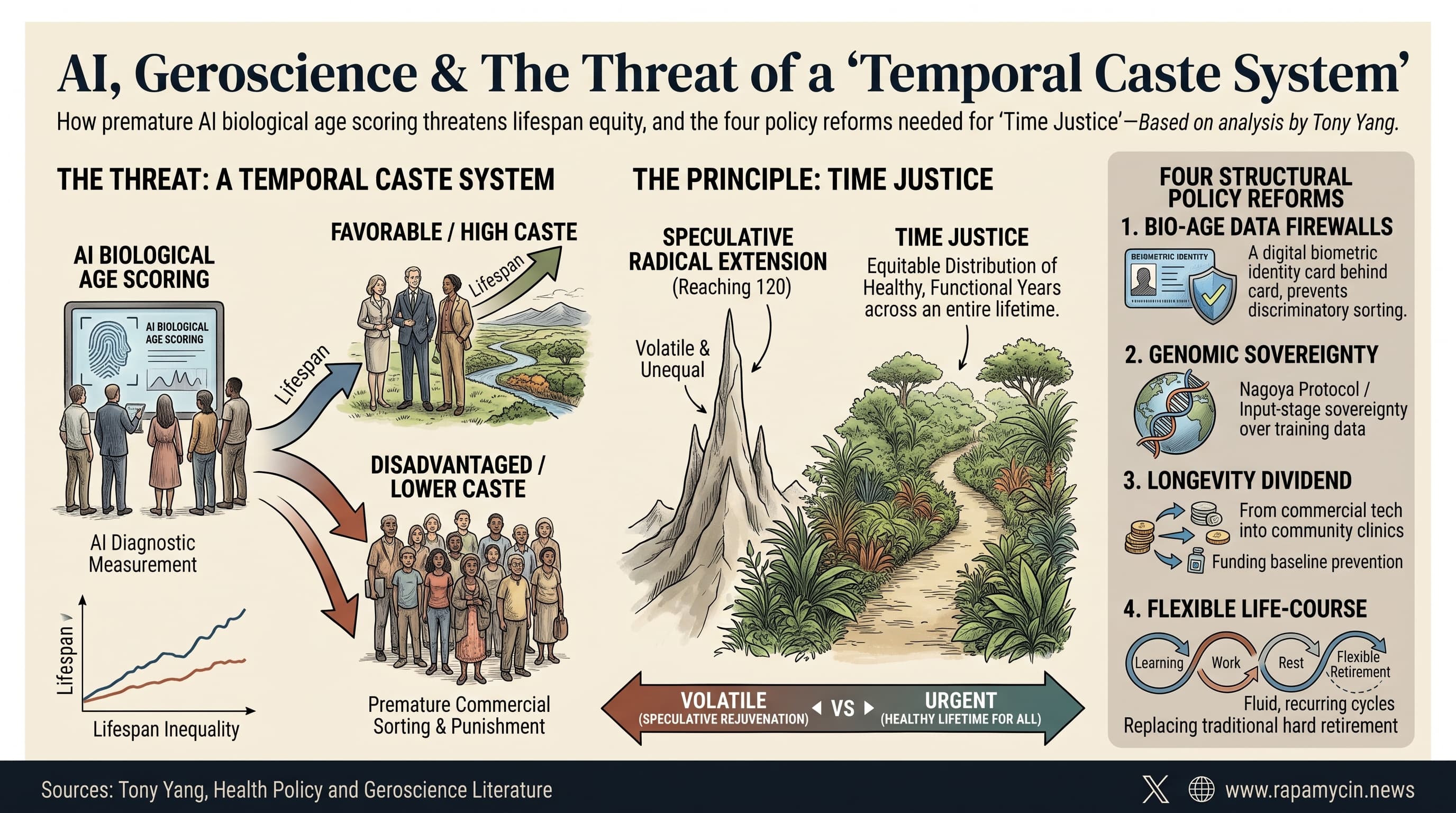
Tony Yang argues that integrating artificial intelligence into geroscience threatens to transform biological lifespan into a temporal caste system. Rather than pursuing a speculative international human right to radical life extension or reaching age 120, legal and health policy must prioritize time justice: the equitable distribution of conditions that ensure healthy, functional years across an entire lifetime. Because artificial intelligence will deploy first as diagnostic measurement and biological age scoring rather than therapeutic rejuvenation, premature commercial sorting threatens to punish disadvantaged populations. Yang proposes four structural policy reforms: erecting firewalls around biological age data, securing input-stage sovereignty over genomic training data under frameworks like the Nagoya Protocol, instituting a commercial longevity dividend to fund baseline prevention, and restructuring traditional retirement into flexible life-course models.
The frontier of artificial intelligence in biology is frequently framed through the lens of radical life extension: neural algorithms engineering synthetic proteins, custom senolytic cocktails clearing damaged cells, and interventions pushing human longevity beyond 120 years. Yet, a legal and policy commentary published in the Journal of Law, Medicine & Ethics cuts through this speculative optimism with a sobering premise. The primary threat of longevity technology is not a failure to invent transformative therapies, but the rapid conversion of time itself into a luxury commodity.
Authored by health policy scholar Y. Tony Yang of The George Washington University, the commentary responds to international legal proposals that advocate for a universal human right to an artificial-intelligence-extended lifespan. Yang argues that focusing on high-tech longevity rights fundamentally misdiagnoses the problem. Modern societies already tolerate massive, preventable variations in survival driven by poverty, environmental toxicities, inadequate primary care, and occupational hazards. In the United States alone, the wealthiest one percent of men live nearly fifteen years longer than the poorest one percent, a demographic disparity that continues to widen. Pushing for individual entitlements to cutting-edge rejuvenation before addressing baseline health merely reinforces existing inequalities.
The crux of the argument centers on how artificial intelligence enters the longevity field. It will not arrive tomorrow as a single rejuvenation pill. Instead, it is arriving today as infrastructure for measurement: biological aging clocks, wearable telemetry, multi-modal risk scoring, and predictive genomic modeling. This shift creates what Yang terms an epistemic divide. While affluent individuals obtain granular predictive analytics, personalized behavioral guidance, and early access to clinical trials, marginalized communities remain either underrepresented in training algorithms or penalized by actuarial models. Insurers, employers, and financial institutions could easily weaponize biological age estimations to deny coverage or employment, effectively writing off individuals with accelerated epigenetic aging.
To counter this trajectory, the commentary outlines four policy solutions. First, regulators must establish a strict legal firewall preventing corporate or institutional use of biological age metrics for underwriting or employment screening. Second, international agreements must treat human genomic training data under models similar to the Nagoya Protocol, granting source populations sovereign rights and benefit-sharing at the data-extraction stage. Third, developers commercializing longevity products built on publicly funded research should pay into a pooled longevity dividend, directly underwriting baseline public health measures like hypertension management, cancer screenings, and environmental remediation. Finally, societies must overhaul outdated industrial life-cycle institutions, replacing rigid retirement cliffs with continuous education, phased career structures, and compensated caregiving.
Ultimately, the analysis urges the scientific and medical communities to redirect their focus. Rather than chasing speculative, high-cost technologies that benefit a privileged minority, the true moral and biological priority must be time justice: defending every person’s opportunity to live a healthy, capable, and complete life.
Context and Source
- Open Access Paper: AI Longevity and the Law of Time Justice: A Commentary on Truby and Kantiana, “AI’s Promise of Healthy Longevity: Exploring the Implications of Extended Lifespans Under International Law”, Published15 October 2026.
- Institution: The George Washington University
- Country: United States
- Journal Name: Journal of Law, Medicine & Ethics
- Impact Evaluation: The impact score of this journal is 1.3, evaluated against a typical high-end range of 0–60+ for top general science, therefore this is a Low impact journal.
Related Reading:
- The Coming Longevity Divide: Why Your Right to a Longer Life Is Heading to Court
- Billionaire Longevity Escape Velocity (B-LEV): Is this going to be an Issue?
- The Rich and Powerful Want to Live Forever. What if They Could?
- The Cure for Death Means Billionaires Will Live Forever—and Be Rich Forever
- Inside the billion-dollar meeting for the mega-rich who want to live forever (MIT Tech Review)
- How to Live Forever and Get Rich Doing It (The New Yorker)
- Hevolution Foundation, Saudi $ Billions into Anti-Aging