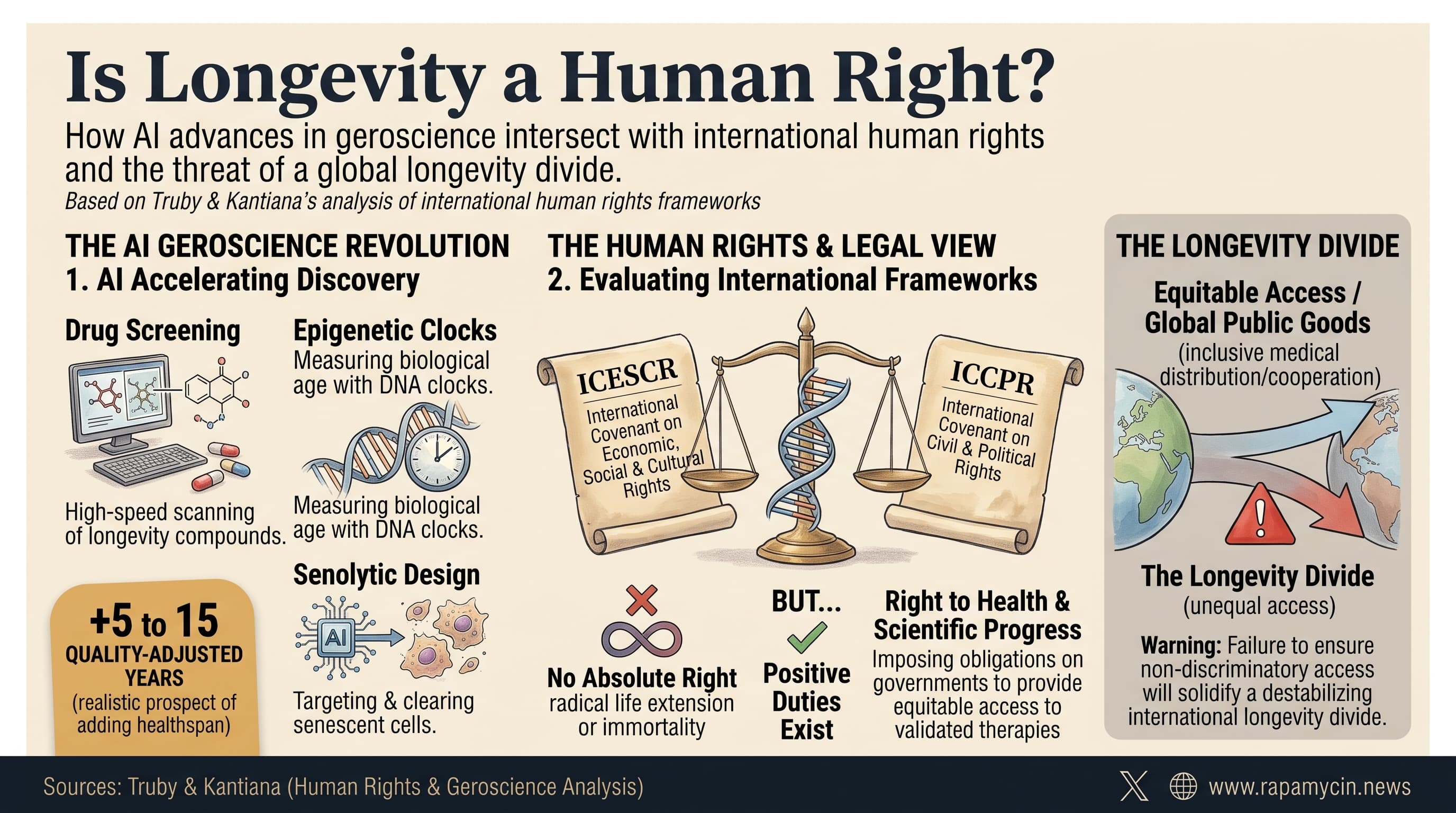
Artificial intelligence is accelerating geroscience discovery across drug screening, epigenetic clocks, and senolytic design,presenting the realistic prospect of adding 5 to 15 quality-adjusted years of life. However, translating these biological advances into human populations creates legal, ethical, and distribution crises. Truby and Kantiana examine international human rights frameworks, primarily the International Covenant on Economic, Social and Cultural Rights and the International Covenant on Civil and Political Rights, to evaluate whether a fundamental human right to life extension exists. They conclude that while an absolute right to radical life extension or immortality is absent, the existing right to health and the right to scientific progress impose positive duties on governments to provide equitable, non-discriminatory access to validated longevity interventions as global public goods, warning that failure to do so will solidify a destabilizing international longevity divide.
For decades, radical human life extension belonged strictly to science fiction and speculative bioethics. That boundary is dissolving. Machine learning algorithms now screen vast chemical libraries to pinpoint senolytic compounds, decode epigenetic aging signatures, and optimize cellular reprogramming targets in hours rather than decades. These tools are shifting medicine from treating established age-related pathologies to preventing intrinsic biological decay.
Yet, as Truby and Kantiana demonstrate, biological breakthroughs do not exist in a legal vacuum. The core issue confronting longevity science is no longer solely whether we can intervene in the biological rate of aging, but whether societies possess the legal, economic, and institutional architecture to deliver those interventions without creating a fractured species. Currently, average life expectancies already diverge by more than twenty years between high-income nations and low-income countries. If artificial intelligence accelerates treatments that add a decade or more of functional vitality, and those therapies remain private, proprietary, or concentrated in wealthy nations, the existing health disparity will widen into an insurmountable longevity divide.
The authors evaluate this crisis by interrogating existing international human rights instruments. Under Article 12 of the International Covenant on Economic, Social and Cultural Rights, individuals are entitled to the highest attainable standard of health. Historically, this standard applied to sanitation, maternal care, and infectious disease control. Truby and Kantiana ask whether aging itself, recently reframed by the World Health Organization as an associated decline in intrinsic capacity, qualifies as a treatable condition under treaty provisions. If longevity therapeutics prove genuinely disease-modifying, states may face positive legal duties to make them available just as they do with essential vaccines.
This right intersects directly with Article 15, the right to enjoy the benefits of scientific progress. International law requires that the applications of science serve human welfare without structural discrimination. Today, artificial intelligence training datasets are predominantly generated in high-income regions and frequently exclude older demographics, producing algorithms that overlook the biological realities of diverse global populations.
Furthermore, prolonging functional life forces a structural re-evaluation of societal mechanisms, from pension solvency and retirement ages to intergenerational caregiving burdens and environmental strain. The authors stress that international bioethical conventions and treaties, such as the Convention on Biological Diversity, mandate that longevity research protect biodiversity, ensure fair benefit sharing of natural molecules, and preserve resources for future generations.
The path forward demands intentional policy preparation. A human right to extended healthy life is already taking root within established legal duties. If societies fail to democratize geroscience, advanced biological enhancements will simply amplify entrenched global inequalities.
Context and Source
- Open Access Paper: AI’s Promise of Healthy Longevity: Exploring the Implications of Extended Lifespans Under International Law, Published 24 April 2026.
- Institutions: Centre for International Law, National University of Singapore; Saw Swee Hock School of Public Health, National University of Singapore
- Country: Singapore
- Journal Name: Journal of Law, Medicine & Ethics (Volume 54, Issue 3, 2026, Pages 377-383)
- Journal Impact Evaluation: The impact score of this journal is 2.1, evaluated against a typical high-end range of 0 to 60+ for top general science, therefore this is a Medium impact journal.