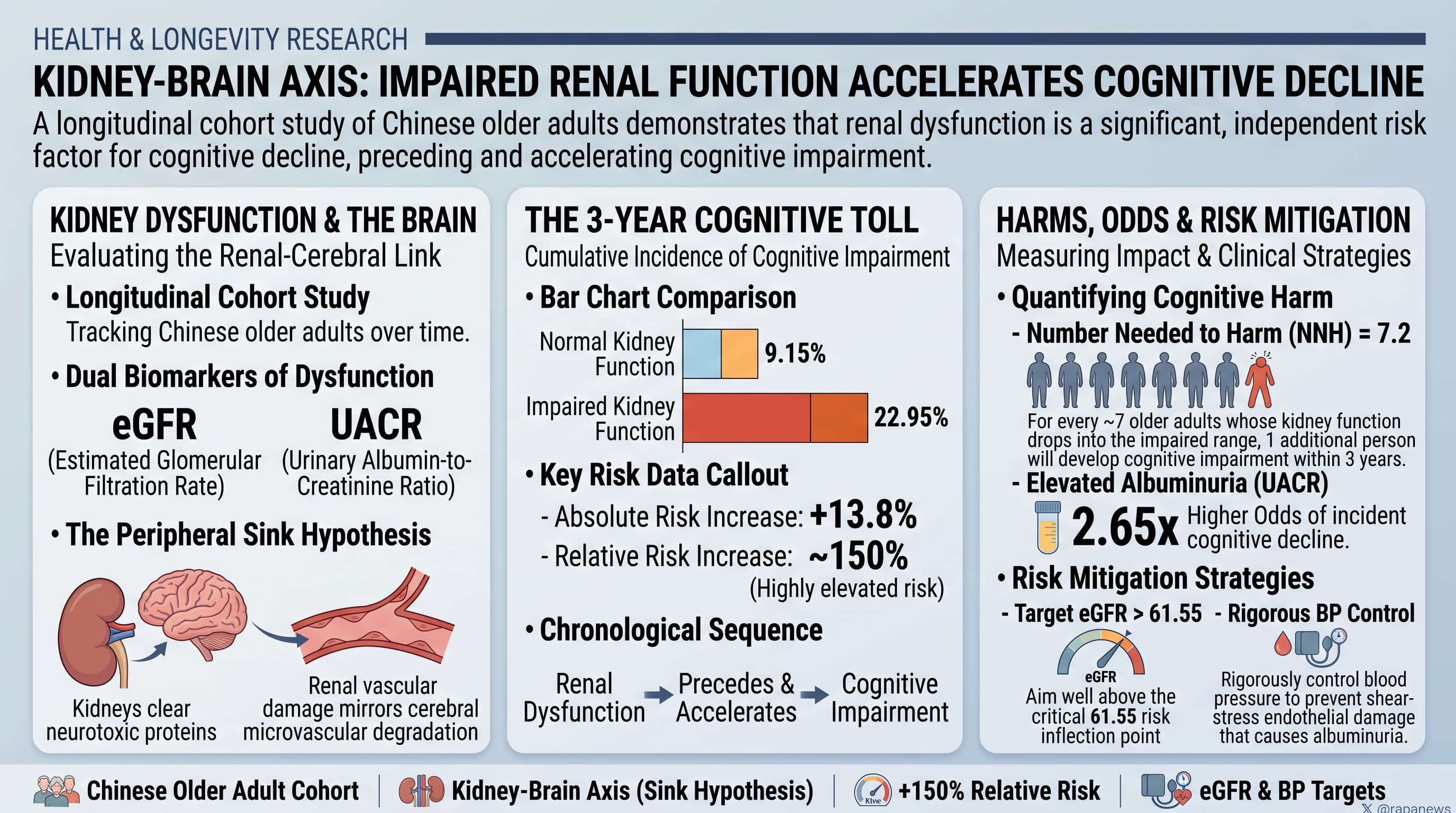
A longitudinal cohort study of Chinese older adults demonstrates that impaired kidney function is a significant, independent risk factor for cognitive decline. Evaluated through both estimated glomerular filtration rate and urinary albumin-to-creatinine ratio, the data show that renal dysfunction precedes and accelerates cognitive impairment. The findings strongly support the peripheral sink hypothesis, suggesting the kidneys are responsible for clearing neurotoxic proteins and that renal vascular damage mirrors cerebral microvascular degradation.
Dementia and cognitive decline are traditionally viewed exclusively through the lens of brain specific pathology. Neurologists focus on central nervous system aggregates of amyloid-beta and hyperphosphorylated tau proteins to explain the progression of Alzheimer’s disease and related dementias. However, the central nervous system does not operate in isolation. Peripheral organs are essential to the maintenance of brain homeostasis. This study pivots the focus to the kidneys, highlighting their crucial role in clearing systemic metabolic waste and neurotoxic proteins from the blood.
Researchers analyzed data from the Chinese Longitudinal Healthy Longevity Survey, tracking older adults to determine if baseline kidney function could predict future cognitive impairment. They utilized a dual parameter approach, measuring both the estimated glomerular filtration rate and the albumin-to-creatinine ratio. This methodology provides a comprehensive view of renal health, capturing both filtration capacity and endothelial vascular integrity.
The results from a three-year longitudinal follow-up present a compelling case for the kidney-brain axis. Older adults with impaired kidney function at baseline developed cognitive impairment at significantly higher rates than those with normal renal profiles. The physiological connection is twofold. First, the kidneys serve as a peripheral sink for amyloid-beta and tau. When glomerular filtration declines, these proteins accumulate systemically, cross the blood-brain barrier, and deposit in cerebral tissue. Second, the kidneys and the brain share unique microvascular architectures. The juxtamedullary afferent arterioles in the kidneys and the cerebral perforating arteries in the brain are both exposed to high pressure gradients. Consequently, elevated albuminuria serves as an early biomarker of systemic endothelial damage, reflecting simultaneously occurring microvascular degradation in the brain.
Interestingly, the study identified distinct thresholds where the risk of cognitive decline accelerates. The probability of cognitive impairment rises sharply once the estimated glomerular filtration rate drops below 61.55. Furthermore, this relationship exhibits a strong sex difference, with renal decline serving as a far more potent predictor of cognitive impairment in men than in women. These findings confirm that cognitive preservation requires a systemic approach. Maintaining renal filtration capacity and vascular integrity is not merely about preventing kidney disease; it is a fundamental requirement for long term cognitive health.
Actionable Insights
For longevity optimization, the primary directive is to treat kidney function biomarkers as leading indicators for brain health. Routine blood panels must track estimated glomerular filtration rate and albumin-to-creatinine ratio as aggressively as lipid profiles.
The practical magnitude of this intervention is substantial. Participants with impaired kidney function experienced a 22.95 percent cumulative incidence of cognitive impairment over just three years, compared to 9.15 percent in those with normal function. This represents an absolute risk increase of 13.8 percent and a relative risk increase of approximately 150 percent. The number needed to harm is roughly 7.2, meaning for every seven older adults who allow their kidney function to drop into the impaired range, one additional person will develop cognitive impairment within three years. Furthermore, elevated albuminuria resulted in a 2.65 times higher odds of incident cognitive decline.
To mitigate these risks, target an estimated glomerular filtration rate well above the critical risk inflection point of 61.55. Control systemic blood pressure rigorously to prevent the sheer-stress endothelial damage that causes albuminuria. Interventions that support vascular endothelial health and reduce systemic inflammation will dually protect renal filtration and cerebral microvasculature.
Context/Source
- Open Access Paper: Associations Between Kidney Function and Risk of Cognitive Impairment Among Chinese Older Adults
- Institution: Shanxi Bethune Hospital, Shanxi Medical University; Guilin Medical University
- Country: China
- Journal: Geriatrics & Gerontology International
- Impact Evaluation: The impact score of this journal is 3.2, evaluated against a typical high-end range of 0–60+ for top general science, therefore this is a Medium impact journal.
Related Reading:
- The Renal Pacemaker: How Kidney Senescence Drives Systemic Aging
- D & Q "Hit-and-Run" Senolytic Therapy Reverses Diabetic Kidney Aging and Restores Klotho
- Survey: Your Kidney function (eGFR) and age?
- Kidney Performance (Low GFR for age)
- Lubiprostone (Constipation Drug) Stops Kidney Decline
- UCLA researchers may have discovered how to heal damaged kidneys