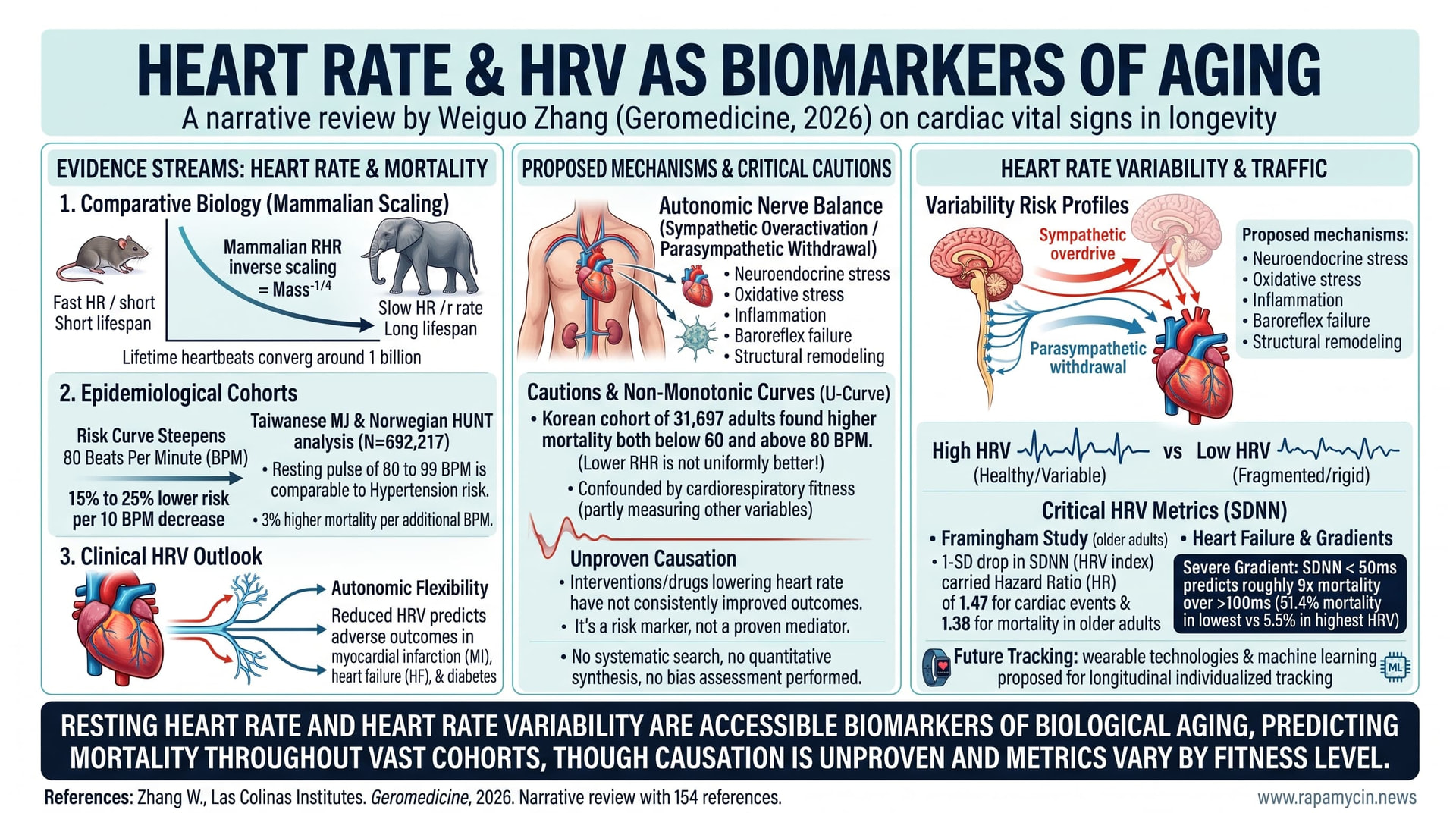
This single-author narrative review argues that resting heart rate and heart rate variability should be treated not merely as clinical vital signs but as accessible biomarkers of biological aging. It assembles three evidence streams: comparative biology showing that across mammals heart rate scales inversely with body mass and lifespan; large epidemiological cohorts, including a combined Taiwanese and Norwegian analysis of 692,217 adults, showing that elevated resting heart rate predicts cardiovascular and all-cause mortality; and clinical studies showing that reduced heart rate variability predicts adverse outcomes after myocardial infarction, in heart failure, and in diabetes. The proposed mechanisms are sympathetic overactivation, parasympathetic withdrawal, neuroendocrine stress activation, oxidative stress, inflammation, baroreflex failure, and structural remodeling. The review proposes wearables and machine learning as the route to individualized longitudinal tracking.
The pulse is the oldest diagnostic instrument in medicine and, on the evidence assembled here, one of the more underrated ones. This review makes the case that two numbers anyone with a cheap wrist device can read, resting heart rate and heart rate variability, carry real information about how fast a person is aging.
The comparative biology opening is the most quotable and the least useful. A shrew’s heart runs near a thousand beats a minute and the animal is dead within a couple of years. An elephant idles around forty and lives for decades. Across mammals, heart rate scales roughly as body mass to the minus one-quarter power, and the total number of heartbeats in a lifetime converges on something near a billion across many species. The review presents the old fixed-heartbeat hypothesis, then correctly labels it oversimplified, while still letting it set the tone.
The human epidemiology carries the argument. Across Framingham, the Chicago studies, NHANES, French and Finnish and Swedish and Chinese and Japanese and Korean cohorts, higher resting heart rate predicts cardiovascular and all-cause death after adjustment for the obvious confounders. The largest analysis, pooling the Taiwan MJ and Norwegian HUNT cohorts across 692,217 adults over 25 years, found that a resting pulse in the eighties and nineties cost measurable life expectancy, with the risk at 90 to 99 beats per minute comparable to carrying hypertension. That comparison is the single most striking line in the paper.
Heart rate variability (HRV) tells a different story. Where resting heart rate reports how hard the autonomic system is leaning on the heart, variability reports how flexibly it can respond. In Framingham, a one standard deviation drop in a standard variability index was associated with roughly a 47 percent higher hazard of new cardiac events. In heart failure patients, the gradient is brutal: mortality ran 5.5 percent in those with the highest variability and 51.4 percent in those with the lowest.
The review also flags that the relationship is not monotonic. A Korean cohort of 31,697 adults found higher cardiovascular mortality both above 80 beats per minute and below 60. The Rotterdam Study found that unusually high variability also predicted cardiac death in older adults.
Actionable Insights
A hazard ratio is how much a person’s risk of an event multiplies relative to a comparison group. A hazard ratio of 1.5 means 50 percent higher risk. These are observational associations, not proof that changing the number changes the outcome.
Resting heart rate. Pulling the per-unit figures from the cohorts tabulated here: a Swedish cohort found about 3 percent higher all-cause mortality per additional beat per minute. FINRISK found 24 percent higher cardiovascular death in men and 32 percent in women per 15 beats. Working those back, roughly 15 to 25 percent lower mortality risk per 10 beats lower is a defensible central estimate, with one French cohort reporting a near doubling per 15 beats at the extreme end. In practical terms, 80 beats per minute is where the risk curve clearly steepens across multiple independent cohorts.
Heart rate variability. In Framingham, a one standard deviation drop in SDNN carried a hazard ratio of 1.47 for incident cardiac events and 1.38 for mortality in older adults. In heart failure, SDNN below 50 milliseconds marked a group with roughly nine times the mortality of those above 100.
Two cautions that matter. Lower is not uniformly better: one Korean cohort found elevated cardiovascular mortality below 60 beats per minute as well as above 80. And resting heart rate is heavily shaped by cardiorespiratory fitness, so these associations are partly measuring something else.
Context and Source
- Open Access Paper: Resting heart rate and heart rate variability in cardiovascular aging: Biomarkers and potential therapeutic targets
- Institution: Las Colinas Institutes, Irving, Texas, USA. This is an independent research entity rather than a university or academic medical center, which is relevant context for a single-author narrative review produced without institutional peer infrastructure.
- Country: United States
- Journal: Geromedicine, 2026
- Impact evaluation: The impact score of this journal is Not Yet Assigned.
Related Reading:
- The Heart That Beats Too Evenly: Heart Rate Variability Tracks the Aging Brain
- Lifelong Aerobic Exercisers Have Nearly Double the Heart Rate Variability of Inactive Peers
- Loss of Resilience as the Key Measure of Aging, And How to Track It
- The Smartwatch on Your Wrist Is a Measuring Instrument Nobody Calibrated