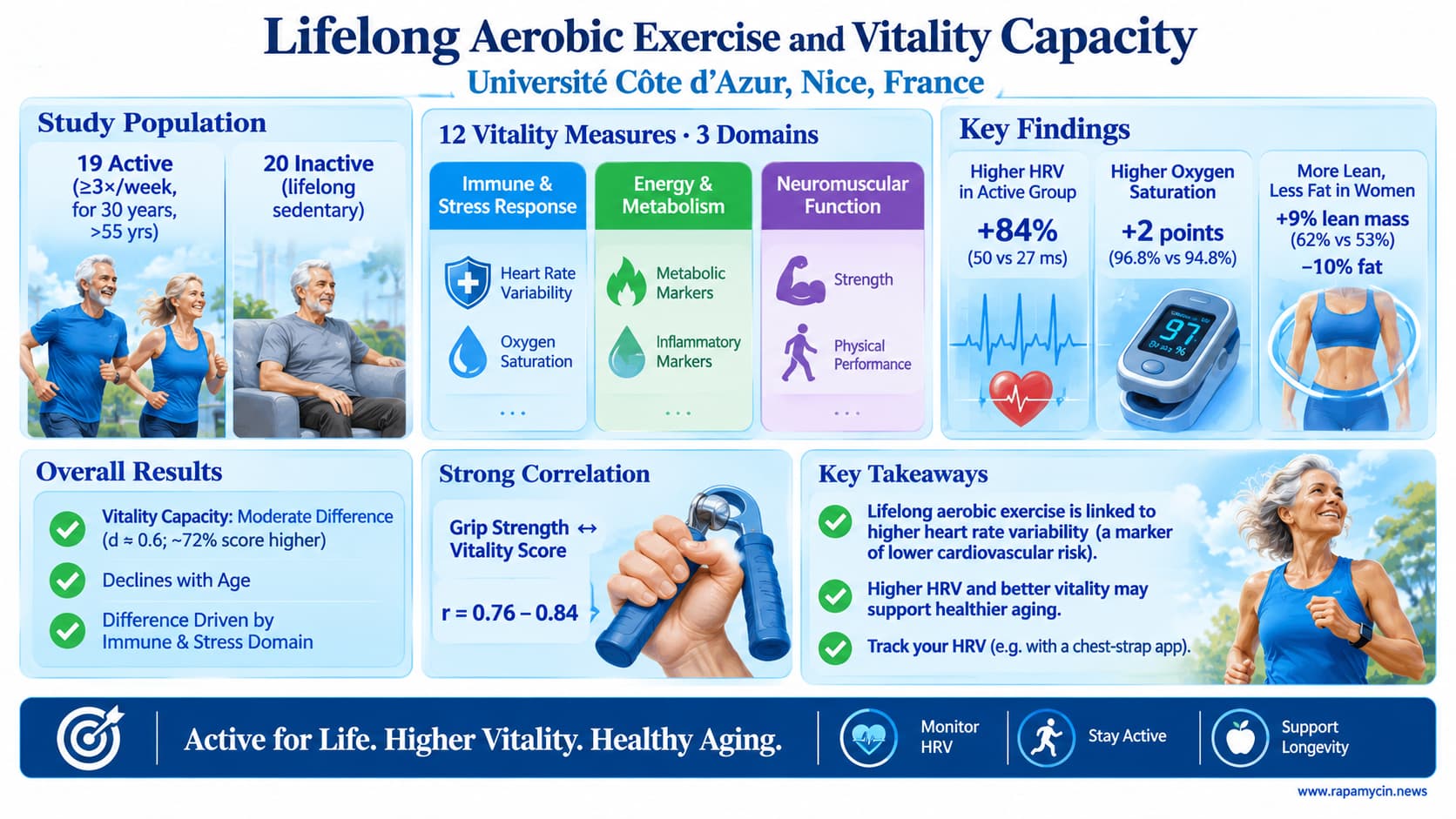
Researchers at Université Côte d’Azur in Nice, France, compared 19 healthy adults over 55 who had done structured aerobic exercise at least three times a week for 30 years with 20 healthy, lifelong inactive peers. They built a “vitality capacity” score from 12 measures proposed by a World Health Organization working group, grouped into three domains: immune and stress response, energy and metabolism, and neuromuscular function. The lifelong active group scored modestly higher overall, and vitality capacity declined with age. The difference came almost entirely from the immune and stress domain, and within it from two measures: heart rate variability, which was about 84 percent higher in the active group, and resting blood oxygen saturation, which was 2 points higher. Strength, inflammatory markers and quality of life did not differ.
The World Health Organization’s model of healthy aging rests on intrinsic capacity, the physical and mental resources a person can draw on. Underneath that sits a deeper concept called vitality capacity: the body’s physiological reserve, reflected in how well its immune, metabolic and neuromuscular systems hold up. A WHO working group proposed 12 measures to capture it, but no one had yet built a score using all three domains together. This French study tries to do that and asks whether lifelong exercise shows up in it.
The researchers recruited two unusual groups from the Nice area. The active group had done structured aerobic exercise at least three times a week for 30 years, with no break longer than a year. The inactive group reported mostly sedentary lives and no regular sport for the same period. Everyone was healthy, took no regular medication, did not smoke, and was over 55, with an average age of about 64.
Each person completed blood tests, body scans, strength tests, lung function tests, questionnaires and a week of wrist accelerometer monitoring. The team converted each measure into a standardized score, averaged them within each domain, and then averaged the three domains into one vitality capacity score.
The lifelong active group scored higher, by about 0.2 standard deviation units. Older participants in both groups scored lower, and age explained a substantial share of the variation between people. The interesting part is where the difference came from. The neuromuscular domain, built from grip strength, knee strength and lung function, explained most of the spread between individuals but did not differ between groups. The energy and metabolism domain did not differ either, apart from active women carrying markedly more lean mass and less fat than inactive women.
The gap lay almost entirely in the immune and stress domain, and two measures drove it. Heart rate variability, a marker of the nervous system’s control over heart rhythm, was nearly double in the active group. Resting oxygen saturation was about 97 percent versus 95 percent. The inflammatory markers IL-6 and TNF-alpha, along with self-rated immune health, did not differ.
That pattern matters for interpretation. Higher heart rate variability is a classic consequence of endurance training, so the score may largely be picking up cardiovascular fitness rather than immune resilience. The study did not measure aerobic fitness directly, which would have helped clarify this.
Other caveats apply. With 39 people, the study can detect only large effects. People who exercise for 30 years differ from inactive people in genetics, income, diet and health behaviors, and a cross-sectional study cannot separate those from the effect of exercise. The inactive volunteers were unusually healthy for sedentary people, which may have narrowed the differences.
This study signals fit decades of research linking aerobic activity to healthier aging, particularly in the heart and autonomic nervous system.
Actionable Insights
- Lifelong aerobic exercise went with markedly higher heart rate variability (RMSSD of about 50 vs 27 ms, roughly 84% higher). The effect size was large (Cohen’s d of about 1.0), meaning the typical active participant exceeded about 84% of inactive participants. In population studies, low heart rate variability predicts higher cardiovascular risk, so this is a meaningful marker to track, for example with a chest-strap HRV app.
- Resting oxygen saturation was 2 points higher (96.8% vs 94.8%). The effect size was large statistically, but 2 points is close to the accuracy limit of finger pulse oximeters.
- Lifelong active women had about 9 points more lean mass (62% vs 53% of body mass) and 10 points less fat (d of about 1.45, a very large difference).
- The overall vitality score difference was moderate: unadjusted d of about 0.6, meaning the typical active participant scored above roughly 72% of inactive ones.
- Grip strength correlated strongly with the overall score (r of 0.76 to 0.84). It is a simple, cheap marker worth tracking yourself.
- Activity was not linked to differences in inflammatory markers, strength relative to lean mass, or quality of life in this healthy sample.
Context and Source
- Paywalled Paper: Vitality capacity association with lifelong aerobic physical activity in older adults
- Institutions: Université Côte d’Azur (LAMHESS; CNRS, INSERM, IBV); CHU Nice
- Country: France
- Journal: GeroScience (Springer), published online 16 September 2026
- Impact evaluation: GeroScience has a 2025 impact factor of 5.4 and is ranked Q1. The impact score of this journal is 5.4, evaluated against a typical high-end range of 0 to 60+ for top general science, therefore this is a Medium impact journal.