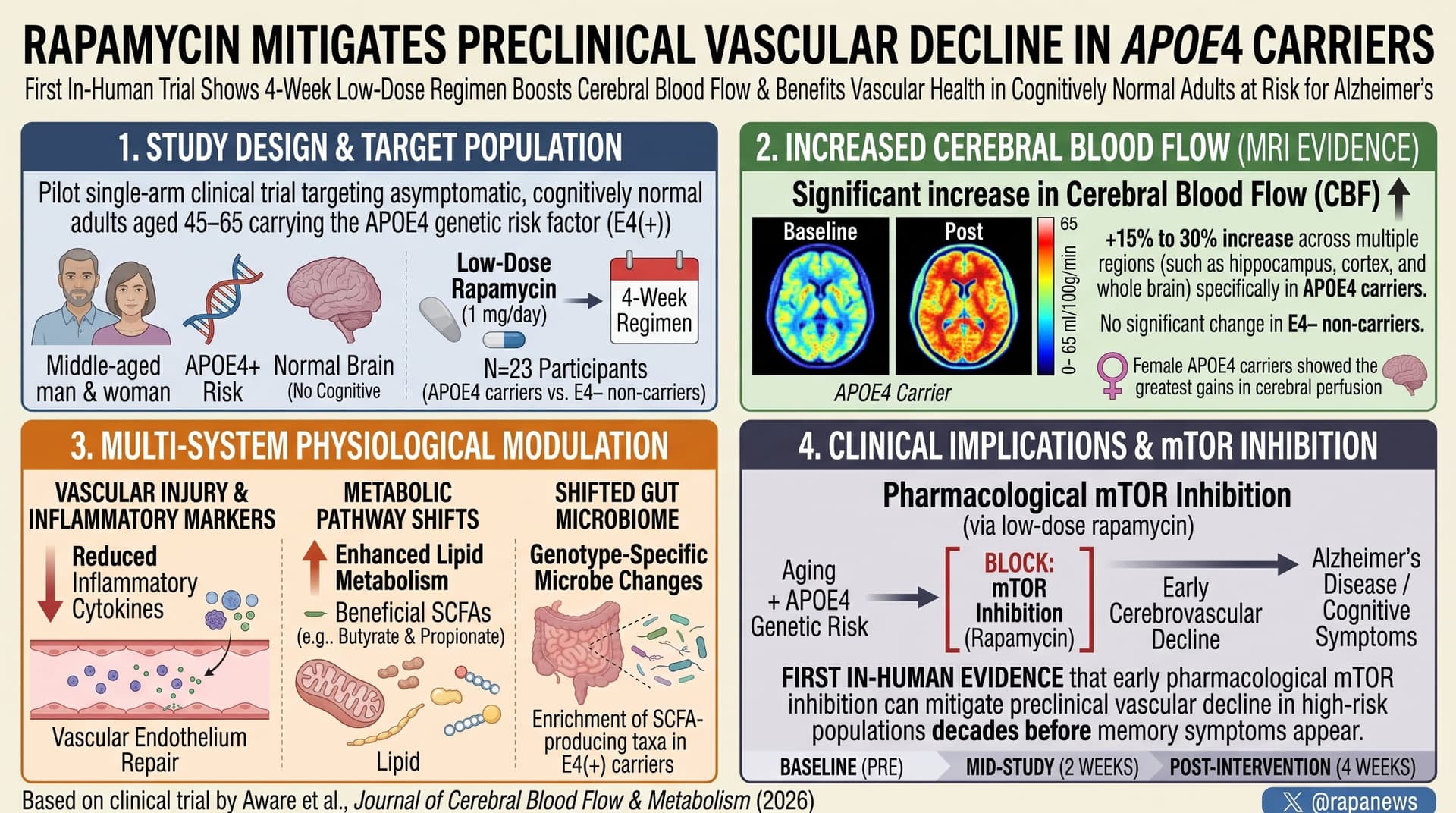
A clinical trial demonstrates that a four-week regimen of low-dose rapamycin significantly increases cerebral blood flow in middle-aged, cognitively normal individuals carrying the APOE4 genetic risk factor for Alzheimer’s disease. The intervention also modulated systemic metabolic pathways, decreased markers of vascular injury, and shifted gut microbiome compositions in a genotype-specific manner. These findings provide the first in-human evidence that early pharmacological inhibition of mTOR can mitigate preclinical vascular decline in high-risk populations before the onset of cognitive symptoms.
The APOE4 allele remains the most potent genetic risk factor for late-onset Alzheimer’s disease, but its damage begins decades before memory fails. Carriers of this gene experience a breakdown in cerebral blood flow and neurovascular coupling as early as their forties. This vascular decay acts as a preliminary catalyst for the subsequent accumulation of amyloid and tau proteins, starving the brain of nutrients and triggering neuroinflammation. A critical objective in longevity medicine is identifying interventions capable of halting or reversing this early vascular aging before structural neurodegeneration occurs.
Researchers published the results of a pilot single-arm clinical trial testing whether rapamycin can rescue these early physiological deficits in humans. Rapamycin is an FDA-approved compound extensively documented to extend lifespan in diverse animal models by inhibiting the mTOR pathway. Prior preclinical studies from the same research group demonstrated that rapamycin restored cerebral blood flow and glucose uptake in asymptomatic young APOE4 mice, an effect mediated by the activation of endothelial nitric oxide synthase. The researchers recruited twenty-three healthy adults between the ages of 45 and 65, comprising nine APOE4 carriers and fourteen non-carriers. Participants took 1 milligram of rapamycin daily for four weeks.
The primary metric of success was cerebral blood flow, measured via high-resolution pseudo-continuous arterial spin labeling MRI. The data showed a distinct divergence based on genetics. In APOE4 carriers, rapamycin triggered widespread and significant increases in blood flow across the frontal, parietal, and cortical brain regions. Non-carriers did not experience this universal increase, suggesting their vascular systems were not under the same early, mTOR-driven suppression. Furthermore, Alzheimer’s biomarkers like serum amyloid A and phosphorylated Tau-217 remained stable and within healthy ranges throughout the intervention, supporting the vascular cascade hypothesis that blood flow deficits precede visible plaque accumulation.
Beyond the brain, the drug initiated complex systemic alterations. APOE4 carriers experienced an enrichment of beneficial gut bacteria, specifically Bacteroides and Butyricicoccus species, which are known for their short-chain fatty acid synthesis. This occurred alongside a reduction in inflammatory markers like monocyte chemoattractant protein-1 and Tie-2. Interestingly, both genetic groups showed a significant drop in red blood cell distribution width, an emerging biomarker for biological aging and oxidative stress.
This study offers clinical validation for a concept previously confined to animal studies. It shows that vascular deficits associated with the APOE4 genotype are not necessarily permanent structural damage, but physiological states that can be pharmacologically addressed. While this short-term pilot cannot prove the prevention of dementia, it validates the use of low-dose rapamycin as a safe tool to modulate aging physiology in humans, moving the field closer to precision medicine interventions for neurodegeneration.
Actionable Insights
For individuals proactively managing their health, especially those carrying the APOE4 allele, this trial provides actionable intelligence regarding mTOR inhibition. A low dosage of 1 milligram of rapamycin daily is well-tolerated and yields measurable vascular improvements in just four weeks.
The magnitude of the physiological benefit is practical. Regional cerebral blood flow increased by greater than 15 percent in APOE4 carriers, translating to an absolute mean increase of 4.68 milliliters per 100 grams of tissue per minute. The researchers quantified this effect size as a Cohen’s d ranging from 0.30 to 0.55, representing a moderate, reliable physiological shift.
Additionally, while the daily 1mg dosing protocol used in this study is quite different from what is typically used in the longevity field, biohackers should note the reduction in red blood cell distribution width in both treatment groups. This provides a cheap, widely accessible hematology marker to track the systemic efficacy of longevity interventions. Finally, because rapamycin caused distinct shifts in metabolic processing, including transient increases in Interleukin-6 alongside decreases in other inflammatory chemokines, users should closely monitor their individual inflammatory markers and lipid profiles to ensure net-positive adaptations when utilizing mTOR inhibitors.
Context/Source
- Paywalled Paper: Rapamycin increases cerebral blood flow and modulates metabolic, inflammatory, and microbiome profiles in healthy middle-aged APOE4 carriers: a pilot single-arm trial.
- Institution: University of Missouri.
- Country: USA.
- Journal Name: Journal of Cerebral Blood Flow & Metabolism.
- Impact Evaluation: The impact score of this journal is approximately 5.4, evaluated against a typical high-end range of 0 to 60+ for top general science, therefore this is a Medium impact journal.
Related Reading:
- The Brain's Broken Plumbing: Why Diminishing Blood Flow Drives Dementia
- Not Just Plumbing: Your Smallest Blood Vessels May Set the Pace of Aging in Every Organ
- The Arginine Paradox Solved: Why Citrulline is the Superior Vascular Anti-Aging Agent
- Fountain of Youth in the Veins: How Young Blood Restores Brain Blood Flow via IGF-1