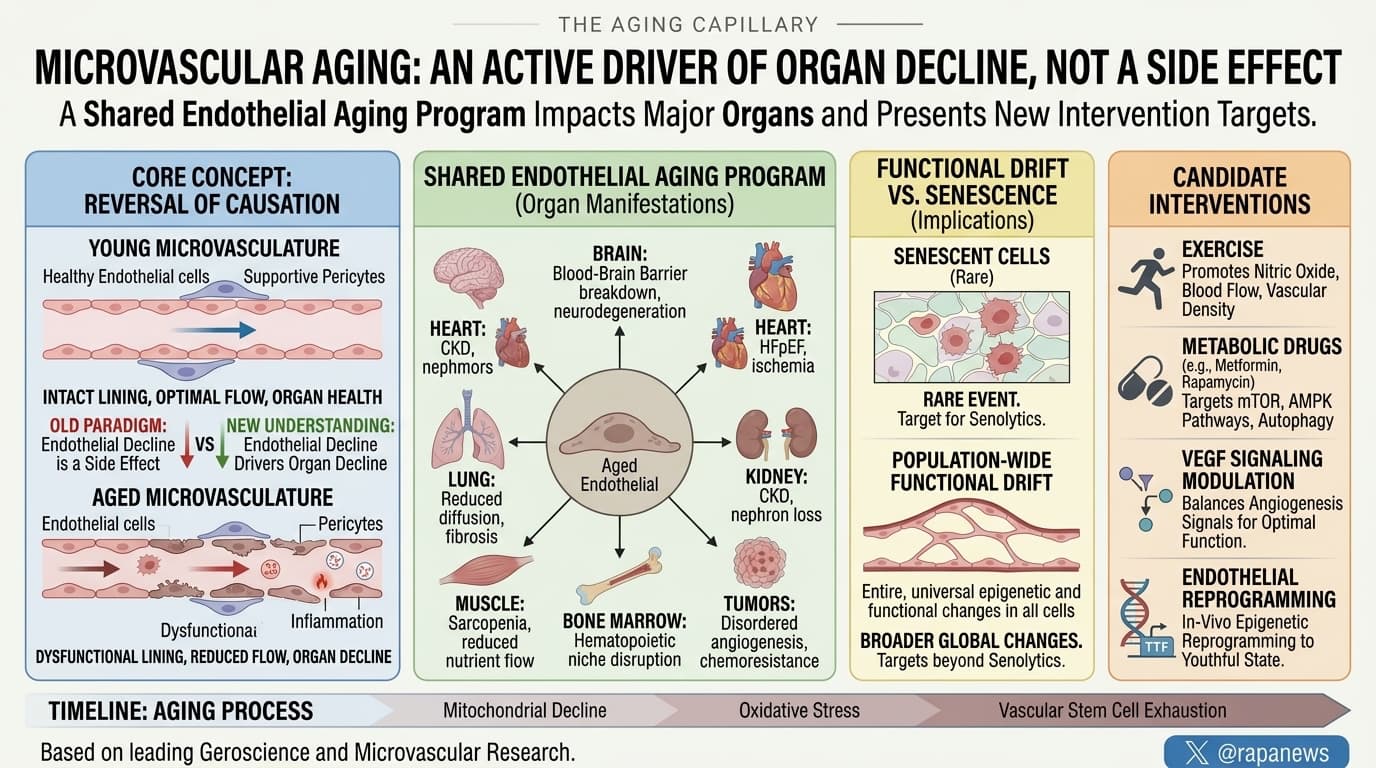
This narrative review argues that aging of the microvasculature (capillaries, their endothelial lining and supporting pericytes) is an active driver of organ decline, not a side effect of it. It describes a shared endothelial aging program that plays out differently in the brain, heart, kidney, lung, muscle, bone marrow and tumors. It separates rare senescent cells from a broader, population-wide drift in endothelial function, which has direct consequences for senolytic strategies. It then surveys candidate interventions, from exercise and metabolic drugs to VEGF signaling and endothelial reprogramming.
For more than three centuries, doctors have quoted Thomas Sydenham’s remark that a man is as old as his arteries. Two of Germany’s most prominent vascular biologists now argue that the saying points at the wrong vessels. In a review in Nature Cardiovascular Research, Stefanie Dimmeler and Hellmut Augustin make the case that the body’s smallest vessels, and the endothelial cells that line them, help set the pace of aging in every organ.
The central idea is that blood vessels are not plumbing. Endothelial cells send chemical instructions, called angiocrine signals, to the tissue around them. When those cells age, the instructions change. The review describes a shared aging program found in vessels throughout the body: less nitric oxide, more oxidative stress, DNA damage, a thinner sugar coating on the vessel lining, and stiffer surrounding tissue. The outcome depends on the organ. In the brain it appears as a leaky blood-brain barrier, in the heart as stiffening and heart failure with preserved ejection fraction, in the kidney as protein leaking into urine, and in muscle and bone as frailty and osteoporosis.
The most useful correction concerns senescent cells, the “zombie” cells that senolytic drugs are meant to remove. Single-cell studies show that truly senescent endothelial cells remain a small minority even in very old mice. Most of the endothelium instead drifts gradually into a less capable, mildly inflamed state. Killing a rare cell population cannot fix a problem that affects nearly every cell. It may also backfire: removing senescent endothelial cells worsened liver injury and pulmonary hypertension in mouse experiments.
Timing is another theme. Human protein data suggest blood vessels are among the first tissues to show aging, with an inflection near age 50. The authors argue that treatments helpful in midlife may be useless or harmful later. Statins illustrate the point. They partly mimic the vascular effects of exercise, yet their benefit shrinks in people over 75 without existing vascular disease, possibly because aged endothelial cells respond less to the drug’s signals.
On treatments, the review is candid about how little is proven. Exercise remains the best-supported way to improve endothelial function. Metformin, SGLT2 inhibitors and GLP-1 receptor agonists improve vascular measures, but nobody has shown whether they act on the vessel wall directly or simply improve whole-body metabolism. More exotic ideas, including boosting VEGF signaling, a mitochondrial drug called SUL-238 and reprogramming of endothelial cells, rest almost entirely on mouse work.
The authors end with a question they cannot answer: does rejuvenating vessels reverse organ aging, or only slow further decline? Readers should keep the paper’s nature in mind. It is a narrative review. Its value lies in the framework, and that framework is still a hypothesis.
Actionable Insights
The review contains no new trial data, so the numbers below come from the studies it cites.
- Exercise is the only intervention the authors call established for vascular aging. The review gives no effect size for it.
- Statins lower major vascular events by about 21 percent for each 1 mmol/L (39 mg/dL) drop in LDL cholesterol. If 20 of 100 people like you would have an event over ten years, that means about 16 instead, or 4 fewer. Over age 75 the reduction falls to about 13 percent, and in people over 75 without vascular disease it was not statistically distinguishable from zero.
- SGLT2 inhibitors cut worsening heart failure or cardiovascular death from about 21 to 16 per 100 patients over 18 months in one landmark trial. That is 5 fewer per 100, in people who already had heart failure.
- Senolytics are not ready. Fisetin did not extend lifespan in the most rigorous mouse testing program, and senescent cell removal caused harm in some models.
- Vascular aging appears to accelerate around age 50, so blood pressure, lipids, urine albumin and fitness deserve attention in midlife rather than later.
Context/Source
- Paywalled Paper: Vascular aging as a driver of organ dysfunction and systemic aging, Published 23 September 2026
- Institutions: Institute of Cardiovascular Regeneration, Goethe University Frankfurt; German Center for Cardiovascular Research (DZHK); Cardio-Pulmonary Institute, Frankfurt; European Center for Angioscience, Heidelberg University, Mannheim; German Cancer Research Center, Heidelberg
- Country: Germany
- Journal: Nature Cardiovascular Research
- Impact evaluation: The impact score of this journal is 12.6 (2025 Journal Impact Factor; 5-year 13.5), evaluated against a typical high-end range of 0 to 40 for top cardiovascular journals (0 to 60+ for top general science), therefore this is a High impact journal.
Related Reading:
- The Vascular Pacemaker: How the Secretory Engine of Aging Arteries Synchronizes Whole-Body Decay
- The Arginine Paradox Solved: Why Citrulline is the Superior Vascular Anti-Aging Agent
- Dietary Data Mining Links Traditional Mediterranean Staples to Reduced Vascular Aging in Chinese Adults
- Age-related vascular degeneration in skin and how to avoid it (DIY tadalafil cream may help)
- Wild Blueberries: The "Elicited" Super-Polyphenol for Vascular Aging?
- Early Adulthood Cardio Fitness Predicts Vascular Aging Decades Later Better Than Cholesterol Subfractions
- Effects of Nutritional Supplements on Vascular Function: A Narrative Review (paper 20 July 2026)
- How the Collapse of Nitric Oxide Signaling Accelerates Aging