Biomarker Data (Effect Size Calculation)
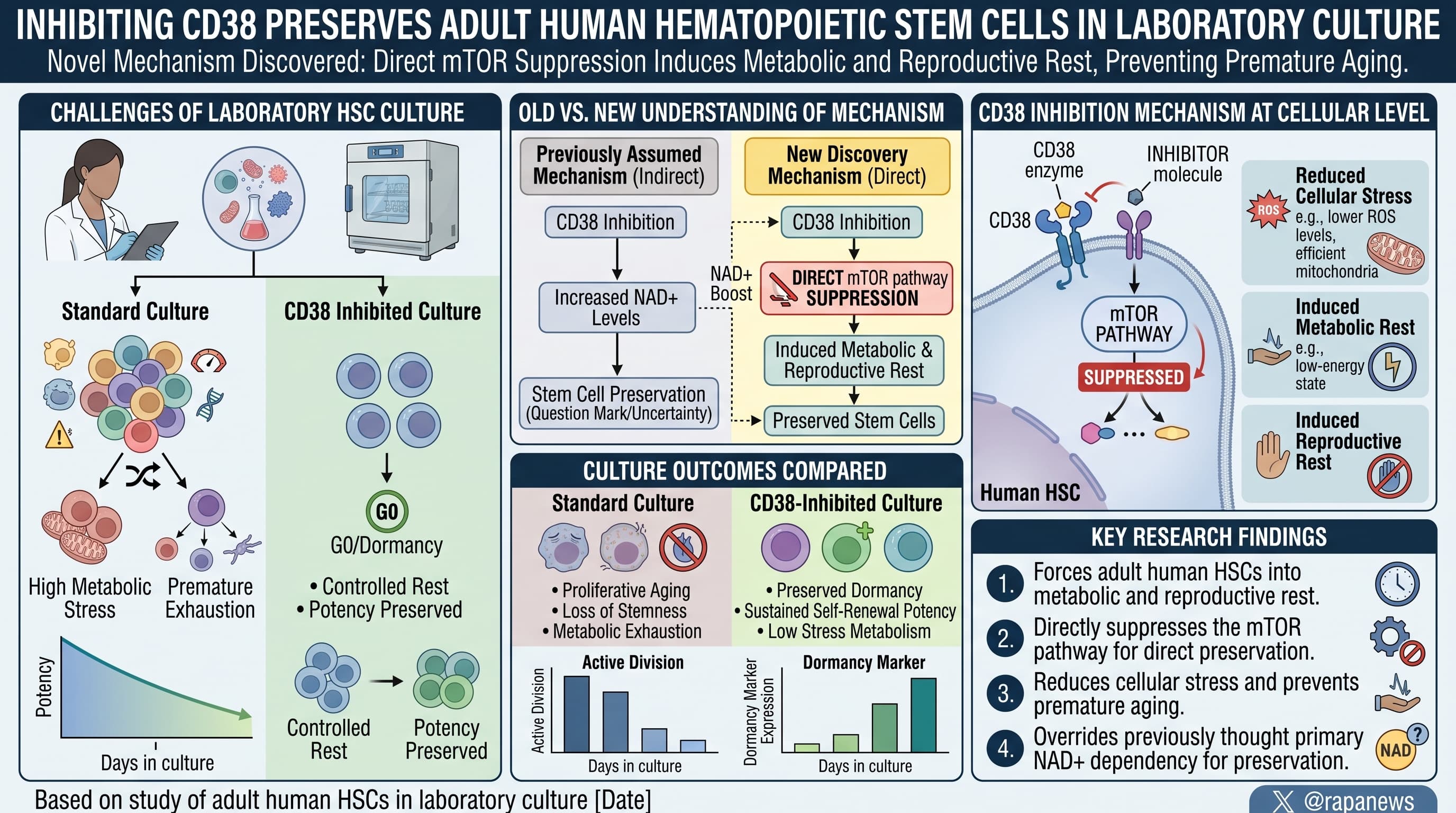
The biomarker improvements center on physiological stem cell preservation metrics. After a 7 day ex vivo culture, the absolute numbers of primitive human stem cells transplanted into primary bone marrow increased by a factor of 15.8 (a 1480 percent improvement) when treated with the CD38 inhibitor compared to the vehicle control.
In the rigorous secondary transplantation assay, which measures true long term stem cell function, the relative risk of failing to engraft was drastically reduced. The estimated frequency of long term stem cells increased by 8.6 fold (an 860 percent improvement). When accounting for total bone marrow cellularity, the absolute number of functional long term stem cells yielded a 37 fold increase (a 3600 percent absolute magnitude improvement) over standard culture conditions. These standardized effect sizes indicate a transformational, rather than incremental, preservation of biological function.
Mechanistic Deep Dive
The paper connects CD38 biology directly to the mTOR and PI3K longevity pathways. By inhibiting CD38, the compound 78c sharply reduced mTOR phosphorylation at the Ser2448 site. This molecular blockade prevented the stem cells from crossing the G1 to S phase checkpoint of the cell cycle.
Additionally, the treatment initiated widespread proteomic remodeling. It suppressed ribosomal protein translation, which significantly reduced the endoplasmic reticulum proteostatic load. Simultaneously, it triggered the assembly of heterochromatin, effectively locking the genome into a highly compacted, stress resistant epigenetic state. The organ specific aging priority here is the hematopoietic and immune system, specifically guarding against clonal hematopoiesis and bone marrow exhaustion [Confidence: High].
Novelty
Previously, the primary utility of CD38 inhibition was thought to be the restoration of intracellular NAD levels to prevent age related metabolic decline. This paper fundamentally uncouples CD38 from its exclusive NADase identity in stem cells. It proves that NAD augmentation alone using nicotinamide or nicotinamide riboside fails to preserve stemness. Instead, CD38 acts as an upstream accelerator of the PI3K-AKT-mTOR pathway, and its inhibition preserves cells through metabolic frugality and cell cycle arrest rather than energy abundance [Confidence: High].
Follow-on Prompt:
how exactly did they inhibit the CD38 enzyme?
Claude Opus 5.5 Response:
The researchers inhibited the CD38 enzyme pharmacologically by treating the cultured hematopoietic stem cells with a specific small molecule inhibitor designated as 78c.
The inhibition was achieved by adding the 78c compound directly to the ex vivo culture medium (evaluated against a DMSO vehicle control) during the cell incubation period. By exposing the cells to this chemical agent, the researchers successfully blocked CD38 activity, which subsequently suppressed the downstream PI3K-AKT-mTOR signaling axis.
Methodological Context and Knowledge Gaps: The research team relied exclusively on this pharmacological blockade—supported by supplementary data using flavonoids—to induce the dormant state. They did not utilize genetic ablation techniques, such as CRISPR-Cas9 knockouts or RNA interference (RNAi), to permanently delete or silence the CD38 gene.
Relying solely on a small molecule inhibitor introduces a distinct knowledge gap regarding target specificity. While 78c is recognized as a CD38 inhibitor, fully ruling out off-target intracellular effects requires corroborating data from genetic knockout models to confirm that the observed mTOR suppression and stem cell preservation are exclusively mediated by CD38 inhibition.
Follow-on Prompt:
Are there any commercially available CD38 inhibitors that have some good research supporting them? What is the estimated effect-size in each case?
Claude Opus 5.5 Response:
Commercially available CD38 inhibitors exist, but their “availability” spans three completely different regulatory classifications: over-the-counter nutraceuticals, prescription oncological biologics, and unregulated research chemicals.
The supporting research and calculated effect sizes vary drastically across these domains. A massive divide remains between animal efficacy and quantified human clinical data.
1. Nutraceuticals (Dietary Supplements)
-
Compounds: Apigenin and Quercetin.
-
Commercial Status: Widely available over-the-counter as dietary supplements.
-
Estimated Effect Size (Animal Data): In preclinical murine models, mice lacking the CD38 enzyme or treated with the CD38 inhibitor apigenin exhibit approximately 50 percent higher intracellular NAD+ levels compared to controls. Quercetin functions similarly, with data showing it can raise NAD+ levels in the muscle and liver of mice.
-
Estimated Effect Size (Human Data): Zero quantified clinical effect size. There are currently no rigorous, placebo-controlled human clinical trials confirming that standard oral supplementation of apigenin or quercetin achieves the systemic tissue concentrations required to meaningfully inhibit CD38 in vivo. Claims regarding their efficacy rely entirely on extrapolating in vitro and murine data to humans [Confidence: High].
2. Pharmaceutical Biologics (Monoclonal Antibodies)
-
Compounds: Daratumumab (Darzalex).
-
Commercial Status: FDA-approved prescription medication.
-
Estimated Effect Size (Clinical Data): In the CASTOR and POLLUX pooled clinical trials for multiple myeloma, daratumumab yielded a Hazard Ratio (HR) of 0.35. This absolute effect size translates to a 65 percent reduction in the risk of disease progression or death.
-
Critical Limitations: This drug is not a metabolic inhibitor designed to preserve cellular energy or promote longevity. It is an antibody that binds to CD38 and triggers the immune system to lyse (destroy) the target cell entirely. Because healthy immune cells also express CD38, this therapeutic induces profound immunosuppression, including high-grade neutropenia and lymphopenia. It has zero practical utility for longevity biohacking [Confidence: High].
3. Small Molecule Biochemicals (Research Only)
-
Compounds: 78c (CD38-IN-78c).
-
Commercial Status: Available strictly from biochemical suppliers as a research compound. It is illegal to market or sell for human consumption.
-
Estimated Effect Size (Animal Data): Long-term administration of the highly specific CD38 inhibitor 78c to naturally aged mice increased their median survival lifespan by approximately 10 percent. Furthermore, researchers noted that the treatment improved late-life physical performance and preserved metabolic health.
-
Estimated Effect Size (Human Data): Not applicable. There is no human safety, pharmacokinetic, or long-term efficacy data available for 78c or similar synthetic small-molecule CD38 inhibitors. Ingesting unregulated research chemicals carries immense toxicity risks due to this lack of human profiling [Confidence: High].
Summary of Translational Reality
The CD38 inhibitor landscape currently lacks a safe, clinically validated compound for human longevity. The agents with massive, proven clinical effect sizes (like daratumumab) are toxic cell-destroyers. The safe, over-the-counter options (like apigenin) lack quantified human efficacy data. The most promising metabolic longevity inhibitors (like 78c) remain strictly confined to animal research models. Clinicians and researchers require randomized human trials measuring intracellular NAD+ changes and target engagement before confirming a definitive effect size for any over-the-counter CD38 inhibitor.
Follow-on Prompt:
Could Rapamycin be considered a CD-38 inhibitor? See this data: Rapamycin Prevents Blood Stem Cell Aging, New MIT Study
The biological mechanisms of rapamycin and CD38 inhibitors operate on different targets within the same cellular signaling pathway. Rapamycin binds directly to the intracellular mechanistic Target of Rapamycin (mTOR) complex, whereas CD38 is a cell surface enzyme that acts upstream of mTOR. Because they intervene at distinct molecular locations, rapamycin cannot be classified as a CD38 inhibitor.
Mechanistic Convergence
The MIT research data highlighting that rapamycin prevents blood stem cell aging by inhibiting cellular enlargement aligns with the outcomes of CD38 blockade. Both interventions achieve stem cell preservation through the suppression of the mTOR pathway, but they do so via different biochemical routes.
-
CD38 Inhibitors (e.g., 78c): Act as upstream modulators. Blocking the CD38 enzyme downregulates the PI3K-AKT-mTOR signaling axis, which subsequently enforces metabolic rest and cell cycle arrest.
-
Rapamycin: Acts as a downstream, direct inhibitor. It physically restricts the mTORC1 complex, bypassing upstream receptors entirely to prevent stem cell hypertrophy and exhaustion. Laboratory studies demonstrate that rapamycin replicates the stem cell maintenance effects of 78c precisely because both agents ultimately suppress mTOR.
Functional Divergence
Conflating rapamycin with a CD38 inhibitor overlooks a critical divergence in their secondary physiological effects. CD38 is a primary consumer of NAD molecules in mammalian tissues. Inhibiting CD38 not only suppresses mTOR but simultaneously preserves intracellular NAD pools. Rapamycin exerts no direct inhibitory action on the NADase activity of the CD38 enzyme.
While rapamycin successfully mirrors the stem cell preservation benefits of CD38 blockade by halting cellular growth signals, it will not address the age related decline in NAD driven by CD38 overexpression. Clinicians and biohackers must view these as two distinct pharmacological tools that share overlapping downstream benefits but require separate application protocols depending on whether NAD preservation is a concurrent goal.
References