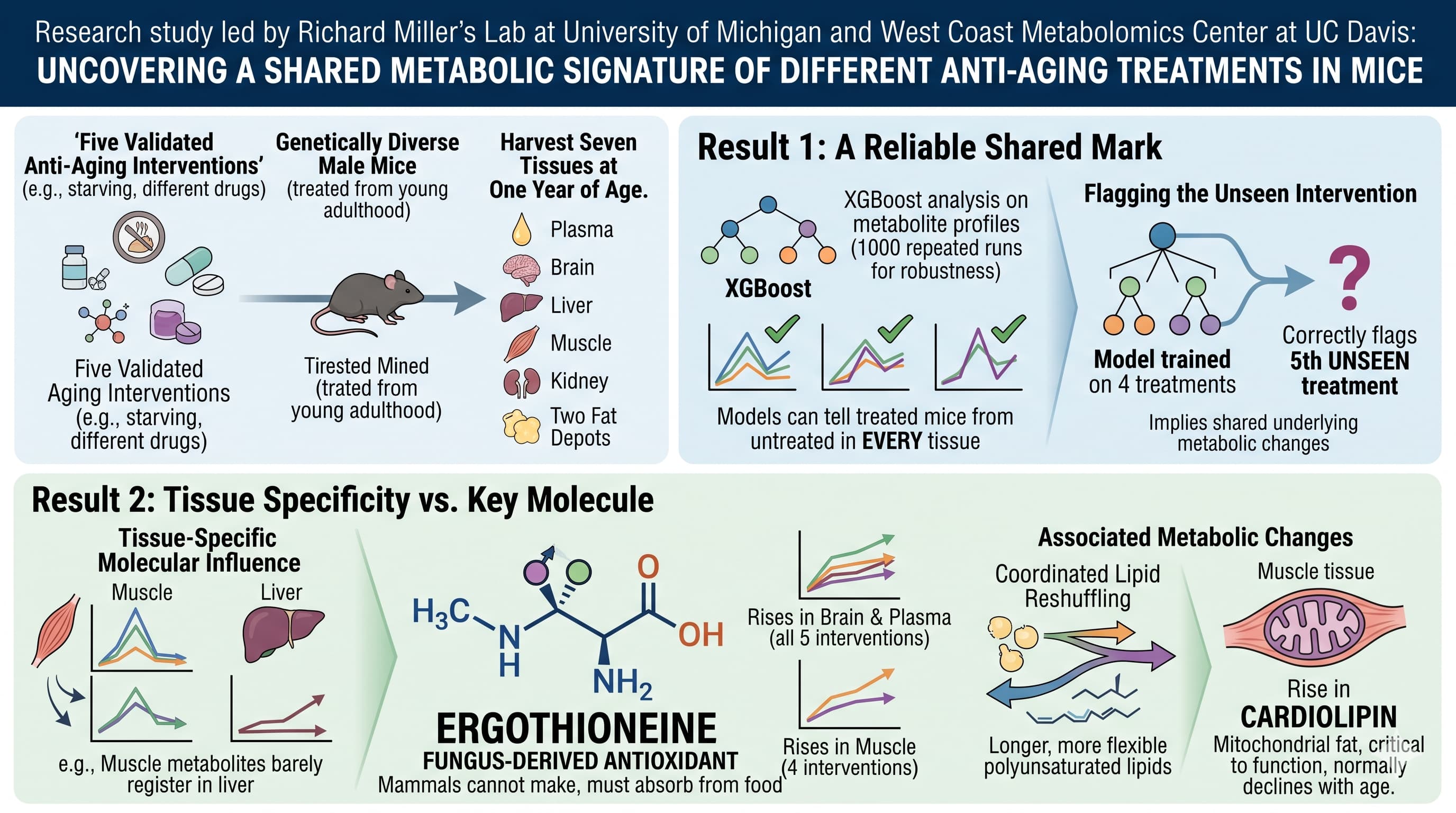
Five mechanistically distinct longevity interventions — rapamycin, acarbose, 17α-estradiol, canagliflozin, and caloric restriction — produce partly overlapping metabolic signatures across seven mouse tissues, with the dietary antioxidant ergothioneine rising consistently in brain, plasma, and muscle. A machine-learning model can spot “treated” mice from any of the five interventions even when trained only on the other four.
Researchers have long known how to slow aging in mice — calorically restrict them, or give them one of a handful of drugs — but why these very different treatments all work has stayed murky. A team led by Richard Miller’s lab at the University of Michigan, working with the West Coast Metabolomics Center at UC Davis, asked a deceptively simple question: do these interventions, despite hitting different molecular targets, leave a shared chemical mark on the body?
To find out, they treated genetically diverse male mice with one of five validated interventions from young adulthood, then harvested seven tissues — plasma, brain, liver, muscle, kidney, and two fat depots — at one year of age, well before the animals would start dying. They fed the resulting metabolite profiles into XGBoost, a tree-based machine-learning system, and added a useful trick: running each model a thousand times to stop the rankings jumping around with random chance, a recurring headache in this kind of high-dimensional analysis.
Two things stood out. First, the models could reliably tell treated mice from untreated controls in every single tissue. More striking, a model trained on any four interventions could correctly flag mice given the fifth, unseen intervention — implying these distinct treatments share underlying metabolic changes rather than each carving its own separate path.
Second, when the team asked which individual molecules carried the most weight, the answer was mostly tissue-specific. The metabolites that mattered in muscle barely registered in liver, and so on. Only one molecule punched through across multiple tissues: ergothioneine, a fungus-derived antioxidant that mammals cannot make and must absorb from food. It rose in brain and plasma under all five interventions, and in muscle under four. Alongside it, the team saw coordinated reshuffling of fats — a shift toward longer, more flexible polyunsaturated lipids, and in muscle a rise in cardiolipin, a fat critical to mitochondrial function that normally declines with age.
The authors are careful: they don’t yet know whether ergothioneine causes any benefit or is simply a marker of altered nutrient uptake. And they haven’t yet tested whether their model can distinguish genuine longevity drugs from drugs that do nothing for lifespan — the crucial control that would prove this is an aging signature and not just a “something was given” signature. But as a proof of concept, it hints at a faster way to screen candidate anti-aging compounds: read the metabolic tea leaves at one year instead of waiting three for the animals to die.
Actionable Insights
The single translatable thread is ergothioneine — the only metabolite that rose across multiple tissues under every intervention. It is a dietary compound (richest sources: oyster, king oyster, shiitake mushrooms; lower amounts in tempeh, organ meats, some beans), so unlike the drugs studied, it is something you can actually consume. It is also available widely as a supplement.
But the effect size that matters here is not in this paper. This study shows ergothioneine rising as a correlate of treatments that extend lifespan — it does not show that taking ergothioneine extends lifespan or improves any outcome. The authors explicitly raise the possibility that elevated ergothioneine is a surrogate marker for increased gut absorption of other nutrients, not a causal agent.
Practical take-home: ergothioneine is low-risk and biologically plausible, but its benefit remains unproven; treat it as a reasonable dietary hedge, not a validated geroprotector.
Source:
- Open Access Paper: Multi-Tissue Metabolomic Signatures of Five Longevity Interventions Converge on Ergothioneine and Lipid Remodeling in Male UM-HET3 Mice
- Institution: University of Michigan (lead), with UC Davis West Coast Metabolomics Center, Institute for Systems Biology / Phenome Health / Buck Institute, and University of Illinois Urbana-Champaign.
- Country: United States.
- Journal: None — this is a bioRxiv preprint (posted June 25, 2026)
Related Reading:
- The Mushroom Molecule That May Rewrite Aging: Ergothioneine Emerges as a Multi-Target Geroprotector
- Why Your Antacids and Smoking Habit are Aging Your Brain, and Why Ergothioneine Might Save it
- Ergothioneine found to increase lifespan in mice by 21%
- Mushrooms on My Mind, Ergothioneine , Erinacines, Hericenones, etc