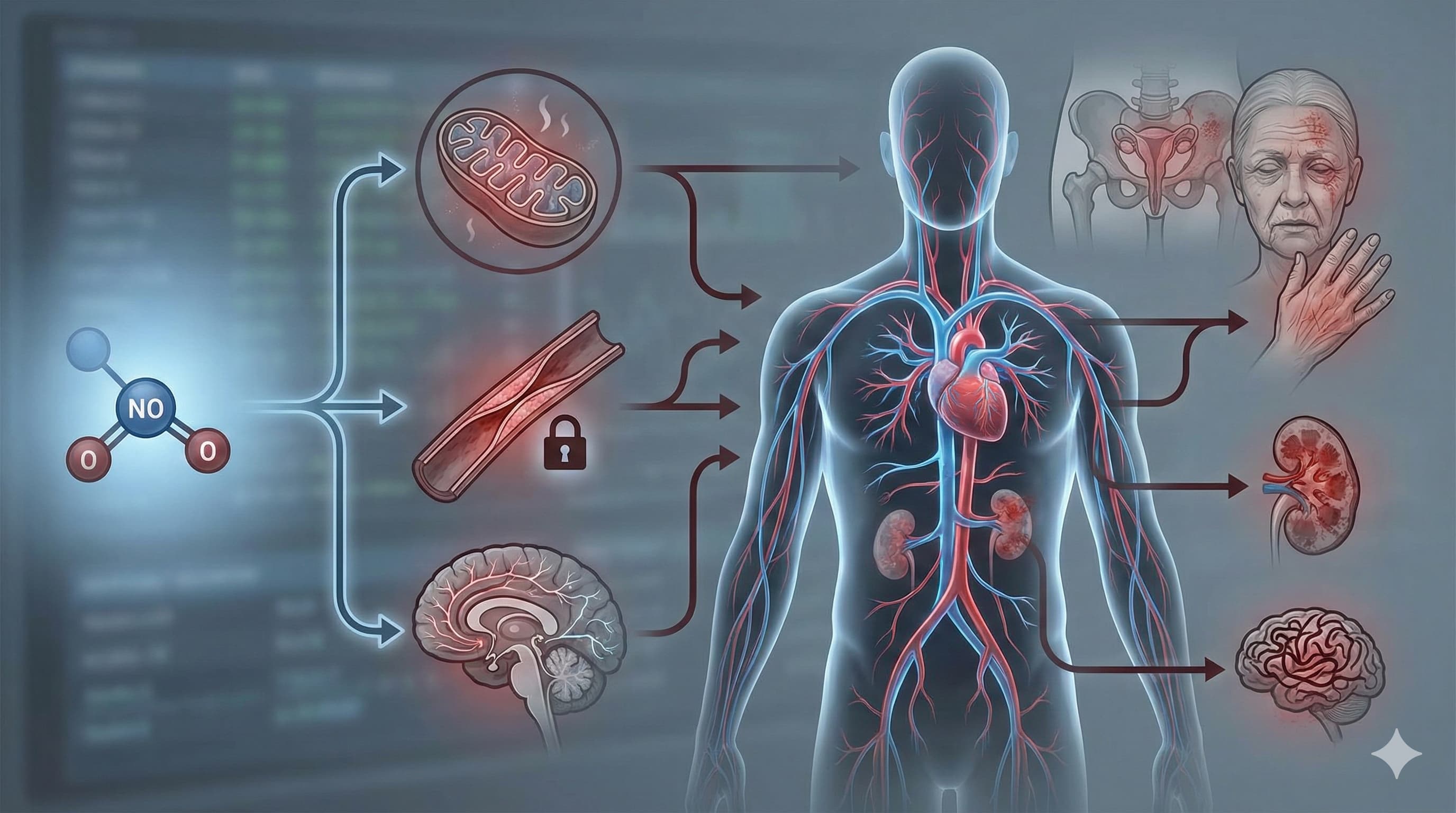
How the Collapse of Nitric Oxide Signaling Accelerates Aging

Nitric Oxide (NO) is frequently misunderstood as merely a vasodilator or a performance-enhancing supplement. However, this review establishes NO as a foundational “molecular currency” of aging that undergoes a catastrophic devaluation as we get older. The central thesis is that aging is not just a passive decline in NO levels, but an active dysregulation where the machinery meant to produce NO—specifically endothelial Nitric Oxide Synthase (eNOS)—breaks down (“uncouples”) and begins manufacturing damaging free radicals instead.

This physiological switch creates a vicious cycle: as NO bioavailability drops, mitochondrial function falters, vascular stiffness increases, and cognitive decline accelerates. The review painstakingly maps this failure across multiple organ systems, linking the loss of NO signaling to erectile dysfunction, skin aging, renal failure, and neurodegeneration. Crucially, the paper argues that restoring the “coupling” of NO synthase—rather than just blasting the system with arginine—is the key therapeutic target. It highlights a convergence of synthetic drugs (like PDE5 inhibitors) and natural compounds (like resveratrol and icariin) that can reverse this uncoupling, potentially restoring youthful signaling phenotypes.

Source:


Can Boosting Nitric Oxide Rescue Aging Arteries and Exercise Capacity?

Aging is fundamentally a vascular and mitochondrial disease, heavily mediated by the progressive loss of nitric oxide (NO) bioavailability. NO is a ubiquitous gaseous signaling molecule essential for regulating skeletal muscle blood flow, mitochondrial ATP production, and overall endothelial health. While sedentary aging decimates endogenous NO production—leading to a steady 1% annual decline in VO2max after age 30 and severely impaired functional sympatholysis—lifelong aerobic exercise appears to preserve it. Older “Masters athletes” maintain NO levels comparable to healthy young adults, effectively insulating themselves against primary vascular aging and delaying physiological decline.

The central question is whether exogenous supplementation can reverse age-related NO deficits in the broader population.

The clinical data reveals a sharply split verdict. Interventions targeting the canonical L-arginine/NOS pathway (L-citrulline, L-arginine) or the alternative nitrate-nitrite-NO pathway (inorganic nitrate, beetroot juice) successfully elevate surrogate systemic NO biomarkers in older adults. However, the translation of these biochemical markers into measurable endurance or exercise performance improvements is highly inconsistent. Dietary nitrate shows ergogenic promise primarily in older adults suffering from distinct clinical pathologies, such as chronic obstructive pulmonary disease (COPD) or heart failure. Conversely, performance benefits for healthy or highly trained older cohorts remain largely unproven, with several trials showing null results. Furthermore, dietary antioxidants and (poly)phenols fail to demonstrate reliable efficacy for enhancing NO or performance in this demographic. Consequently, while NO manipulation remains biologically plausible for extending healthspan, current over-the-counter protocols lack the rigorous, healthy-cohort validation required to guarantee functional outcomes in aging individuals.

Source:

Related Reading:

1 Like

Note: I’m combining the analysis of two research papers that focus on NO:

Mechanistic Deep Dive

  • Pathways: Aging impairs NO bioavailability primarily by altering endothelial NO synthase (eNOS) activity. This is driven by the oxidation of the crucial cofactor tetrahydrobiopterin (BH4) into biologically inactive BH2. This oxidation uncouples eNOS, causing it to produce tissue-damaging superoxide radicals instead of NO. Concurrently, age-upregulated arginase activity degrades systemic L-arginine, depleting the substrate required for NO generation.
  • Mitochondrial Dynamics: A reduction in NO severely compromises mitochondrial biogenesis and operational efficiency. Skeletal muscle mitochondria in aged individuals exhibit suppressed maximal ATP generation, diminished protein synthesis, and elevated reactive oxygen species (ROS) leakage.
  • Organ-Specific Priorities: The vascular endothelium and the skeletal muscle microvasculature are the primary aging priorities identified. Diminished NO signaling blunts exercise hyperemia and reduces capillary density, creating a hard bottleneck on oxygen delivery and fractional oxygen extraction.

Novelty

  • The review explicitly differentiates “sedentary aging” from “active aging” to define primary versus secondary aging effects on NO metabolism.
  • It highlights a critical, often-ignored sex discrepancy: estrogen-deficient postmenopausal women do not achieve the NO-boosting vascular adaptations from aerobic exercise seen in older men, suggesting estrogen plays a permissive role in eNOS upregulation and superoxide scavenging.

Interventions & Compounds

The review categorizes interventions that re-couple eNOS or boost NO signaling:

Synthetic Agents:

  • PDE5 Inhibitors (Sildenafil/Tadalafil): Enhance cGMP signaling. Shown to improve cognitive function (NMDA pathway) and reduce muscle fatigue, beyond just ED applications.
  • Statins: Upregulate eNOS and nNOS expression independent of lipid lowering.
  • eNOS Cofactors: Supplementation with BH4​ or Folic Acid to reverse uncoupling.

Natural Mimetics (Biohacker Interest):

  • Icariin: Acts as a PDE5 inhibitor and upregulates eNOS/nNOS expression.
  • Resveratrol: Activates the SIRT1-eNOS axis, promoting endothelial health.
  • Sulforaphane: Activates Nrf2, reducing the oxidative stress that scavenges NO.
  • L-Citrulline/Arginine: While mentioned, the review notes that Arginase upregulation in aging may divert Arginine away from NO production, making Arginase inhibitors a more potent target than simple Arginine supplementation.

5. Novelty

  • Systemic Integration: The paper successfully argues that “skin aging” (loss of thermoregulation) and “brain aging” (cognitive decline) share the exact same root cause: eNOS uncoupling. It connects the sympathetic nervous system’s control of skin blood flow directly to the NO pathway.
  • Oocyte Aging: It presents a less commonly discussed role of NO in oocyte quality, specifically how NO delays oocyte aging by stabilizing the microtubular spindle apparatus via cGMP.

6. Critical Limitations

  • Translational Uncertainty: The majority of mechanistic evidence cited is derived from rodent models (specifically Wistar and SHR rats). Human data is largely observational or limited to specific vascular flow studies.
  • Lack of Dosage Protocols: The review lists compounds (e.g., Tropisetron, Higenamine) but fails to provide human-equivalent dosages (HED) or pharmacokinetic data, rendering the information actionable only for researchers, not practitioners.
  • MDPI Quality variance: As a broad review in Molecules, the depth of critical analysis on conflicting data is shallow. It tends to list positive findings without rigorously weighing negative results or publication bias.
  • The “Arginine Paradox”: The review touches on but does not fully resolve the “Arginine Paradox”—why supplementing arginine works in vivo despite intracellular levels being well above the enzyme’s Km. It relies on the ADMA explanation but misses newer transport theories.

Claims & Verification

Claim 1: Sedentary aging reduces nitric oxide (NO) bioavailability, leading to diminished endothelium-dependent vasodilation and impaired exercise capacity. Mechanistically, this is driven by eNOS uncoupling, arginase upregulation, and the oxidation of the cofactor BH4 into BH2.

Claim 2: Regular aerobic exercise prevents the age-related decline in NO-mediated vasodilator function and preserves endothelial health in older adults.

Claim 3: L-citrulline supplementation effectively increases systemic NO biomarkers and may improve submaximal exercise blood flow in older adults, though its impact on physical performance remains mixed.

Claim 4: Dietary inorganic nitrate (e.g., beetroot juice) enhances exercise capacity in older clinical populations (e.g., COPD, heart failure) but shows equivocal or no ergogenic benefit in healthy older adults.

Claim 5: Estrogen-deficient postmenopausal women do not achieve the same vascular endothelial improvements (via NO signaling) from aerobic exercise as older men, unless treated with exogenous estrogen.

Claim 6: Resveratrol reverses endothelial dysfunction via the SIRT1-eNOS axis.

Claim 7: L-Citrulline is superior to L-Arginine for increasing systemic NO bioavailability.

Claim 8: Nitric Oxide directly delays oocyte aging and improves IVF outcomes.

The Strategic FAQ

1. Why do Master’s athletes maintain youthful NO levels—is it preserved eNOS coupling, or a mechanical upregulation of baseline expression due to sheer stress? Current evidence suggests it is a combination of both. Lifelong aerobic exercise upregulates extracellular superoxide dismutase (SOD), which neutralizes ROS before they can scavenge NO, thereby preserving eNOS coupling. Simultaneously, chronic vascular shear stress mechanically upregulates the transcriptional expression of eNOS.

2. Does the “enterosalivary bottleneck” for nitrate reduction render antibacterial mouthwash a direct antagonist to cardiovascular healthspan? Yes. Antiseptic mouthwashes directly eradicate the commensal facultative bacteria (e.g., Rothia, Neisseria) responsible for reducing nitrate to nitrite. Clinical data consistently shows that chlorhexidine mouthwash abolishes the blood-pressure-lowering effects of dietary nitrates.

3. Given that L-arginine suffers massive hepatic and intestinal first-pass metabolism, why is it still evaluated in clinical trials instead of exclusively shifting to L-citrulline? Inertia in clinical trial design and historical precedent. L-arginine was discovered as the direct NOS substrate first. While L-citrulline is objectively superior for elevating systemic arginine levels via renal conversion, L-arginine remains a cheap, widely available standard for intravenous (where first-pass metabolism is bypassed) and legacy oral formulations.

4. How do NO-boosting supplements impact the L-arginine/ADMA ratio in aging cohorts? ADMA is an endogenous NOS inhibitor that accumulates with age and metabolic dysfunction. L-citrulline supplementation effectively “outcompetes” ADMA by drastically elevating systemic L-arginine concentrations, successfully restoring a youthful, pro-vasodilatory L-arginine/ADMA ratio.

5. Is the failure of antioxidants (like Vitamin C) to boost NO an issue of incorrect dosing, or a fundamental misunderstanding of redox signaling in aging? It points to a fundamental misunderstanding of redox biology. Blanket ROS scavenging blunts essential adaptive hormesis. High-dose exogenous antioxidants can actually impair exercise-induced mitochondrial biogenesis and fail to target the localized, specific intracellular microdomains where eNOS uncoupling occurs.

6. Could chronic, forced elevation of NO via supplementation inadvertently increase peroxynitrite formation in older adults with high baseline oxidative stress? Theoretically, yes. If NO is aggressively increased without addressing a highly oxidative cellular environment (e.g., severe mitochondrial dysfunction), the NO can rapidly react with superoxide to form peroxynitrite (ONOO−)—a highly toxic reactive nitrogen species. This highlights the risk of monotherapy in severe metabolic disease.

7. Given estrogen’s permissive role in exercise-induced NO production, are post-menopausal women essentially non-responders to L-citrulline without HRT? No, but the mechanism differs. Exercise relies on estrogen-dependent receptor pathways to upregulate eNOS and scavenge superoxide. L-citrulline mass-loads the substrate pool, operating independently of upstream estrogen receptor activation. However, the efficiency of that conversion may still be blunted in an estrogen-depleted, high-oxidative-stress environment.

8. Are there negative feedback loops where chronic dietary NO3- suppresses endogenous eNOS expression? Current long-term data does not indicate meaningful downregulation of eNOS following exogenous nitrate use. Because the nitrate-nitrite-NO pathway operates largely independent of NOS enzymes—and is actually favored in hypoxic, acidic tissues where NOS fails—it acts as a complementary salvage pathway rather than a competitive replacement.

9. Does the increase in vascular capillary density from NO signaling translate into measurable mitigation of sarcopenia? The loss of microvascular capillary density is a primary driver of type II muscle fiber atrophy in aging. While NO boosters enhance oxygen delivery and acute functional sympatholysis, NO donors alone cannot reverse sarcopenia without a concurrent mechanical hypertrophic stimulus (resistance training) and adequate amino acid availability.

10. How does the systemic half-life of oral L-citrulline dictate the optimal dosing window for exercise-induced functional sympatholysis? Because the conversion of L-citrulline to L-arginine in the kidneys takes time, dosing must be pre-loaded. Taking it 60 to 120 minutes prior to physical exertion aligns the Tmax​ of plasma L-arginine with the onset of the exercise-induced hypoxic stimulus, maximizing functional sympatholysis and muscle hyperemia.

2 Likes

This is very useful information. Thanks.

For what it’s worth I make boosting NO a pillar of my health protocol. I take Citruline daily along with Berkley Nitrate / nitrite supplements. I test my oral nitrite levels periodically in AM and PM. And I take tadalaphil daily. I have found some interesting benefits to convince me to continue with this effort.

1 Like