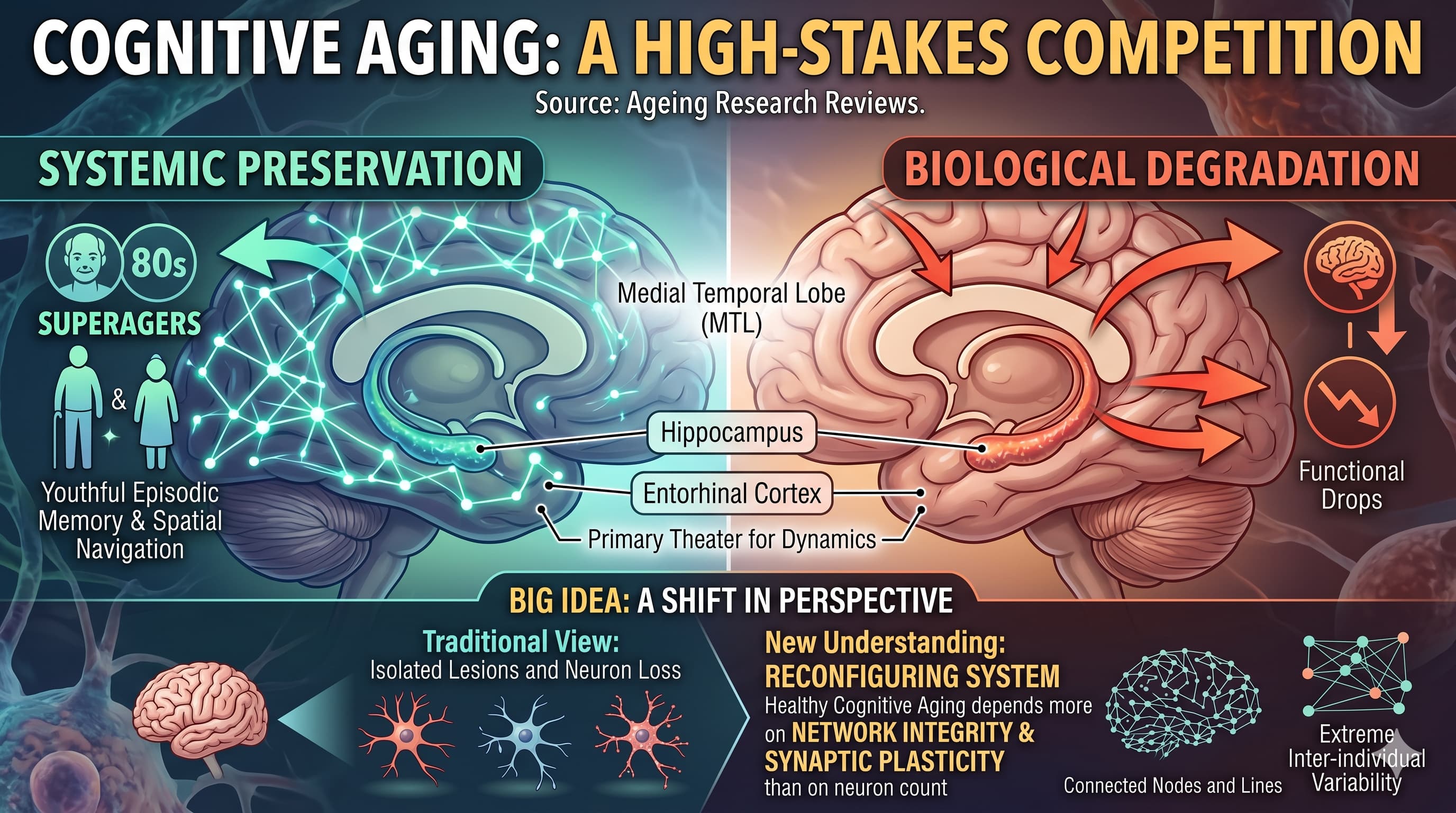
Cognitive aging is not a monolithic march toward decline, but a high-stakes competition between biological degradation and systemic preservation. This comprehensive review, published in Ageing Research Reviews , challenges the notion that chronological age is a reliable predictor of mental acuity. Instead, the authors reveal a landscape of extreme “inter-individual variability,” where “Superagers” maintain youthful episodic memory and spatial navigation into their 80s, while others experience steep functional drops.
The “Big Idea” presented is a shift from viewing the aging brain as a collection of isolated lesions to seeing it as a reconfiguring system. The authors identify the Medial Temporal Lobe (MTL) , specifically the hippocampus and entorhinal cortex, as the primary theater for these dynamics. While traditional aging research focuses on neuron loss, this paper argues that healthy cognitive aging depends more on network integrity and synaptic plasticity.
The researchers propose a new hierarchical framework of Hallmarks of Healthy Cognitive Aging. At the top are Core Regulatory Mechanisms , such as the balance between neuronal excitation and inhibition (E/I balance) and large-scale network coordination. When these core systems are stable, the brain can tolerate significant molecular stress. However, when they falter, “ancillary” processes—like vascular leaks, glial inflammation, and the accumulation of tau proteins—accelerate the transition from healthy stability to “vulnerable” trajectories.
This systems-level view explains why two individuals of the same age can have vastly different cognitive profiles: one’s brain successfully “buffers” age-related insults through adaptive remodeling, while the other’s network dynamics collapse into instability. Ultimately, the paper advocates for moving away from “average” aging models to focus on the divergent biological pathways that lead to either resilience or decay.
Actionable Insights
-
Prioritize Vascular Stability: Adequate hippocampal perfusion and blood-brain barrier (BBB) integrity are active determinants of cognitive trajectory. Small vessel health in the CA1 and dentate gyrus predicts cognitive decline, suggesting that managing blood pressure and metabolic health is foundational for “brain maintenance”.
-
Manage the HPA Axis: Chronic elevation of glucocorticoids (stress hormones) can create a “feed-forward loop” of hippocampal dysfunction. Preserving the negative feedback regulation of the stress axis is identified as a hallmark of “Higher Cognitive Health” (HCH).
-
Optimize Network Specificity: Healthy aging is characterized by “neural selectivity”—the brain’s ability to activate specific regions rather than responding broadly. Activities that challenge “pattern separation”—the ability to distinguish between similar but distinct experiences—may support this specificity.
-
Support Mitochondrial Homeostasis: Neurons generated in youth that maintain mitochondrial stability and synaptic connectivity are linked to successful aging. Interventions targeting mitochondrial dynamics and cellular quality control (proteostasis) may preserve the “operating regime” of neural circuits.
Context
- Open Access Paper: Hallmarks of healthy cognitive aging: inter-individual differences in aging trajectories
- Institutions: University of Bordeaux (France), German Center for Neurodegenerative Diseases (DZNE, Germany), and various international collaborators.
- Country: France/Germany/Sweden/Denmark/Portugal/Netherlands .
- Journal: Ageing Research Reviews, 20 March 2026
- Impact Evaluation The impact score of this journal (CiteScore) is 23.3, evaluated against a typical high-end range of 0–60+ for top general science, therefore this is an Elite impact journal in the field of gerontology and neuroscience.