Half of Muscle Aging Never Happens in People Who Kept Training

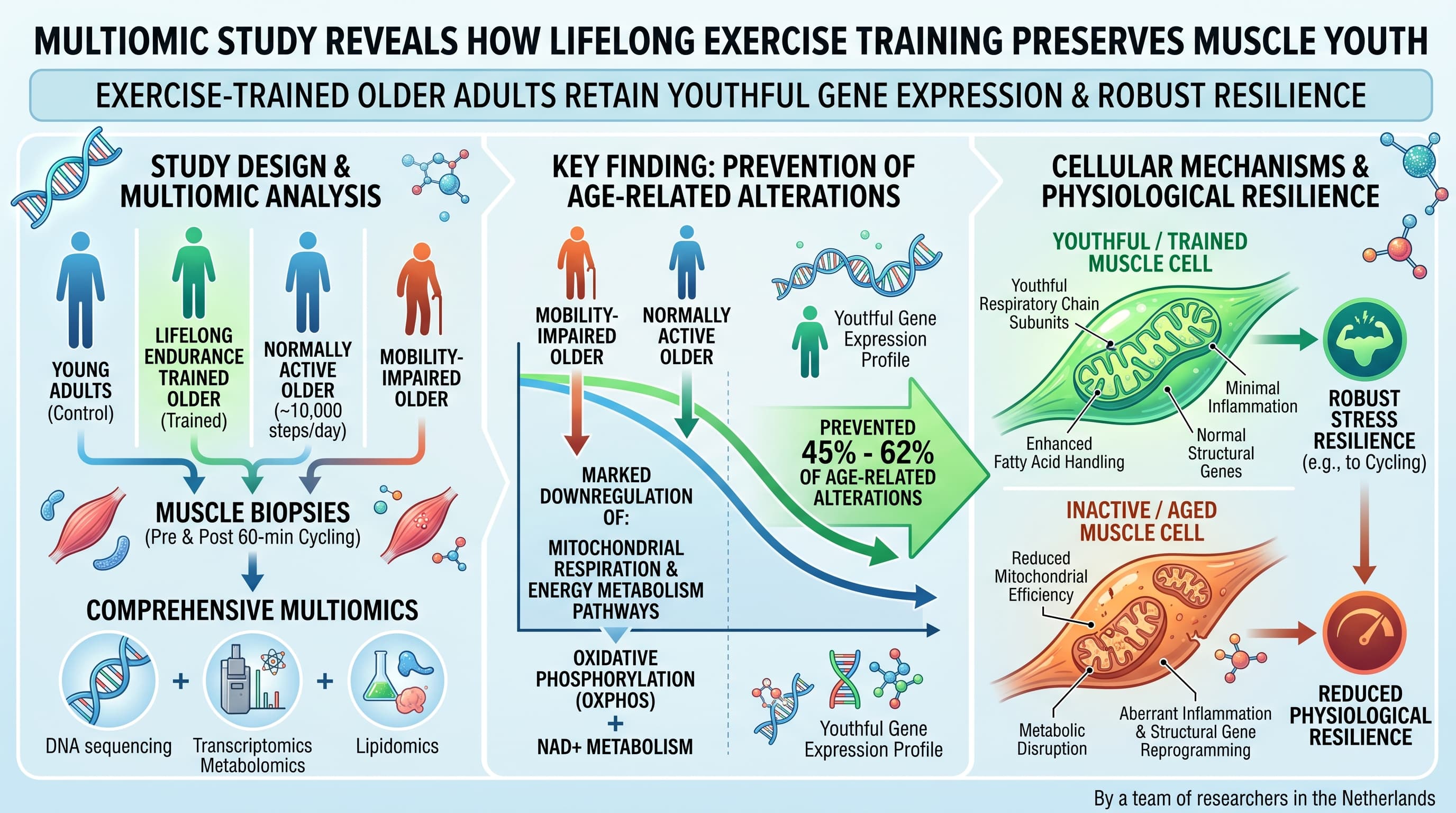
**A Dutch multiomics study of 47 muscle biopsies reports that roughly 56 percent of the gene expression changes that distinguish old muscle from young muscle are simply absent in older adults who have trained consistently for years. The preventable fraction is dominated by mitochondrial energy metabolism, including electron transport chain subunits, mitochondrial ribosomal proteins, and NAD+ pathway metabolites. The fraction that persists regardless of training clusters instead around synaptic transmission and WNT signalling, with no dominant pathway. A second finding is that trained older adults do not merely age more slowly at rest, they also respond to an acute exercise bout in a pattern that resembles young adults. **

For decades the standard picture of muscle aging has been a slow, uniform slide. Mitochondria falter, energy metabolism drifts, strength goes. A Dutch team has now taken that picture apart and found that it is really two pictures stacked on top of each other, and only one of them responds to exercise.

Georges Janssens, Riekelt Houtkooper and colleagues at Amsterdam UMC and Maastricht University recruited 47 people and took muscle biopsies from the thigh. Eleven were in their twenties. The other 36 were over 65 and were sorted by how much they actually moved: 16 long-term exercisers averaging around 14,000 steps a day plus at least three training sessions a week, 15 people living an ordinary active life at roughly 9,600 steps, and five with measurable physical impairment. Everyone then rode a stationary bike for an hour at half their personal maximum and gave a second biopsy immediately afterwards. Every sample was run through three molecular readouts at once: more than 24,000 gene transcripts, 135 metabolites and 1,383 individual lipid species.

The headline number is the split. Comparing the young group with the ordinary older group produced a long list of genes that change with age. When the same comparison was run against the trained older group, roughly 56 percent of those changes were not there. Their muscle had not aged less in every respect. It had failed to age in a specific respect.

What falls into the preventable half is telling. It is dominated by the machinery of energy production: electron transport chain components such as NDUFS1 and COX5A, and a cluster of mitochondrial ribosomal proteins that build the respiratory apparatus itself. The metabolite data pointed the same way, with NAD+ pathway compounds among the ten most age-altered molecules, alongside triglyceride buildup inside the muscle fibre.

The unavoidable half looks nothing like it. Those genes cluster around synaptic transmission and WNT signalling, meaning the wiring between nerve and muscle and the developmental programmes that maintain tissue structure. No single pathway dominates, which the authors read as drift rather than a targetable process.

The second finding may matter more in practice. Aging did not just blunt the response to that hour on the bike, it distorted it. Ordinary older adults depleted and accumulated metabolites at four to six times the rate of the young, and accumulated four times as many altered lipid species. The trained older adults responded in a pattern closer to the young, and their inflammatory signalling genes, including IL6 and IL1B, fired harder than in their sedentary peers, not softer. Fitness bought a stronger stress response, not a quieter one.

The caveat is structural and the authors state it. Nobody was randomised. These are people who chose to train for decades, in a country where cycling is ordinary and where the sedentary comparison group still walks close to 10,000 steps a day. The trained group was also about three years younger and leaner. What the study establishes is that half of the muscle aging signature is compatible with being absent, and where the other half lives.

Actionable Insights

Maintaining regular, structured endurance training preserves cellular energy production into late life. Casual daily walking is insufficient to safeguard mitochondrial capacity; older participants logging 9,600 steps per day still experienced widespread bioenergetic decline, whereas individuals completing at least three 1-hour structured exercise sessions weekly maintained youthful muscle profiles.

The magnitude of this protective benefit is substantial. Exercise prevented 55.9% of normal age-related gene upregulations and 57.1% of age-related gene downregulations. For mitochondrial respiratory complex I and complex V gene expression, training kept median transcript counts within approximately 5% to 10% of young levels, contrasting with a 30% to 50% decrease seen in untrained older adults. Standardized effect sizes across respiration markers and clinical stamina indices between trained and untrained individuals regularly exceeded 1.2 standard deviations (Cohen’s d).

Practical guidance highlights the necessity of reaching genuine cardiovascular exertion rather than merely accumulating low-intensity steps. In addition, practitioners must be cautious with non-specific, long-term anti-inflammatory interventions: the transient inflammatory and stress response provoked by exercise is an indispensable signal that drives tissue remodeling and cellular resilience in aging muscle.

Context/Source

5 Likes

Not surprised since we just learned that mitochondria in old people that exercise is not that different compared to that of young people. In fact, the paper below seems a lot more informative, since it actually identified the other half of muscle strength decline that exercises can’t do anything about.

2 Likes

Thank you! Does the article contain more details on what these “1-hour structured exercise sessions” (weekly) might be?

2 Likes

Prompt: What types of examples were in the research paper for three 1-hour structured exercise sessions? What are examples of these types of programs?

Research Paper Parameters

The authors of the Nature Aging study do not specify the exact exercise modalities or programs utilized by the participants in their personal routines. The inclusion criterion for the “trained” cohort simply required participants to have “engaged in at least three structured exercise sessions of at least 1 h each per week for an uninterrupted period of more than 1 year”.

The only specific exercise protocol detailed in the methodology is the acute testing intervention used to trigger the post-exercise molecular response, which consisted of a 1-hour submaximal bout in a fasted state on an electronically braked cycle ergometer at 50% of the individual’s maximal capacity. The authors briefly note in the discussion that lifelong endurance training maintains mitochondrial network integrity, whereas resistance training confers durable improvements in strength and mobility, but they provide no prescriptive routines.

Examples of 1-Hour Structured Exercise Programs

To meet the threshold of a rigorous, structured training regimen capable of inducing the mitochondrial and transcriptomic adaptations observed in the study, programs must demand sustained metabolic and mechanical output. Effective protocols typically operate on a six-day-a-week schedule, alternating between cardiovascular conditioning and resistance training.

Cardiovascular Conditioning Examples

  • High-Intensity Interval Training (HIIT): A 60-minute session incorporating a 15-minute warm-up, a Swedish 4x4 protocol (four intervals of 4 minutes at 85 to 95% of maximum heart rate, separated by 3 minutes of active recovery), followed by a 15-minute cooldown.
  • Load Carriage (Rucking): A continuous 60-minute session carrying a weighted backpack over variable terrain to sustain an elevated heart rate while simultaneously inducing muscular endurance stress in the lower body and core.
  • Low-Intensity Steady-State (LISS) Cardio: A 60-minute continuous effort on an incline treadmill (for instance, walking at a 15-degree incline) to maintain a steady Zone 2 heart rate, optimizing lipid oxidation and mitochondrial efficiency.

Resistance Training Examples

  • Eccentric-Focused Strength Training: A 60-minute session emphasizing the eccentric (yielding) phase of muscle contraction. This involves executing 4 to 5 compound movements (such as squats, deadlifts, and presses) using a slow 4-second negative descent on each repetition to maximize mechanical tension and neuromuscular adaptation.
3 Likes

The results show that 56% of the age-associated muscle gene-expression changes seen in less-trained older adults were absent in those trained. 44 % were present in the trained.
Those present were genes that cluster around synaptic transmission and WNT signalling, meaning the wiring between nerve and muscle and the developmental programmes that maintain tissue structure. No single pathway dominates, which the authors read as drift rather than a targetable process. I asked my AI if this is unavoidable when aging for the trained. Answer:

Your interpretation is broadly right, but the conclusion “therefore it is not possible to target it” is too strong. The study suggests that the remaining, training-resistant component of muscle aging does not yet reveal one dominant, druggable master pathway—not that neuromuscular wiring or tissue-maintenance biology is inherently untargetable.

What the paper implies

The reported result is striking: in older adults with long-term structured training, roughly 56–57% of the age-associated muscle gene-expression changes seen in less-trained older adults were absent. The preserved portion was particularly related to mitochondrial respiration, energy metabolism, and related metabolic functions.

The expression changes that persisted despite training included:

  • Synaptic-transmission-associated genes, including examples such as PCDH8 and UNC13C—consistent with age-related change in nerve–muscle communication.
  • WNT-related genes such as DAAM2 and CTR9, a signalling system involved in development, regeneration, cell identity, and muscle-resident stem-cell biology.
  • A more dispersed set of changes without one overwhelmingly enriched pathway.

That makes the authors’ “unavoidable” label useful in a specific sense: these changes were not prevented by the particular exposure studied—habitual, sustained exercise training. It does not establish that they are biologically inevitable in every person, irreversible, causal, or beyond intervention.

Why “not targetable” does not follow

Gene expression is often a readout of an upstream process, not the process itself. For example, higher expression of a synaptic gene could reflect compensatory remodelling, partial denervation with reinnervation, altered fibre-type composition, changes in motor-neuron input, or shifts in the proportions of muscle fibres, Schwann cells, fibro-adipogenic progenitors, immune cells, and vascular cells in a biopsy. The study’s transcriptomic data alone cannot disentangle these possibilities.

So the more precise conclusion is:

Exercise appears highly effective for the preventable metabolic/mitochondrial portion of the muscle-aging transcriptome, while the persistent portion points to neuromuscular and regenerative biology that is not fully corrected by training and currently lacks an obvious single molecular lever.

The two persistent domains

Neuromuscular-junction maintenance

The neuromuscular junction (NMJ) is the specialized synapse where a motor neuron activates a muscle fibre. With aging, motor units can be lost; surviving motor neurons may sprout to reinnervate orphaned fibres, producing larger but less finely controlled motor units. NMJ fragmentation and altered synaptic organization may occur alongside this remodelling.

That biology is potentially addressable at several levels, although no established anti-aging NMJ drug exists:

  • Preserving motor-neuron health and axonal transport.
  • Supporting Schwann-cell and terminal-perisynaptic-cell function.
  • Reducing repeated denervation–reinnervation cycles.
  • Maintaining muscle-side synaptic architecture, including acetylcholine-receptor clustering and synaptic basal-lamina integrity.
  • Addressing systemic contributors: insulin resistance, inactivity, inflammation, inadequate protein/energy intake, neuropathy, vascular disease, and neurotoxic exposures.

Notably, other research has found that exercise in aged muscle can induce genes related to neurotransmission and may be associated with neuromuscular synaptic protection or remodelling. That differs from saying training fully returns NMJ biology to its young state.

WNT and regenerative architecture

WNT signalling is not one simple “maintenance switch.” It is a large, context-dependent signalling network. In skeletal muscle, it can affect satellite-cell behaviour, regeneration, fibrosis, extracellular-matrix remodelling, and cell-fate decisions. Depending on timing, tissue, pathway branch, and dose, increasing or suppressing WNT activity could be beneficial or harmful.

That is exactly why the absence of a clean dominant signal matters: broad systemic WNT manipulation would be biologically risky. WNT pathways participate in normal tissue turnover and are implicated in cancer biology when dysregulated. The plausible future direction is therefore likely to be cell-specific, tissue-specific, and temporally controlled modulation, rather than “take a WNT activator.”

Important limitations

The strongest caution is that this is an observational comparison of groups with different lifelong training histories, not a randomized experiment assigning people to decades of training. Thus, it supports an association between long-term structured training and a more youthful muscle molecular profile; it cannot prove that training alone caused every difference.

Also:

  • “Unavoidable” means unaffected in this study’s trained group, rather than absolutely unavoidable.
  • The outcome is molecular: it is not identical to muscle strength, power, balance, motor-unit number, falls, or disability.
  • Some persistent transcriptional changes could be compensatory and adaptive rather than harmful.
  • The specific type, dose, and timing of training matter. The paper should not be read as demonstrating that resistance work, aerobic conditioning, balance work, power training, and high-intensity intervals all have identical effects on these pathways.

Practical meaning

For an older person already interested in preserving muscle and function, the study reinforces—not weakens—the case for structured training. It suggests exercise is exceptionally powerful for preserving the metabolic machinery of aging muscle, even if it cannot fully erase age-related changes in innervation and regeneration-related biology.

The practical implication is to cover both sides of function rather than pursue a speculative WNT or NMJ supplement:

  • Progressive resistance training to preserve strength and muscle mass.
  • Power-oriented work, scaled safely, because rapid force production is especially relevant to mobility and falls.
  • Aerobic conditioning and intervals where appropriate, for mitochondrial capacity and cardiometabolic health.
  • Balance, gait, and coordination work, which address the functional output of the nerve–muscle system even if they do not “reset” its transcriptome.
  • Adequate protein, total energy, vitamin D status where indicated, and management of neuropathy risks such as diabetes, B12 deficiency, excess alcohol, and neurotoxic medications.

In short: the study identifies a research gap, not a biological dead end. The nerve–muscle and tissue-architecture components may be harder to target because they are distributed, multicellular, and context-dependent—but they remain plausible targets for future therapies once researchers establish which changes are causal, which are compensatory, and which cell types drive them.

1 Like