Just learned about MVX, the Metabolic Vulnerability Index, which is used to estimate ACM within a 1-5 year period. Attia had the inventor of this biomarker on his latest podcast - link here to podcast and transcript/summary.
AI summary:
Just learned about MVX, the Metabolic Vulnerability Index, which is used to estimate ACM within a 1-5 year period. Attia had the inventor of this biomarker on his latest podcast - link here to podcast and transcript/summary.
AI summary:
What separates this risk marker from other risk markers? It’s mainly 2 things:
Fuller explanation from AI:
Because this looks in part at citrate i looked at the figures in the paper which talked about figures in plasma about 2 micromolar. Normal is more like 100. Odd.
The population is people with low thyroid function, and hence low metabolic rate, so I would expect citrate to be low due to low krebs cycle activity.
ChatGPT (5.5paid)
Worked for 12s
I found one particularly clear extreme in the human literature: postoperative plasma citrate around 60 µmol/L. That appears to be among the lowest well-documented values I can find in studies reporting absolute concentrations.
In the classic surgical-stress work summarized by Costello and colleagues, 65 surgical patients were studied. The mean plasma citrate fell from about 112 µmol/L preoperatively to 91 µmol/L at 1 day, then to 76 µmol/L at 2–4 days and 78 µmol/L at 5–7 days. In a particularly striking patient with severe hyperparathyroidism, plasma citrate started around 300 µmol/L but fell after surgery to approximately 60 µmol/L, remaining severely depressed for more than 10 days.
The authors attribute the postoperative fall primarily to a major increase in hepatic clearance and uptake of circulating citrate, rather than increased renal clearance. Their experimental work estimated roughly 55% hepatic extraction of delivered plasma citrate after surgery.
For context, an enzymatic reference study found healthy subjects spanning 80–170 µmol/L, with a mean around 120 µmol/L. Thus, 60 µmol/L is roughly half the usual mean concentration.
Interestingly, several diseases I searched do not produce especially low serum citrate:
Condition Reported citrate behaviour
Major surgery ↓ strongly; individual values ~60 µmol/L
Healthy subjects ~80–170 µmol/L
Profound hypothyroidism ↑ to 157 ± 48 µmol/L
After thyroid-hormone replacement ~93 ± 25 µmol/L
Severe diabetic ketoacidosis Generally ↑, sometimes markedly
NAFLD/NASH fibrosis Tends to ↑
Hyperparathyroidism Can be markedly ↑
The thyroid result is particularly relevant to your earlier question. A recent human study of 16 patients made profoundly hypothyroid after thyroidectomy found citrate of 157 ± 48 µmol/L. After 20 weeks of thyroid hormone, it fell to 93 ± 25 µmol/L—a 72% difference. This also confirms the much older observation that myxoedema can be associated with raised plasma citrate.
So far, I have not found a convincing published human plasma/serum citrate measurement substantially below about 50–60 µmol/L. Values in the 20–40 µmol/L range may exist, but I would not regard them as established from the literature I’ve located.
There is also an interesting implication for the citrate/acetyl-CoA hypothesis: low circulating citrate is not necessarily a marker of failing mitochondrial citrate production. The surgical example is almost the opposite—the low plasma concentration appears to result from very rapid tissue uptake/utilization, particularly by liver. Conversely, profound hypothyroidism produces high plasma citrate despite impaired mitochondrial oxidative metabolism. This means serum citrate alone may be a poor proxy for mitochondrial citrate export or nuclear acetyl-CoA availability.
A potentially more informative next search would be for the lowest intracellular/tissue citrate concentrations reported in ageing or mitochondrial disease, because that is closer to the citrate → ACLY → nuclear acetyl-CoA question than serum citrate is.
Direct-to-Consumer Options & Pricing
Even though you are buying it yourself, a licensed physician associated with the online service will review and approve the lab requisition behind the scenes. You then take that requisition form to a local Labcorp facility for the blood draw. [1, 2, 3, 4]
Apparently, it is known that that numerical concentration across nmr platforms can vary. So that seems to explain that.
It doesn’t explain the very low figures in the paper, but I am not inclined to spend any more time on this issue.
Attia podcast aired yesterday with an 2+ hour interview of James Otvos, the scientist that led the development of the MVX. Besides the MVX test, a lot of info about lipids and testing labs. The MVX data presented certainly surprised (positively) Attia.
I’m sold, and I’ll be buying this test- hopefully from GoodLabs as I requested they add this test to their panels.
Agree. I found Attia’s podcast exceptionally informative and worth a second review. I recommend it, Among other things, the podcast brought to mind @John_Hemming’s discussions on citrate. Otvos is a first tier scientist who came at this topic (stumbled on it, really) from a unique perspective.
I ordered it from LabCorp, via the Nutritional Healing Center of Ann Arbor. Also $49. Glad you posted this. Some people may not want to know, but it provides actionable intelligence, as RapAdmin might say.
So what IS the actionable intelligence for a high MVX? I don’t recall them talking about that in the podcast. Are there specific actions that can be taken to lower MVX itself, or just secondary things we can do to help mitigate the consequences?
Serum citrate is rapidly converted by the liver into sodium bicarbonate. One molecule of citrate is normally converted into three molecules of bicarb. However, patients with liver damage have a lower conversion rate. How would you rate your liver, John Hemming?
I have over 4 years of weekly liver markers and it has generally been quite good on the ALP/ALT/AST front (where good is normally lower). Here are the last few weeks:
ALP AST ALT
47 22.1 15.5
46 <18.7 <10
38 18.6 11.4
42 15.1 7.7
60 24 19
46 22 11
49 18.9 12
44 22.8 <10
50 23
I am not sure why this is relevant, however. Not all citrate is converted by the liver, some is excreted in urine, some is processed by cells. The citrate cellular membrane transporters in the SLC13 series are expressed by a wide range of cells.
The normal citrate serum figures are the normal ones.
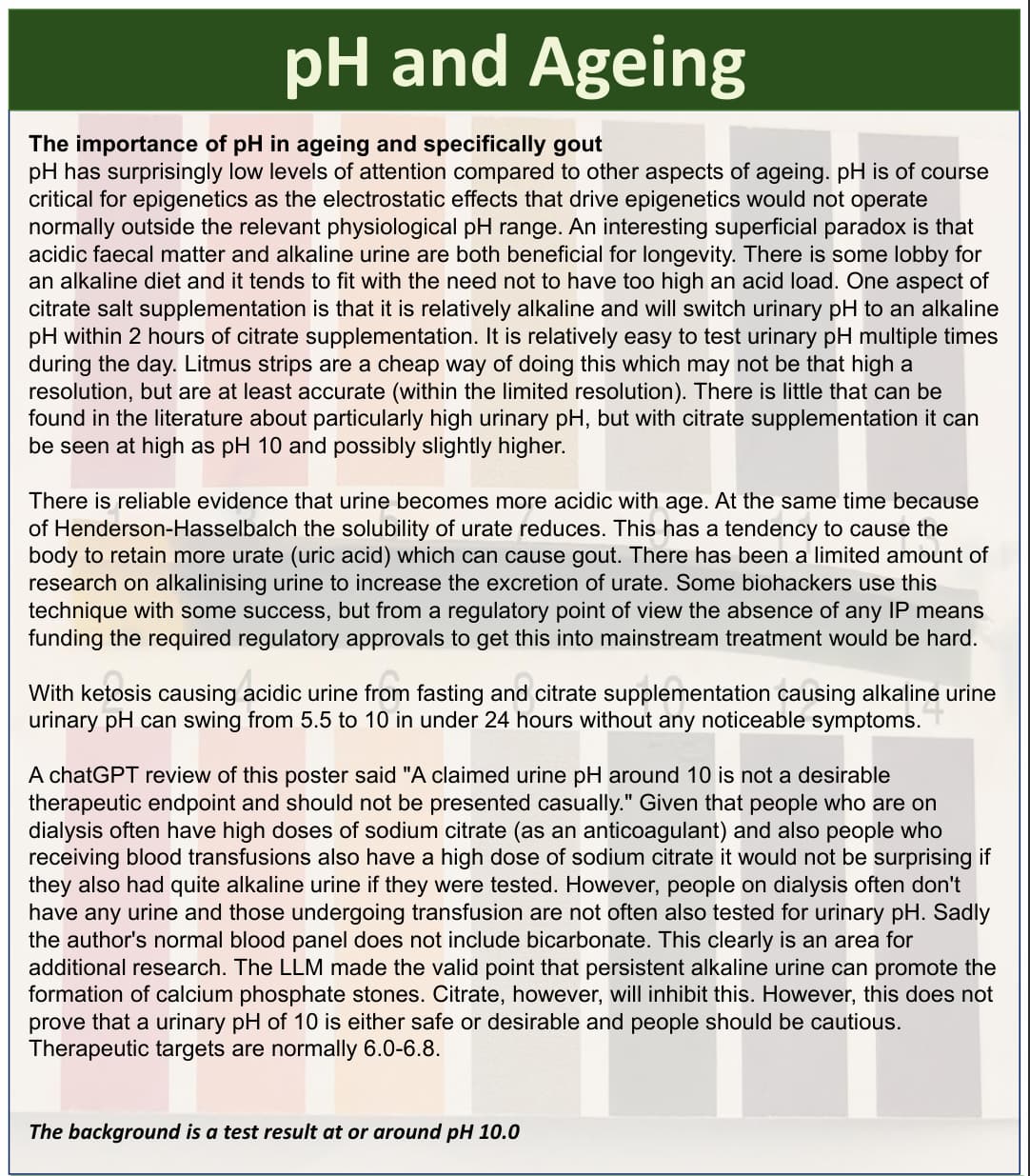
I have written about the alkalinising effects of citrate in my BSRA 2026 poster
I take about six half-teaspoons of sodium citrate per day, which, as you say, has an alkalizing effect on the body’s pH. I have found it to be an excellent treatment for both acid reflux and metabolic acidosis. The liver is relevant because of the biomechanics.
I accept that the liver processes some of the citrate into bicarbonate and that SLC13A5 is expressed strongly in the liver. However, I don’t understand where this is relevant to the odd results in the original paper.
Just got results back from my first test. The summary:
Here’s a more detailed AI summary:
Good numbers, though I’m not surprised. I’m sure you would rank high on the conscientiousness index. It might be helpful if you listed here, in one place, all your peptides, supplements, and other protocols, as well as your age, diet, and fitness routine, if that is not too much to ask.
Current list:
I’m in my 40s. My current diet is mostly high protein (meat, protein shakes) and high fiber (a lot of beans, vegetables, fruits). I used to be more disciplined in my diet, but because now I’m satiated more easily by food, I can eat anything I want and not worry about eating too much.
These days I only work out only 3 times a week, but I do everything during those 3 sessions: lift weights and a cardio session right after. My lifting focus is mainly on lower body movements, and on doing unlilateral training. Unlilateral training helps me in 2 things: general balance, and ability to effectively lift more weights per limb.
Here’s my old supplement list for comparison: