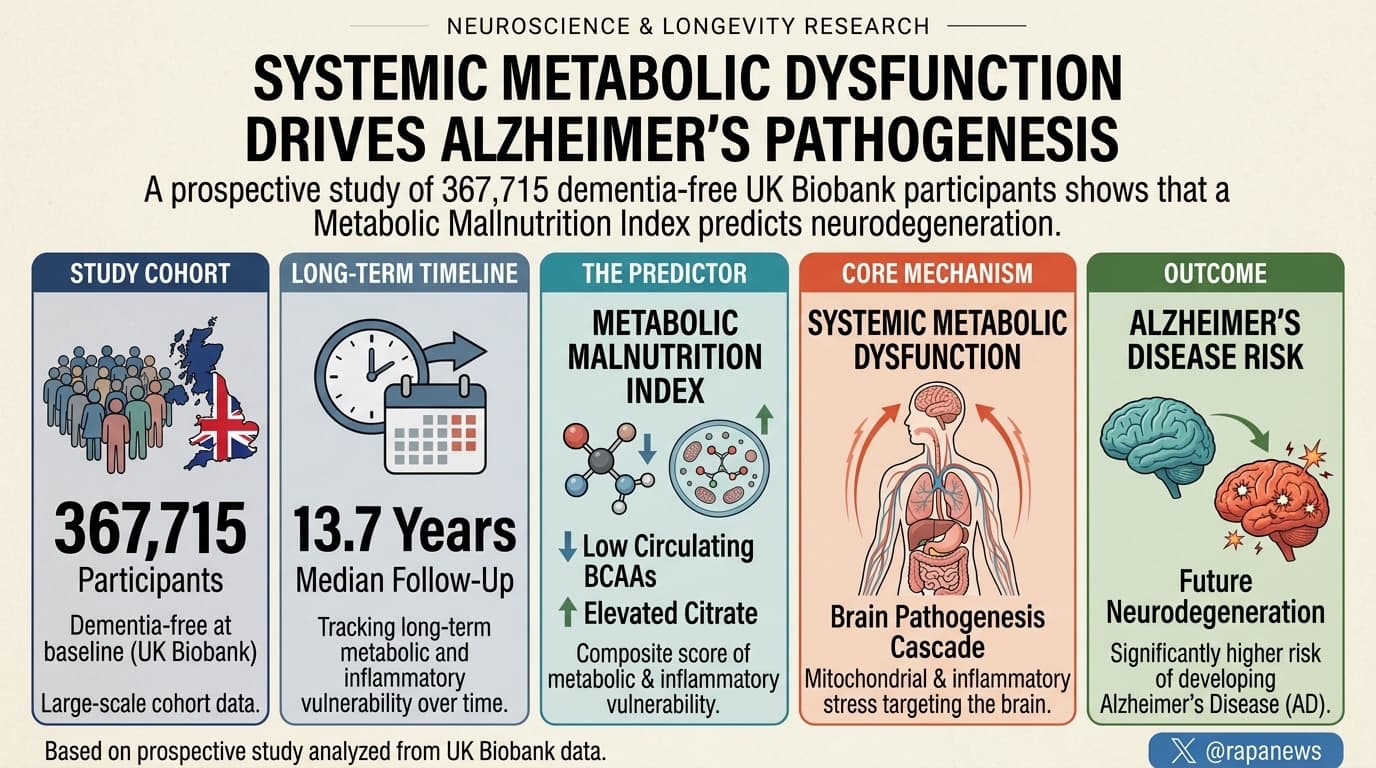
Systemic metabolic dysfunction is increasingly recognized as a core mechanism in the pathogenesis of Alzheimer’s disease. This prospective cohort study analyzed 367,715 dementia-free participants from the United Kingdom Biobank to determine if pre-established indices of metabolic and inflammatory vulnerability could predict future neurodegeneration. Over a median follow-up of 13.7 years, researchers found that the Metabolic Malnutrition Index, a composite score driven primarily by low circulating branched-chain amino acids and elevated citrate, was significantly associated with a higher risk of developing Alzheimer’s disease. Conversely, a systemic inflammatory index showed no predictive value for the disease.
Alzheimer’s disease etiology extends far beyond localized amyloid and tau accumulation into the broader realm of systemic metabolic failure. This study leverages the massive United Kingdom Biobank dataset to investigate whether composite indices of metabolic vulnerability can predict Alzheimer’s disease risk over a decade before clinical onset. The researchers tracked 367,715 dementia-free individuals for a median of 13.7 years and captured 2,615 incident cases of Alzheimer’s disease.
The investigation focused on three indices originally designed to predict all-cause cardiovascular mortality: the Metabolic Vulnerability Index, the Inflammatory Vulnerability Index, and the Metabolic Malnutrition Index. The data reveal a strict bifurcation in predictive power between metabolic and inflammatory markers. The Inflammatory Vulnerability Index, which aggregates glycoprotein acetyls and small high-density lipoprotein particles, showed no statistically significant association with Alzheimer’s disease after rigorous covariate adjustment.
Metrics driven by branched-chain amino acids demonstrated robust predictive utility. The Metabolic Malnutrition Index relies on a nonlinear combination of three branched-chain amino acids (leucine, isoleucine, valine) and citrate. Higher scores on this index indicate lower circulating branched-chain amino acids and elevated citrate. Participants in the highest quartile of the Metabolic Malnutrition Index faced a 47 percent greater relative risk compared to those in the lowest quartile. Individual analysis confirmed that higher levels of circulating leucine, valine, and isoleucine were inversely associated with Alzheimer’s disease risk, while elevated citrate was positively associated with the disease.
These findings suggest that systemic amino acid depletion and energy metabolism imbalances precede cognitive decline by many years. Branched-chain amino acids are critical for skeletal muscle maintenance and anabolic signaling pathways. Their depletion likely serves as a proxy for accelerating sarcopenia, impaired protein turnover, and systemic frailty. Furthermore, the elevation of circulating citrate points to tricarboxylic acid cycle bottlenecking and broader mitochondrial dysfunction. The data strongly suggest that maintaining skeletal muscle mass and ensuring adequate amino acid availability are crucial systemic defenses against neurodegeneration.
Actionable Insights
For individuals actively optimizing their healthspan, the practical takeaway is the critical importance of maintaining skeletal muscle and amino acid availability as a defense against neurodegeneration. The data show that low circulating branched-chain amino acids (leucine, valine, isoleucine) and high citrate levels are strong predictors of future Alzheimer’s disease.
To illustrate the real-world magnitude of this effect, we can examine the absolute and relative risk data. The baseline incidence of Alzheimer’s disease in this cohort was 0.71 percent over 13.7 years. Participants in the highest quartile of metabolic malnutrition experienced a fully adjusted 47 percent relative increase in risk compared to the lowest quartile (Hazard Ratio of 1.47). In absolute terms based on the cohort data, the disease incidence rate was 0.62 percent in the lowest quartile (570 cases out of 91,929 individuals) and rose to 0.87 percent in the highest quartile (801 cases out of 91,929 individuals). This yields an absolute risk increase of 0.25 percentage points. Translated to a standardized effect size, a Hazard Ratio of 1.47 represents a small practical effect (an approximate Cohen’s d of 0.25).
Actionable steps include prioritizing dietary protein intake rich in leucine to maintain anabolic signaling, engaging in regular heavy resistance training to build skeletal muscle, and monitoring metabolic health markers to prevent mitochondrial dysfunction.
Context/Source
- Paywalled Paper: Metabolic Vulnerability Indices and Alzheimer’s Disease Risk: A Prospective UK Biobank Study, Published October 2026.
- Institution: Cancer Center, The First Hospital of Jilin University
- Country: China
- Journal Name: The Journal of Nutrition
- Impact Evaluation: The impact score of this journal is 4.4, evaluated against a typical high-end range of 0–60+ for top general science, therefore this is a Medium impact journal.
Related Reading:
- Metabolic Vulnerability Index (MVX) Can Spot Who Dies First, Thirty Years Ahead of Time
- Metabolic Vulnerability Index
- The MetaboHealth score Predicts 10-Year All-Cause Mortality Risk
- My Dementia Avoidance Protocol - Please improve it and offer advice
- Predicting and Preventing Alzheimers & Dementia (and minimizing risk)