I got my numbers back from Labcorp and I only got 3 values in total. One for the Metabolic Vulnerability Index, Inflammation Vulnerability, and Metabolic Malnutrition Index. Unfortunately, I didn’t get back any of the subcomponents for each of those indexes.
I wouldn’t use them again unless they give you the details.
I recommend this test, which actually cost the same as the basic one Own Your Labs has (40$), and is the one I took: Own Your Labs · OYL
4 Likes
I agree. I posted so others wouldn’t get their test from Labcorp.
1 Like
There are some confusions here in part because of the novel developmental history of MVX. Too much to summarize in a short post but it is all unpacked in detail in Attia’s podcast.
There is no alternative vendor. Labcorp owns and developed the MVX (Metabolic Vulnerability Index) test. The test was created by Labcorp using their proprietary nuclear magnetic resonance spectroscopy technology, including highly adapted spectrometers used and software to analyze specific serum metabolites. While the underlying NMR platform was pioneered by LipoScience (which Labcorp acquired), Labcorp holds the patents for the multi-variable metabolic vulnerability index evaluations and performs the analysis for both the standard MVX and the MVX Plus variants.
2 Likes
The three indices are all you get. The best primer for learning what they mean (and might mean) is Attia’s podcast.
1 Like
IMO, the real value of the MVX parameters – and not so much the specific metrics but developmental process – derives from the few hundred thousand cases it has been analyzed agains in various ways. Much of this value is in process.
With this in mind, if you are looking for a gero metric to manage to, this is definitely not it at this point.
1 Like
On the citrate issue, I don’t think we should conflate the MVX citrate signal and supplemental citrate. They differ in compartment, timescale, mechanism, and quite possibly in the sign of their biological meaning. MVX measures fasting, steady-state serum citrate, an endogenous readout of your metabolic set-point. Oral citrate is a transient absorbed dose that is disposed of in a few hours in ways that do not elevate fasting plasma citrate. For this and other reasons, we should not be comparing the two citrate metrics. You can “supplement citrate” and leave fasting plasma citrate unmoved.
1 Like
Supplemental citrate goes through serum, but it creates a pulse of additional citrate that fades after a period of time.
The metric I was looking at was ordinary serum fasting citrate. A figure of 2.32mg/dl is around 140 micromoles per litre which is in the normal range.
2 Likes
The evolution of the NMR diagnostic platform, culminating in the commercialization of the Metabolic Vulnerability Index (MVX), spans four decades beginning in a public university lab in the 1980s. The organizational structure transitioned from a university research lab to a venture-backed startup, a publicly traded diagnostic firm, and ultimately (in 2014) an integrated enterprise product within Labcorp. At the time and through to today, Labcorp had the vision to retain key scientists even though doing so likely degraded their financial profile for the product. The scientists acknowledge Labcorp’s contributions but hope to find funding to resume the scientific arm of the venture since Labcorp functions as a clinical lab and not a research facility.
Importantly, Labcorp is the sole owner of everything associated to MVX and NMR LP. They do not license the Vantera hardware, the software algorithms, or proprietary diagnostic assays like the Metabolic Vulnerability Index (MVX) and NMR LipoProfile to third-party clinical laboratories and have no public plans to do so. (As I understand it, there are dozens or more patents involved.) Therefore, make certain that any lab requisition you purchase is an authentic Labcorp document and that the sample will be either drawn at a Labcorp authorized facility or transmitted to them in an acceptable form.
Yes, besides a pronounced effect on metabolic acidosis, a complication of kidney disease, I am running faster with greater ease, probably because of a reduction in lactate.
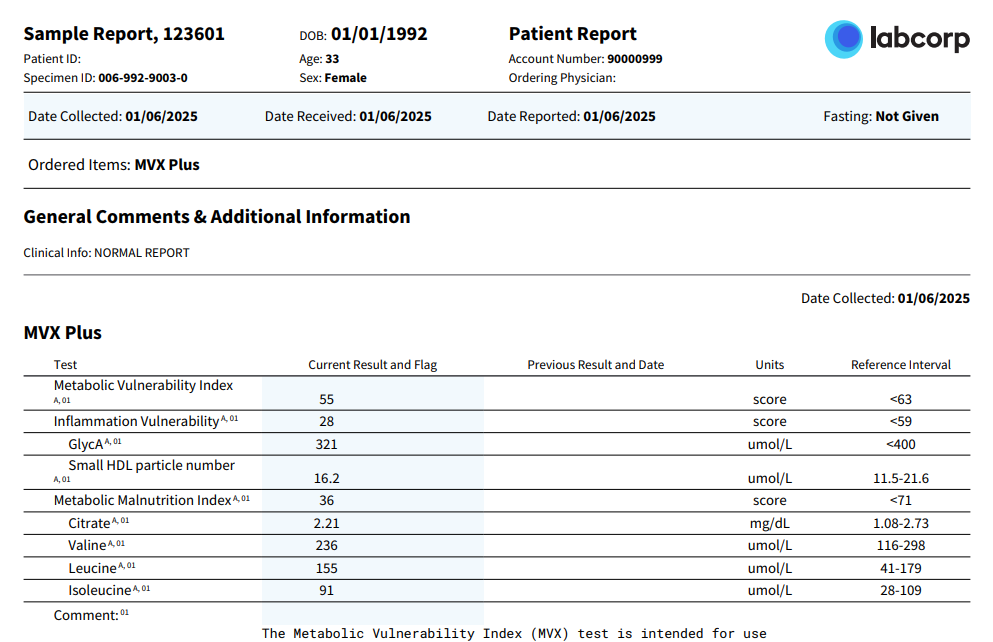
Yep, that’s what my report looks like
This Plus version comports with the detail covered in the Attia podcast and the large scale studies I have been reading. Comparing the two report numbers at LabCorp (#123590, #123601), it looks like the additional charge for the Plus is a way to cover the costs of the research that went into developing the last round of algorithms.
Vascular aging index, Frailty index, Metabolic vulnerability index, and the Klemera-Doubal method are all solid biomarkers to look at.
1 Like
I think it be better to look at the underlying biomarkers. When you start creating collective indices you end up losing information.
1 Like
Linked earlier in this thread
1 Like
I may have missed it in this thread, but I was curious what the optimal measure ranges in the MVI are for health and longevity. Here is what Claude suggests. Do you agree? People who have done the test - how did your results come in, with regard to these ranges?
MVX components: target ranges for healthspan/lifespan
Speaking as an endocrinologist, with the caveat up front that no published optimal ranges exist for these analytes as longevity targets. The MVX was derived in sick cohorts (CATHGEN + Intermountain catheterization patients, then heart failure) to predict near-term death. What follows is my synthesis of the mortality epidemiology plus population distributions — clinical judgment, not a validated cut-point set.
The six analytes
| Analyte | Direction in MVX | Population anchor | My approximate optimum | Confidence |
|---|---|---|---|---|
| GlycA | ↑ = worse | MESA mean 381 ± 62 µmol/L; Labcorp decision limit ≥400 = high | 250–330 µmol/L (≤350 acceptable) | Good |
| Small HDL-P | ↓ = worse (protective) | No published reference interval; UKB/Nightingale median 9.7 µmol/L [8.9–10.6], Labcorp scale runs higher | Upper half of your platform’s distribution — chase the percentile, not a number | Weak |
| Citrate | ↑ = worse | NMR healthy median 1.85 mg/dL (F 1.92 / M 1.72); healthy 95% interval 1.48–2.97 | 1.5–2.0 mg/dL (~78–104 µmol/L) | Moderate |
| Valine | ↓ = worse | LURIC Q1 <191 µmol/L → HR 2.01 vs Q4 >326 | 220–290 µmol/L | Moderate |
| Leucine | ↓ = worse | LURIC Q1 <102 µmol/L → HR 1.98 vs Q4 >179 | 120–165 µmol/L | Moderate |
| Isoleucine | ↓ = worse | LURIC Q1 <53 µmol/L → HR 1.80 vs Q4 >91 | 60–85 µmol/L | Moderate |
Composite scores (1–100, sex-standardized, higher = worse): the report flags MVX <63 / IVX <59 / MMX <71 as “low risk,” but those are disease thresholds. A kidney-transplant cohort averaged MVX 42 ± 11. For longevity purposes I’d want the lowest population quartile — MVX ≤35–40.
The three things that should bother you about this panel
1. The BCAA direction is inverted relative to longevity biology. MVX scores low BCAAs as bad because in catheterization and heart failure cohorts, low BCAAs mark catabolism, sarcopenia and protein-energy wasting. But isoleucine restriction extends lifespan ~33% in male mice and improves healthspan even when started late, and high-normal BCAAs predict incident T2D and insulin resistance in healthy adults. So the curve is almost certainly U-shaped, and MVX only sees the left limb. This is why I’ve put the optimum in the upper-middle rather than the top quartile: never be in the bottom quartile, don’t try to be in the top. In a metabolically healthy 45-year-old, a “low” MMX driven by top-decile BCAAs is not reassuring.
2. Small HDL-P is directionally contested. Within MVX (and in sepsis/infection-death cohorts) low small HDL-P predicts mortality. In classical atherosclerosis epidemiology, small HDL particles correlate positively with CVD risk. The discrepancy traces to different NMR deconvolution algorithms (LP3 vs LP4 subclass boundaries) and different outcomes. Don’t treat it as a clean target until you know which algorithm produced your number.
3. Units are not portable. Labcorp’s Vantera reports GlycA in µmol/L against a <400 cut-point and citrate in mg/dL; Nightingale reports different absolute values on a different calibration. A UK Biobank-derived quartile is not your Labcorp quartile. Only compare within-platform.
Effect size reality check
In UK Biobank (274,092 participants, 13.7 years, 24,241 deaths), MVX gave HR 1.12 per SD, with Q4 vs Q1 at 1.21 after full adjustment. In the multimorbidity analysis, ~1.23–1.32 per SD. That is a real population signal and a weak individual one. The panel is better read as a composite readout of inflammation + nutritional/mitochondrial adequacythan as six independent levers — and the two most actionable inputs are GlycA (falls with exercise, weight loss, statins, resolving occult inflammatory foci) and adequate protein intake with resistance training (raises BCAAs and small HDL-P from the frailty end without pushing into the insulin-resistant end).
Sources: Metabolic Vulnerability Index thread, rapamycin.news · Labcorp MVX by NMR · Labcorp MVX Plus · Labcorp GlycA · MVX in UK Biobank, Redox Biology · Multimarkers of metabolic malnutrition and inflammation, Lancet Healthy Longevity · MVX in heart failure, JACC: Heart Failure · MVX and multimorbidity, Nutrients · BCAAs and mortality, LURIC · NMR citrate reference intervals · GlycA distribution in MESA · Isoleucine restriction and lifespan, Cell Metabolism · Late-life isoleucine restriction, Nature Aging · MVX patent application