Metabolic Vulnerability Index (MVX) Can Spot Who Dies First, Thirty Years Ahead of Time

I’m a little slow to get on the MVX bandwagon after @qBx123Yk alerted us to in his initial MVX post here in August - but I finally listened to the Peter Attia Podcast interview with Dr. James (Jim) Otvos, and I’m intrigued. The key bit of information from that podcast that catches your attention is this:

Chronological Age-Independence of MVX: Baseline MVX score distributions in 25-to-30-year-old adults (CARDIA cohort) are nearly identical to distributions in 60-year-old cohorts (MESA) and independently predict 30-year premature mortality in disease-free individuals.

In other words, it doesn’t seem that this measure is related to age, and yet it can predict premature mortality risk decades in advance, in seemingly healthy younger people.

The test is available for $40 from “Own Your Own Labs” - more info here (we have no affiliation with this company, its just the cheapest price we’ve found for this test).

So - this seems like a collection of tests (the MVX tests) that I want to learn about. So I’m creating this thread just to cover the research papers that have been done on this MVX index. This is all very new; the first paper was published in 2023, and there are not that many papers (less than a dozen it seems, but most of them seem to be from the past year or two. So - I’ll start with the initial 2023 paper his by Dr. Otvos and his team, then cover the others.

A Blood Test That Sees Hunger and Inflammation at the Same Time

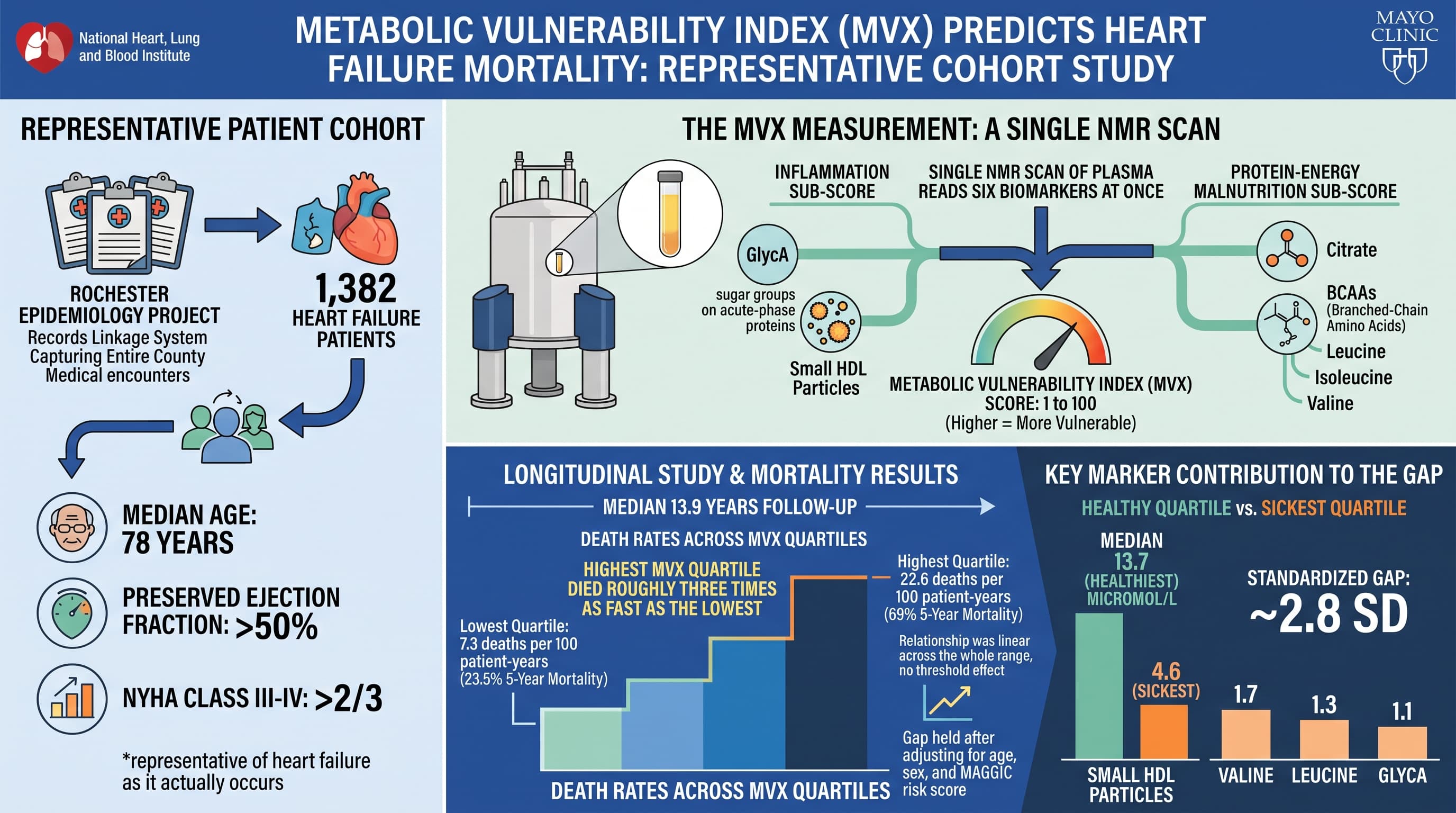
Researchers at the National Heart, Lung, and Blood Institute and Mayo Clinic applied a composite blood score called the Metabolic Vulnerability Index (MVX) to 1,382 heart failure patients drawn from an entire county’s medical records, then followed them for a median of 13.9 years. MVX is measured by a single nuclear magnetic resonance scan of plasma and combines two things that usually get measured separately: a marker of systemic inflammation and a set of markers reflecting protein-energy malnutrition. Patients in the highest MVX quartile died roughly three times as fast as those in the lowest, and that gap held after adjusting for age, sex, and the standard MAGGIC risk score.

For twenty years, cardiologists have argued about the “cytokine hypothesis” of heart failure: the idea that a failing heart is not simply a pump problem but a whole-body inflammatory and wasting disease. Patients lose muscle. They lose appetite. Their blood fills with signals of chronic immune activation. The problem has always been that these processes get measured one marker at a time, and no single marker has been convincing enough to change what doctors do on a Tuesday afternoon.

The Metabolic Vulnerability Index takes a different approach. A single nuclear magnetic resonance scan of a plasma sample reads out six things at once: GlycA, a signal arising from the sugar groups on acute-phase proteins, and small high-density lipoprotein particles, which together form an inflammation sub-score; plus citrate and the three branched-chain amino acids leucine, isoleucine, and valine, which form a malnutrition sub-score. The six are combined into one number from 1 to 100. Higher means more vulnerable (or more “metabolically frail”, as Jim Otvos has suggested.

This is the first time the score has been tested in heart failure, and the cohort is unusually good. Rather than recruiting from a specialist clinic or a drug trial, the team used the Rochester Epidemiology Project, a records linkage system that captures nearly every medical encounter in three Minnesota counties. That means the cohort looks like heart failure as it actually occurs, not as it appears after trial eligibility criteria have filtered out the old and the complicated. Median age was 78. Just over half had preserved ejection fraction. More than two-thirds were in NYHA class III or IV.

The results were graded and consistent. Death rates rose stepwise across the four MVX groups, from 7.3 per 100 patient-years in the lowest to 22.6 in the highest. Five-year mortality went from 23.5 percent to 69 percent. The relationship with mortality was linear across the whole range of scores, with no threshold effect.

The more interesting finding is what the score was not tied to. MVX showed no relationship with ejection fraction, the measure that currently sorts heart failure into its major treatment categories. Nor did it track closely with physical frailty; a companion study in the same cohort found the two correlate weakly and that MVX explains only a few percent of frailty’s mortality signal. Whatever MVX is detecting, it appears to sit in a different lane from both the pump and the patient’s visible condition.

The honest accounting comes when the statistical adjustments pile up. The near-threefold crude difference shrinks to about 1.5-fold once the MAGGIC score, NT-proBNP, and hemoglobin are all in the model. Added to a model already containing those three, MVX moved the concordance statistic from 0.71 to 0.72.

So the result cuts both ways. It supports the biology: inflammation and wasting carry mortality information that ejection fraction and natriuretic peptides do not capture. Two of the authors work for the commercial laboratory that owns the assay, the scoring algorithm is proprietary, and a follow-up study found MVX did not move measurably over twelve months, including in patients on active drug treatment.

Actionable Insights

Nothing here is a therapy. MVX is a risk label, and a follow-up study found it barely moved over a year even under active treatment, so lowering your score is not currently a demonstrated goal. What is useful is seeing which underlying markers did the separating, because those map onto things you can already measure and influence.

Small HDL particles separated the best and worst groups most sharply. Median 13.7 in the healthiest quartile versus 4.6 micromol/L in the sickest, a standardized gap of roughly 2.8 standard deviations, which is very large. Valine came next at about 1.7, GlycA at 1.1, and leucine at 1.3.

Note the direction on the amino acids. In metabolic syndrome research, high branched-chain amino acids signal insulin resistance. Here the opposite pattern carries the risk: low leucine, isoleucine, and valine, consistent with muscle catabolism. In an older, sick population, falling amino acids indicate you are burning your own tissue.

The practical reading: adequate protein intake and resistance training to defend muscle mass, and attention to chronic inflammation, are supported by the direction of these associations. They are not proven by this study, which was observational and tested no intervention.

Context and Source

  • Open Access Paper: The Metabolic Vulnerability Index: A Novel Marker for Mortality Prediction in Heart Failure, Published 2023 Jul 19.
  • Authors: Conners KM, Shearer JJ, Joo J, Park H, Manemann SM, Remaley AT, Otvos JD, Connelly MA, Sampson M, Bielinski SJ, Wolska A, Turecamo S, Roger VL
  • Institutions: National Heart, Lung, and Blood Institute, National Institutes of Health, Bethesda, Maryland; Mayo Clinic, Rochester, Minnesota; LabCorp, Morrisville, North Carolina; NIH Clinical Center Department of Laboratory Medicine
  • Country: United States
  • Journal: JACC: Heart Failure, published by Elsevier on behalf of the American College of Cardiology Foundation.
  • Impact Evaluation: The impact score of this journal is 11.8, evaluated against a typical high-end range of 0 to 60+ for top general science, therefore this is a High impact journal.

Six Molecules in a Blood Tube Can Spot Who Dies First, Twenty Years Ahead of Time

Researchers at Northwestern University applied the Metabolic Vulnerability Index, a commercial six-marker NMR blood score covering inflammation and nutritional status, to 5,887 adults in the Multi-Ethnic Study of Atherosclerosis who were free of cardiovascular disease, cancer, and kidney, liver or lung disease at enrollment. Over a median 17.9 years of follow-up, mortality rose from 19.5 percent in the lowest quartile of the score to 37.4 percent in the highest. After full adjustment for demographics, lifestyle and cardiometabolic risk factors, the top quartile carried a 73 percent higher hazard of death. Critically, the association barely weakened when the analysis accounted for diseases that appeared during follow-up, and held in participants who never developed cardiovascular disease. The signal is large, durable and reproducible across cohorts.

A blood test that measures six small molecules appears to identify which apparently healthy adults will die sooner, and it does so decades ahead of the event.

Researchers at Northwestern University took stored plasma from 5,887 participants in the Multi-Ethnic Study of Atherosclerosis, a long-running US cohort recruited between 2000 and 2002. Everyone in the sample was free of clinical cardiovascular disease at entry. The team also removed anyone reporting cancer, or kidney, liver or lung disease, leaving a group that looked, on paper, healthy. Average age was 61.

Each sample was scored using the Metabolic Vulnerability Index, or MVX, a commercial measurement built from nuclear magnetic resonance readings of plasma. Six molecules go into it. Two reflect inflammation: GlycA, a composite signal from inflammatory glycoproteins made by the liver, and the number of small high-density lipoprotein particles. Four reflect nutritional and energy status: the amino acids valine, leucine and isoleucine, plus citrate, an intermediate of the mitochondrial citric acid cycle.

Participants were followed for a median of 17.9 years. Death rates climbed steadily across MVX quartiles: 19.5 percent in the lowest quarter, then 23.1, 26.7 and 37.4 percent in the highest. After adjustment for age, sex, race, education, insurance, body mass index, physical activity, smoking, alcohol, blood pressure, cholesterol, diabetes and kidney function, people in the top quartile still died at a 73 percent higher rate.

The interesting part is what happened next. One obvious explanation for a score like this is that it simply detects disease already brewing. So the team re-ran the analysis accounting for cardiovascular disease, cancer, heart failure, kidney disease, dementia, lung disease, hip fracture and blood clots that developed during follow-up. The association shrank only modestly, to about 50 percent. When the cohort was split into those who did and did not go on to develop cardiovascular disease, the score predicted death about equally well in both groups.

That pattern suggests MVX is not simply an early disease detector. It appears to track something closer to a background state of vulnerability, a mix of low-grade inflammation and altered protein and energy handling that sits underneath whatever illness eventually arrives.

In plainer terms, a top-quartile score carried roughly the mortality hazard of being six years older than your birth certificate says, at least within this population.

Several cautions apply. This is an observational study, so the score may be reporting on causes rather than being one. Nobody has shown that lowering MVX lowers risk. The score was measured once, at a single time point, and the study had no dietary records fine enough to check whether recent meals shifted the amino acid readings. The six components are combined by a proprietary algorithm, and the paper does not spell out which direction each molecule pushes the total, which makes the result hard to act on at the level of any single marker.

Still, the size of the sample, the length of follow-up and the fact that the signal survives adjustment for the diseases that usually explain such findings make this worth taking seriously. The practical questions now are whether the score can be moved, and whether moving it changes anything.

Actionable Insights

What the paper offers is risk stratification and a pointer to which biology matters.

Magnitude: 37.4 percent of the top MVX quarter died over about 18 years versus 19.5 percent of the bottom quarter, a gap of 17.9 percentage points, or about one extra death for every six people. The adjusted hazard ratio of 1.73 works out to a Cohen’s d near 0.30, small to moderate by convention, and to roughly 6 years of added mortality risk, since human death rates double about every 8 years after 60.

Practical: adjusting for blood pressure, cholesterol, diabetes, body mass index and smoking barely dented the association, so the score carries information a standard panel misses. The inflammation half of the index did more work than the malnutrition half, 1.65 versus 1.38. GlycA responds to exercise, fat loss and smoking cessation, making inflammation the tractable target.

Context and Source

  • Full title: Metabolic Vulnerability Index and Risk of Total Mortality: Findings From the Multi-Ethnic Study of Atherosclerosis, Published 20 February 2026.
  • Institutions: Northwestern University Feinberg School of Medicine, Chicago, Illinois (lead); University of Michigan and VA Ann Arbor Health System, Michigan; University of North Carolina School of Medicine, Chapel Hill. Funded by NHLBI.
  • Country: United States
  • Journal: Circulation: Population Health and Outcomes
  • Impact evaluation: The impact score of this journal is 6.7 (2025 Journal Impact Factor, with a CiteScore of 10.1 and a 5-year JIF of 7.2), evaluated against a typical high-end range of 0 to 60+ for top general science, therefore this is a Medium impact journal.

Systemic Metabolic Vulnerability Drives Age Related Eye Disease Regardless of Genetics

A prospective cohort study utilizing over 200,000 participants from the UK Biobank investigated whether a composite Metabolic Vulnerability Index predicts the onset of major ocular diseases. Researchers determined that elevated systemic metabolic dysfunction independently increases the hazard ratios for macular degeneration, cataracts, and diabetic retinopathy, with the highest disease risks compounding synergistically in individuals who also carry high genetic susceptibility.

The biological aging of the human eye is traditionally viewed through the lens of localized tissue degradation. However, emerging longevity research highlights that ocular decline is often a downstream consequence of systemic metabolic dysfunction. A massive prospective cohort study utilizing data from the UK Biobank shifts the focus from single biomarkers to a composite Metabolic Vulnerability Index. This index aggregates six distinct circulating biomarkers measured via nuclear magnetic resonance spectroscopy, capturing a broader snapshot of systemic inflammation and metabolic malnutrition. The core metric integrates levels of glycoprotein acetyls, small high density lipoprotein particles, citrate, and branched chain amino acids including leucine, valine, and isoleucine.

By tracking over two hundred thousand adults over a decade, researchers observed how baseline metabolic vulnerability correlates with the incidence of four major age related eye diseases. These include age related macular degeneration, cataracts, diabetic retinopathy, and glaucoma. The findings strongly suggest that systemic metabolic rust acts as a universal accelerator for specific ocular pathologies, though the effect is not uniform across all eye tissues. The microvascular network of the retina and the protein structures of the lens appear highly sensitive to systemic metabolic shifts. Conversely, the optic nerve, the primary site of damage in glaucoma, showed no significant vulnerability to these specific systemic metabolic markers.

The study reveals a clear dose response relationship between the Metabolic Vulnerability Index and the onset of macular degeneration, cataracts, and diabetic retinopathy. As systemic metabolic health declines, the risk for these conditions reliably increases. This relationship holds true even after extensive adjustments for chronological age, body mass index, physical activity, and socioeconomic status. The data indicate that the damage is driven by chronic low grade inflammation and altered lipid handling, which likely impair the microvascular perfusion and cellular repair mechanisms necessary to maintain retinal and lens integrity.

Perhaps the most compelling finding emerges when metabolic vulnerability is cross referenced with inherited genetic susceptibility. The researchers utilized Polygenic Risk Scores to quantify baseline genetic risk for each participant. When high genetic risk converges with high metabolic vulnerability, the probability of developing severe ocular disease multiplies. This synergistic effect is most pronounced in age related macular degeneration and diabetic retinopathy. This interplay highlights a crucial reality in longevity science. While genetic predisposition establishes a baseline risk floor, systemic metabolic health dictates whether those genetic vulnerabilities are fully realized or kept dormant. The Metabolic Vulnerability Index serves as a quantifiable gauge of this systemic pressure, offering a broader view of biological aging than standard glucose or cholesterol panels alone.

Actionable Insights:
The central takeaway for individuals optimizing their longevity protocols is that systemic metabolic health directly preserves ocular microvasculature and lens integrity. The Metabolic Vulnerability Index provides a broader assessment of biological aging than isolated fasting glucose metrics. Maintaining optimal insulin sensitivity, managing branched chain amino acid metabolism, and suppressing systemic inflammation are practical interventions to mitigate vision loss.

The real world magnitude of these benefits is modest on an annualized basis but significant over a lifespan. A one standard deviation increase in metabolic vulnerability yields a 7 percent relative risk increase for macular degeneration, a 4 percent increase for cataracts, and an 11 percent increase for diabetic retinopathy. When elevated metabolic vulnerability pairs with high genetic risk, the compounding effect is severe. This combination drives a 132 percent relative risk increase for macular degeneration and a staggering 284 percent relative risk increase for diabetic retinopathy compared to baseline optimal profiles. Modulating metabolic health is therefore non negotiable for individuals with known genetic predispositions to eye disease.

Context/Source:

Outpacing Metabolic Vulnerability: How Cardiovascular Health Interventions Neutralize Biological Risk

This prospective cohort study analyzed over 239,000 UK Biobank participants to evaluate the interaction between intrinsic metabolic risk and modifiable lifestyle factors. Researchers found that while high metabolic vulnerability significantly increases the risk of major adverse cardiovascular events, optimizing behavioral and clinical health metrics can cut this risk by more than half. Achieving optimal cardiovascular health could theoretically prevent over 46 percent of cardiovascular events in the most metabolically vulnerable individuals.

Chronic inflammation and metabolic dysfunction are established drivers of cardiovascular disease and biological aging. Conventional risk assessment models frequently fail to capture the subtle physiological deterioration that occurs well before clinical symptoms manifest. The Metabolic Vulnerability Index provides a composite evaluation of this deterioration. It utilizes nuclear magnetic resonance spectroscopy to quantify systemic inflammation, lipid transport efficiency, and overall metabolic stress. The index measures six specific biomarkers: glycoprotein acetyls, small high-density lipoproteins, citrate, and three branched-chain amino acids (valine, isoleucine, and leucine).

Elevated metabolic vulnerability consistently correlates with increased all-cause and cardiovascular mortality. Prior to this research, it remained unclear whether optimal behavioral and clinical practices could counteract this inherent biological susceptibility. This study investigates the direct interaction between the Metabolic Vulnerability Index and the Life’s Essential 8 framework. This framework, designed by the American Heart Association, quantifies modifiable health variables including diet quality, physical activity volume, nicotine exposure, sleep health, body mass index, non-HDL cholesterol, blood glucose, and blood pressure.

Researchers analyzed prospective data from 239,135 participants in the UK Biobank. The cohort was tracked over a median follow-up period of 13.6 years. The primary outcome evaluated was the incidence of major adverse cardiovascular events, which encompasses myocardial infarction, heart failure, stroke, and cardiovascular mortality.

The analysis confirms a clear dose-response relationship between elevated metabolic vulnerability and cardiovascular events. Higher vulnerability robustly predicts adverse outcomes across myocardial infarction, heart failure, and cardiovascular death. Conversely, high cardiovascular health scores strongly protect against these exact events. The most critical finding emerges from the joint interaction analysis between these two metrics. Individuals possessing high metabolic vulnerability combined with poor cardiovascular health face a radically elevated risk of experiencing a major cardiovascular event.

However, the data strongly suggests that metabolic vulnerability is a dynamic risk signal rather than a permanent biological constraint. Individuals with severe metabolic vulnerability who actively maintain optimal cardiovascular health experience event risk levels comparable to individuals with inherently low metabolic risk. Counterfactual statistical modeling estimates that elevating all individuals in the highest vulnerability quartile up to optimal cardiovascular health standards could prevent 46.18 percent of all major adverse cardiovascular events in that specific subpopulation.

Biomarker-specific analyses indicate that systemic inflammatory burden, driven by glycoprotein acetyls, and lipid-related protective factors, driven by small high-density lipoproteins, provide the vast majority of the predictive power within the index. Branched-chain amino acid dysregulation forms a secondary but highly correlated cluster of metabolic risk. These findings validate the utility of deploying aggressive lifestyle interventions and strict clinical management of blood pressure and atherogenic lipids to alter cardiovascular aging trajectories, even in patients with severe baseline metabolic risk.

Actionable Insights

Standard blood panels often fail to capture hidden metabolic stress and systemic inflammation. This paper validates that monitoring advanced metrics like glycoprotein acetyls and branched-chain amino acids provides superior risk stratification for cardiovascular disease. The critical takeaway is that poor metabolic genetics or baseline biological vulnerability can be aggressively managed.

For individuals implementing longevity protocols, prioritizing the Life’s Essential 8 metrics yields massive quantitative dividends. Achieving optimal cardiovascular health generates a 56 percent relative risk reduction for major adverse cardiovascular events compared to maintaining poor cardiovascular health. If you fall into the highest quartile of metabolic vulnerability, allowing your clinical health metrics to deteriorate results in a 184 percent increase in cardiovascular risk.

By enforcing strict control over blood pressure, non-HDL cholesterol, and blood glucose, alongside daily physical training and optimized sleep, you can neutralize underlying metabolic risk. Optimizing these basic behavioral and clinical parameters is modeled to prevent 46.18 percent of anticipated cardiovascular events in the most biologically vulnerable populations.

Context/Source

  • Open Access Paper: Metabolic vulnerability index and Life’s Essential 8 with risk of major adverse cardiovascular events
  • Institution: Guangzhou University of Chinese Medicine, Jinan University, University of Liverpool, Aalborg University, Medical University of Bialystok
  • Country: China, United Kingdom, Denmark, Poland
  • Journal: npj Cardiovascular Health
  • Impact Evaluation: The impact score of this journal is 1.7, evaluated against a typical high-end range of 0-60+ for top general science, therefore this is a Low impact journal.

Blood and Bones: Why Metabolic Health and Physical Frailty Are Two Separate Clocks in Heart Failure

A longitudinal community cohort study of 985 older adults with heart failure reveals that physical frailty and metabolic vulnerability operate as largely independent predictors of mortality. Measuring both domains significantly improves risk stratification, demonstrating that patients can be metabolically compromised without appearing physically frail, and vice versa.

Narrative The biology of aging presents a complex deterioration of physical capacity and cellular homeostasis. In a 2024 longitudinal cohort study, researchers investigated whether clinical physical frailty directly correlates with internal metabolic dysfunction in heart failure patients. The findings challenge the preliminary assumption that a physically frail patient is automatically metabolically compromised, or conversely, that a physically robust older adult is metabolically sound.

Researchers analyzed 985 community dwelling adults with heart failure over a median follow up of 13.1 years. They measured physical frailty using the Rockwood Index, which tallies clinical deficits such as comorbidities and daily living limitations. Additionally, they calculated the Metabolic Vulnerability Index (MVX). The MVX is a blood based multimarker score measured by nuclear magnetic resonance spectroscopy. It quantifies systemic inflammation via GlycA and small high density lipoprotein particles, alongside malnutrition markers including valine, leucine, isoleucine, and citrate.

The core discovery strongly suggests that physical frailty and metabolic vulnerability operate independently. The correlation between the Rockwood Index and the MVX score was exceptionally weak, demonstrating a Spearman correlation coefficient of just 0.21. This indicates these two metrics capture entirely distinct domains of biological aging.

Survival outcomes highlighted the aggressive nature of physical frailty. The five year mortality rate for patients with low frailty was 21.7 percent, while patients in the high frailty category experienced a 70.5 percent five year mortality rate. High frailty increased the rate of death independently of the MAGGIC risk score, N-terminal pro-B-type natriuretic peptide levels, and the MVX score.

Crucially, the metabolic markers only mediated 3.3 percent to 4.5 percent of the association between frailty and death. This confirms that macroscopic physical deterioration drives mortality through mechanisms largely independent of the specific metabolic pathways measured by the MVX. GlycA and small high density lipoprotein particles likely reflect different inflammatory cascades than conventional markers like C-reactive protein, further fragmenting our understanding of systemic aging.

For clinical practice and aging research, these data establish a clear need to measure multiple biological systems simultaneously. A patient might preserve enough muscle mass to avoid a high frailty categorization while simultaneously harboring severe metabolic inflammation that accelerates cardiovascular decline. Combining standard heart failure models with frailty and the MVX score improved the prognostic accuracy for three year survival, pushing the Uno c-statistic from 0.69 up to 0.74. Treating one domain does not guarantee the biological rescue of the other.

Actionable Insights

For individuals optimizing longevity, physical capability and metabolic health must be tracked and treated as parallel, distinct targets. Do not assume that maintaining high physical function guarantees ideal metabolic and inflammatory profiles. The data show an absolute risk increase in five year mortality of 48.8 percent between low frailty and high frailty groups. This translates to a large real world effect size, representing an adjusted hazard ratio of 3.3 for death among highly frail individuals.

To optimize your healthspan, you must measure both physical capacity metrics (such as grip strength and cardiovascular capacity) and specific metabolic biomarkers. The MVX utilizes branched chain amino acids (valine, leucine, isoleucine), citrate, and inflammatory markers like GlycA. You should monitor standard proxies for these pathways, such as high sensitivity C-reactive protein, advanced lipid panels, and fasting insulin, while simultaneously engaging in targeted resistance training to prevent the physical deficit accumulation that drives frailty and exponential mortality risk.

Context/Source

  • Open Access Paper: Frailty and Metabolic Vulnerability in Heart Failure: A Community Cohort Study, Published 27 March 2024.
  • Institution: Mayo Clinic and National Heart, Lung, and Blood Institute
  • Country: United States
  • Journal: Journal of the American Heart Association
  • Impact Evaluation: The impact score of this journal is 5.4, evaluated against a typical high-end range of 0-60+ for top general science, therefore this is a Medium impact journal.

Six-Biomarker Metabolic Index Predicts Long-Term Mortality Risk in Community Populations

A large prospective cohort study tracking 274,092 participants over 13.7 years demonstrates that a composite six-biomarker blood panel, termed the Metabolic Vulnerability Index, independently predicts all-cause mortality. The index quantifies systemic inflammation and metabolic malnutrition to identify individuals at elevated risk of death regardless of standard clinical disease status. Data indicates that evaluating these specific circulating metabolites offers an actionable methodology for preemptive healthspan extension and long-term risk stratification.

Predicting longevity and all-cause mortality risk remains a significant challenge in clinical practice. Traditional risk factors such as body mass index and blood pressure exhibit a phenomenon known as mortality crossover, where their predictive utility diminishes or inverses in older populations. To address this diagnostic gap, researchers evaluated the Metabolic Vulnerability Index in a broad community cohort using data from the UK Biobank.

The Metabolic Vulnerability Index relies on nuclear magnetic resonance spectroscopy to measure six specific plasma biomarkers: glycoprotein acetyls, small high-density lipoprotein particles, citrate, isoleucine, leucine, and valine. These components serve as proxies for two primary drivers of biological aging: systemic inflammation and metabolic malnutrition. Glycoprotein acetyls act as a stable composite marker for acute-phase reactant proteins, while small high-density lipoprotein particles provide anti-inflammatory tracking that outperforms standard HDL cholesterol measurements. The remaining markers, which include citrate and branched-chain amino acids, reflect energy metabolism and cellular malnutrition.

Over a median follow-up period of 13.7 years, 24,241 deaths occurred within the cohort. Analysis revealed a graded, positive association between elevated Metabolic Vulnerability Index scores and the risk of all-cause mortality. This association remained statistically significant after adjusting for multiple confounders including age, sex, body mass index, smoking status, and existing comorbidities. Notably, the index maintained its predictive power for mortality out to 15 years, although the effect size attenuated slightly over time due to unmeasured age-related variables.

The study highlights a distinct mechanical link between metabolic imbalance, redox homeostasis, and mortality. Metabolic vulnerability induces oxidative stress and endoplasmic reticulum stress, resulting in the overproduction of reactive oxygen species. This redox imbalance accelerates cellular damage at subclinical stages long before overt chronic diseases manifest. Furthermore, the study identified significant sex differences. Females generally exhibited higher baseline index scores, largely attributed to menopausal metabolic shifts, but males faced a higher absolute mortality risk at equivalent index levels. Longitudinal tracking indicated that individuals who consistently maintained high vulnerability scores over repeated assessments faced the steepest mortality trajectories.

Actionable Insights

For individuals optimizing healthspan through advanced protocols and regular biomarker tracking, standard lipid panels may fail to capture the full spectrum of metabolic vulnerability. Adding the Metabolic Vulnerability Index components to routine screening provides highly predictive mortality data. The magnitude of the intervention is measurable: individuals in the highest quartile of the index face a 21 percent higher relative risk of death (Hazard Ratio 1.21) compared to those in the lowest quartile.

From a practical standpoint, controlling the inflammatory components of this index yields the highest biological return on investment. Glycoprotein acetyls and small high-density lipoproteins account for 35.2 percent and 27.3 percent of the index’s predictive power, respectively. Tracking these specific inflammatory and advanced lipid subclasses offers distinct interventional targets alongside conventional ApoB and high-sensitivity C-Reactive Protein management. Reversing longitudinal metabolic vulnerability is strictly necessary, as females who maintain high scores over a multi-year period experience a 39 percent relative increase in mortality risk.

Context/Source

Hidden Metabolic Vulnerability Markers Predict Mortality Risk Regardless of Thyroid Health

A prospective cohort study of 5446 adults reveals that the Metabolic Vulnerability Index and its subcomponents for inflammation and malnutrition strongly predict all-cause mortality over a 14-year period. These associations follow a clear dose-response gradient and remain highly significant even after adjusting for traditional cardiovascular risk factors. Crucially, the predictive power of these composite biomarkers operates independently of thyroid hormone levels, establishing the index as a robust and distinct prognostic tool for tracking systemic aging and physical decline in the general population.

Clinical longevity requires understanding the intersection of chronic inflammation and systemic metabolic malnutrition. We often evaluate healthspan using isolated cardiovascular and inflammatory markers, but subclinical metabolic dysregulation accelerates mortality long before overt cardiovascular or renal failure occurs. A recent study evaluated the prognostic power of the Metabolic Vulnerability Index, a composite biomarker measured via nuclear magnetic resonance spectroscopy, in a general population.

The index aggregates an Inflammation Vulnerability Index and a Metabolic Malnutrition Index. The inflammatory component is derived from small high-density lipoprotein particles and GlycA, a marker of systemic glycoprotein acetylation. The malnutrition component utilizes circulating citrate and branched-chain amino acids, specifically valine, leucine, and isoleucine. Researchers tracked 5446 participants over a median follow-up of 14.1 years, during which 806 deaths occurred. The primary objective was to determine if this vulnerability index predicted mortality in a generally healthy cohort, extending prior validations limited to severe chronic illness cohorts.

Furthermore, investigators tested whether thyroid hormones, which govern systemic bioenergetics, confounded this mortality risk. Non-thyroidal illness syndrome frequently manifests in aging and chronic disease as depressed free triiodothyronine levels, prompting the hypothesis that thyroid dysfunction might be the hidden variable driving the association between metabolic malnutrition and death. The findings clearly establish the Metabolic Vulnerability Index as a potent, independent predictor of all-cause mortality. Spline analyses revealed a graded, dose-response relationship where higher scores directly correlated with increased mortality risk.

Crucially, adjusting for free triiodothyronine, free thyroxine, and thyroid-stimulating hormone did not attenuate the hazard ratios. Sex, thyroid autoimmunity, and baseline thyroid levels did not modify the effect, strongly suggesting that the metabolic and inflammatory perturbations captured by the index operate independently of thyroid hormone status. This research validates a shift toward multi-marker nuclear magnetic resonance panels for proactive physiological tracking. By utilizing a composite index that integrates acute phase reactants with amino acid metabolism, health optimization strategies gain a more comprehensive view of systemic resilience. The data strongly suggest that interventions aimed at optimizing healthspan must simultaneously address both inflammatory suppression and metabolic fuel partitioning.

Actionable Insights

For individuals aggressively tracking their physiological biomarkers, this study provides a clear mandate to measure systemic inflammation and metabolic fuel status concurrently. The data show that individuals in the highest quartile of the Metabolic Vulnerability Index face an 88% relative risk increase in all-cause mortality over 14 years compared to the lowest quartile. The inflammation sub-score alone carries a 72% elevated risk for the highest quartile. Moving from the highest risk category to the lowest nearly cuts relative mortality risk in half over a decade.

Since the Metabolic Vulnerability Index is a proprietary metric generated by Labcorp, individuals utilizing direct-to-consumer lab testing can access this specific nuclear magnetic resonance panel to track their GlycA and branched-chain amino acid levels directly. If the index is elevated, actionable interventions should target lowering systemic inflammation through optimized lipid management and targeted geroprotectors, while preserving muscle mass and resolving protein-energy deficits to correct the malnutrition sub-score.

Context/Source

Bad Blood: How Systemic Metabolic Health Drives Age-Related Macular Degeneration

A large scale prospective analysis of over 260,000 UK Biobank participants reveals that two metabolomics based health scores, the Metabolic Vulnerability Index and the MetaboHealth score, are significantly associated with the incidence of age related macular degeneration. Individuals with the highest metabolic disturbance faced up to a 32 percent higher relative risk of developing the eye disease over a 13 year period, highlighting that retinal health is deeply intertwined with systemic metabolic status and cardiovascular health.

The human retina is one of the most metabolically demanding tissues in the body. Because of this intense energy requirement, the eye is highly sensitive to changes in systemic health. A new study leverages this connection to show that blood based markers of metabolic dysfunction can predict the onset of age related macular degeneration.

Researchers analyzed data from over 260,000 participants in the UK Biobank. They tracked these individuals for a median of 13.6 years to see who developed the blinding eye condition. Rather than looking at single biomarkers, the team utilized two comprehensive composite scores. The first is the Metabolic Vulnerability Index, which measures inflammation and metabolic malnutrition using six specific markers. The second is the MetaboHealth score, a broader measure of biological aging based on 14 distinct metabolites.

The findings provide a clear link between poor systemic metabolism and retinal decay. Participants scoring in the highest 20 percent for metabolic vulnerability had a 17 percent increased hazard of developing the disease compared to those in the lowest bracket. The MetaboHealth score showed an even stronger predictive capacity. Those in the worst quintile faced a 32 percent higher risk.

The specific metabolites driving these indices include glycoprotein acetyls, small high density lipoprotein particles, citrate, and branched chain amino acids like isoleucine, leucine, and valine. These compounds paint a picture of chronic low grade inflammation and impaired energy processing. When these systemic pathways break down, the highly sensitive vascular networks supporting the retina are among the first to suffer.

These associations become significantly more alarming when combined with preexisting conditions. For diabetic patients, a poor MetaboHealth score was linked to a 60 percent increased risk. The researchers also uncovered a potent compounding effect with genetics. Individuals who carried a high polygenic risk score for the disease and also ranked in the highest quintile for metabolic vulnerability faced a massive 153 percent increase in risk.

The research team did not just rely on disease diagnoses. They also examined physical changes in the eye using optical coherence tomography imaging on a subset of participants. They found that higher metabolic disturbance scores directly correlated with a thinning of the photoreceptor segment layer. This structural thinning is an early hallmark of the disease process, providing physical evidence to back up the epidemiological statistics.

Ultimately, the study shifts the paradigm of how we view ocular health. It strongly suggests that retinal diseases are not isolated local failures but are deeply connected to the overall metabolic environment of the body. By identifying these vulnerabilities early through routine blood tests, clinicians might predict and prevent visual decline.

Actionable Insights

The core takeaway is that protecting your vision requires protecting your metabolic health. For individuals prioritizing longevity, preventing age related macular degeneration is critical. The effect sizes in this study translate to real world impact. Being in the worst 20 percent for metabolic aging markers increases your relative risk of developing the disease by 32 percent compared to the best 20 percent. If you have diabetes, poor metabolic scores increase your risk by 60 percent.

In absolute terms, the baseline risk is about 2.08 percent over 13 years. A 32 percent relative increase shifts your absolute risk to roughly 2.74 percent. To mitigate this risk, focus on actionable pathways that improve the MetaboHealth biomarkers. These include reducing systemic inflammation, optimizing branched chain amino acid metabolism, and improving lipid profiles. Interventions like regular cardiovascular exercise, maintaining lean muscle mass, and managing blood glucose are direct ways to influence these metabolic indices and protect long term visual acuity.

Context and Source

The Hidden Wasting Disease: A Novel Blood Index Exposes Silent Mortality Risk in Type 2 Diabetes

Researchers have validated a novel nuclear magnetic resonance blood test index that captures hidden chronic inflammation and metabolic malnutrition in individuals with type 2 diabetes. Analyzing over 9500 participants from the FIELD trial, the study reveals that patients in the highest risk quintile for this composite biomarker face more than double the risk of death over five years, independent of traditional clinical markers like cholesterol or blood sugar. This tool outperforms standard inflammatory markers like high-sensitivity C-reactive protein, highlighting sarcopenia and immune activation as critical, actionable drivers of premature mortality.

Type 2 diabetes is conventionally managed as a disease of excess: excess blood glucose, excess visceral adiposity, and excess circulating lipids. However, this clinical paradigm often misses a parallel, silent driver of mortality, which is the simultaneous depletion of skeletal muscle alongside unchecked systemic immune activation. A recent post hoc analysis of the FIELD study introduces a nuclear magnetic resonance blood test that quantifies this exact biological deterioration through a metric called the Metabolic Vulnerability Index.

The data strongly suggests that biological vulnerability in diabetes goes far beyond what a standard metabolic panel can detect. Researchers analyzed plasma from over 9500 participants using advanced spectroscopy to measure six specific biomarkers. These included inflammatory glycoproteins, small high-density lipoprotein particles, citrate, and branched-chain amino acids. Together, these metabolites form an index that isolates the dual threats of chronic inflammation and metabolic malnutrition, serving as a molecular proxy for sarcopenia.

The findings are stark. Patients in the highest quintile of metabolic vulnerability experienced an all-cause mortality rate more than four times higher than those in the lowest quintile over a five-year period. Even after rigorous statistical adjustment for classical risk factors like age, smoking, kidney function, and baseline cardiovascular disease, the highest risk group maintained a 131 percent elevated risk of death. Notably, this nuclear magnetic resonance index outperformed high-sensitivity C-reactive protein, which is currently the accepted clinical standard for measuring systemic inflammation.

The index is further broken down into two components: the inflammation vulnerability index and the metabolic malnutrition index. The inflammatory component proved to be an exceptionally strong driver of mortality across all age groups. Conversely, the malnutrition component, driven by depleted branched-chain amino acids, showed a distinct threshold effect. It was primarily dangerous only when severely depleted, and its impact on mortality was significantly magnified in older adults over the age of 70. This indicates that low levels of circulating branched-chain amino acids in advanced metabolic disease reflect a dangerous loss of muscle mass and anabolic capacity.

While the results are compelling, it is critical to contextualize the timeline. The FIELD trial recruited patients between 1997 and 2000. These individuals did not have access to modern longevity therapeutics like SGLT2 inhibitors or GLP-1 receptor agonists, nor were they routinely prescribed statins. Consequently, the absolute mortality rates observed in this cohort likely overestimate the baseline risk for a contemporary patient. Nonetheless, the underlying mechanism remains highly relevant. The index provides a high-resolution snapshot of a patient breaking down faster than they can repair, offering a new target for aggressive intervention.

Actionable Insights

For individuals optimizing healthspan, the primary takeaway is that building skeletal muscle and resolving chronic inflammation are just as critical as controlling blood glucose. The Metabolic Vulnerability Index reveals that severe metabolic malnutrition drastically reduces survival. Participants in the highest risk quintile experienced an absolute mortality rate of 14.0 percent over five years, compared to just 3.2 percent in the lowest risk group. This translates to a massive absolute risk increase of 10.8 percent and an adjusted relative mortality risk that is 131 percent higher (Hazard Ratio of 2.31), even after accounting for age, weight, and blood pressure. For every standard deviation increase in this vulnerability score, the risk of death rises by 38 percent.

To combat this, one must prioritize heavy resistance training to build anabolic reserve and prevent sarcopenia. Furthermore, the data supports utilizing targeted aerobic conditioning to increase small high-density lipoprotein particles, thereby addressing the specific inflammatory pathways identified by the index.

Context/Source