I’m a little slow to get on the MVX bandwagon after @qBx123Yk alerted us to in his initial MVX post here in August - but I finally listened to the Peter Attia Podcast interview with Dr. James (Jim) Otvos, and I’m intrigued. The key bit of information from that podcast that catches your attention is this:
Chronological Age-Independence of MVX: Baseline MVX score distributions in 25-to-30-year-old adults (CARDIA cohort) are nearly identical to distributions in 60-year-old cohorts (MESA) and independently predict 30-year premature mortality in disease-free individuals.
In other words, it doesn’t seem that this measure is related to age, and yet it can predict premature mortality risk decades in advance, in seemingly healthy younger people.
The test is available for $40 from “Own Your Own Labs” - more info here (we have no affiliation with this company, its just the cheapest price we’ve found for this test).
So - this seems like a collection of tests (the MVX tests) that I want to learn about. So I’m creating this thread just to cover the research papers that have been done on this MVX index. This is all very new; the first paper was published in 2023, and there are not that many papers (less than a dozen it seems, but most of them seem to be from the past year or two. So - I’ll start with the initial 2023 paper his by Dr. Otvos and his team, then cover the others.
A Blood Test That Sees Malnutrition and Inflammation at the Same Time
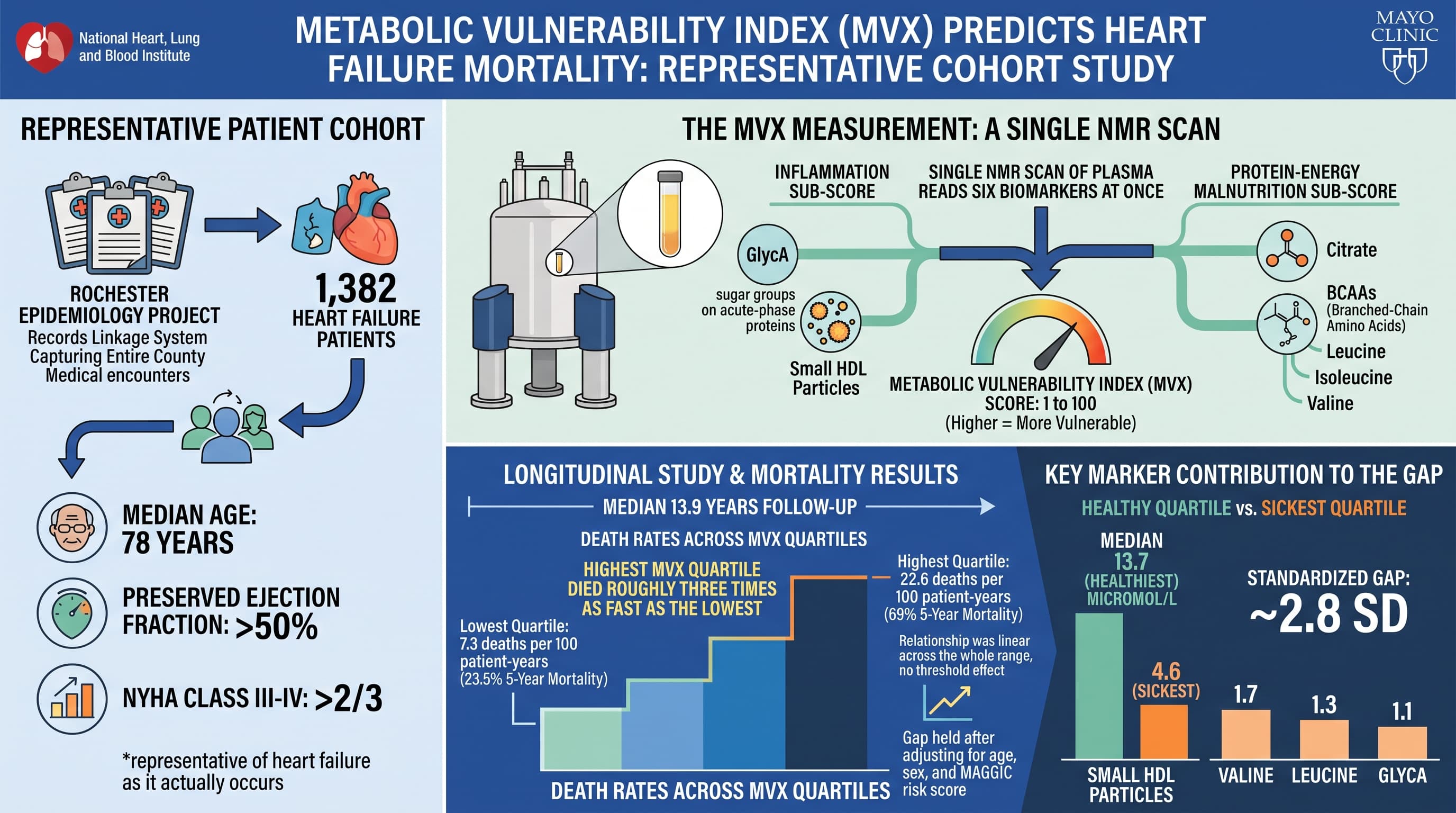
Researchers at the National Heart, Lung, and Blood Institute and Mayo Clinic applied a composite blood score called the Metabolic Vulnerability Index (MVX) to 1,382 heart failure patients drawn from an entire county’s medical records, then followed them for a median of 13.9 years. MVX is measured by a single nuclear magnetic resonance scan of plasma and combines two things that usually get measured separately: a marker of systemic inflammation and a set of markers reflecting protein-energy malnutrition. Patients in the highest MVX quartile died roughly three times as fast as those in the lowest, and that gap held after adjusting for age, sex, and the standard MAGGIC risk score.
For twenty years, cardiologists have argued about the “cytokine hypothesis” of heart failure: the idea that a failing heart is not simply a pump problem but a whole-body inflammatory and wasting disease. Patients lose muscle. They lose appetite. Their blood fills with signals of chronic immune activation. The problem has always been that these processes get measured one marker at a time, and no single marker has been convincing enough to change what doctors do on a Tuesday afternoon.
The Metabolic Vulnerability Index takes a different approach. A single nuclear magnetic resonance scan of a plasma sample reads out six things at once: GlycA, a signal arising from the sugar groups on acute-phase proteins, and small high-density lipoprotein particles, which together form an inflammation sub-score; plus citrate and the three branched-chain amino acids leucine, isoleucine, and valine, which form a malnutrition sub-score. The six are combined into one number from 1 to 100. Higher means more vulnerable (or more “metabolically frail”, as Jim Otvos has suggested we should think of it as).
This is the first time the score has been tested in heart failure, and the cohort is unusually good. Rather than recruiting from a specialist clinic or a drug trial, the team used the Rochester Epidemiology Project, a records linkage system that captures nearly every medical encounter in three Minnesota counties. That means the cohort looks like heart failure as it actually occurs, not as it appears after trial eligibility criteria have filtered out the old and the complicated. Median age was 78. Just over half had preserved ejection fraction. More than two-thirds were in NYHA class III or IV.
The results were graded and consistent. Death rates rose stepwise across the four MVX groups, from 7.3 per 100 patient-years in the lowest to 22.6 in the highest. Five-year mortality went from 23.5 percent to 69 percent. The relationship with mortality was linear across the whole range of scores, with no threshold effect.
The more interesting finding is what the score was not tied to. MVX showed no relationship with ejection fraction, the measure that currently sorts heart failure into its major treatment categories. Nor did it track closely with physical frailty; a companion study in the same cohort found the two correlate weakly and that MVX explains only a few percent of frailty’s mortality signal. Whatever MVX is detecting, it appears to sit in a different lane from both the pump and the patient’s visible condition.
The honest accounting comes when the statistical adjustments pile up. The near-threefold crude difference shrinks to about 1.5-fold once the MAGGIC score, NT-proBNP, and hemoglobin are all in the model. Added to a model already containing those three, MVX moved the concordance statistic from 0.71 to 0.72.
So the result cuts both ways. It supports the biology: inflammation and wasting carry mortality information that ejection fraction and natriuretic peptides do not capture. Two of the authors work for the commercial laboratory that owns the assay, the scoring algorithm is proprietary, and a follow-up study found MVX did not move measurably over twelve months, including in patients on active drug treatment.
Actionable Insights
Nothing here is a therapy. MVX is a risk label, and a follow-up study found it barely moved over a year even under active treatment, so lowering your score is not currently a demonstrated goal. What is useful is seeing which underlying markers did the separating, because those map onto things you can already measure and influence.
Small HDL particles separated the best and worst groups most sharply. Median 13.7 in the healthiest quartile versus 4.6 micromol/L in the sickest, a standardized gap of roughly 2.8 standard deviations, which is very large. Valine came next at about 1.7, GlycA at 1.1, and leucine at 1.3.
Note the direction on the amino acids. In metabolic syndrome research, high branched-chain amino acids signal insulin resistance. Here the opposite pattern carries the risk: low leucine, isoleucine, and valine, consistent with muscle catabolism. In an older, sick population, falling amino acids indicate you are burning your own tissue.
The practical reading: adequate protein intake and resistance training to defend muscle mass, and attention to chronic inflammation, are supported by the direction of these associations. They are not proven by this study, which was observational and tested no intervention.
Context and Source
- Open Access Paper: The Metabolic Vulnerability Index: A Novel Marker for Mortality Prediction in Heart Failure, Published 2023 Jul 19.
- Authors: Conners KM, Shearer JJ, Joo J, Park H, Manemann SM, Remaley AT, Otvos JD, Connelly MA, Sampson M, Bielinski SJ, Wolska A, Turecamo S, Roger VL
- Institutions: National Heart, Lung, and Blood Institute, National Institutes of Health, Bethesda, Maryland; Mayo Clinic, Rochester, Minnesota; LabCorp, Morrisville, North Carolina; NIH Clinical Center Department of Laboratory Medicine
- Country: United States
- Journal: JACC: Heart Failure, published by Elsevier on behalf of the American College of Cardiology Foundation.
- Impact Evaluation: The impact score of this journal is 11.8, evaluated against a typical high-end range of 0 to 60+ for top general science, therefore this is a High impact journal.
