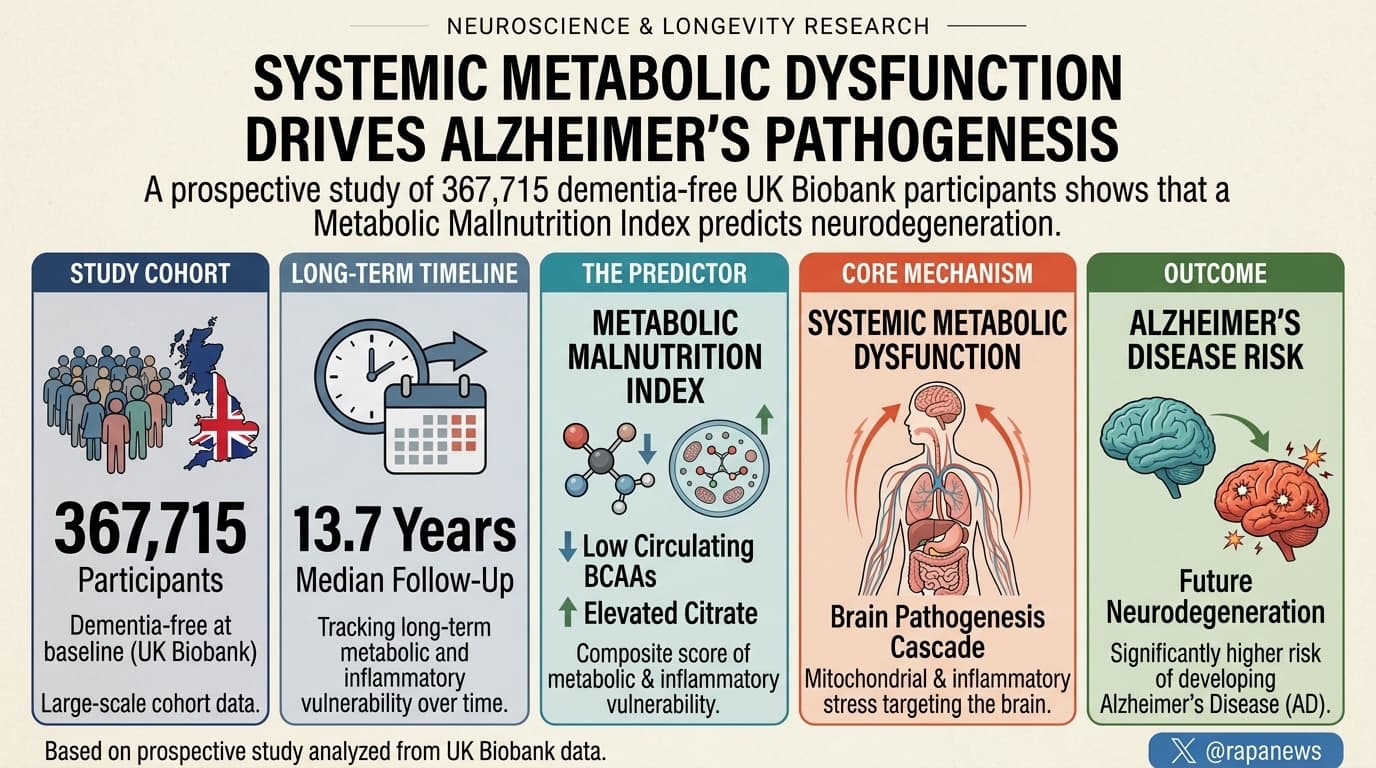
Metabolic Malnutrition and Amino Acid Depletion Emerge as Silent Drivers of Alzheimer's Disease

Systemic metabolic dysfunction is increasingly recognized as a core mechanism in the pathogenesis of Alzheimer’s disease. This prospective cohort study analyzed 367,715 dementia-free participants from the United Kingdom Biobank to determine if pre-established indices of metabolic and inflammatory vulnerability could predict future neurodegeneration. Over a median follow-up of 13.7 years, researchers found that the Metabolic Malnutrition Index, a composite score driven primarily by low circulating branched-chain amino acids and elevated citrate, was significantly associated with a higher risk of developing Alzheimer’s disease. Conversely, a systemic inflammatory index showed no predictive value for the disease.

Alzheimer’s disease etiology extends far beyond localized amyloid and tau accumulation into the broader realm of systemic metabolic failure. This study leverages the massive United Kingdom Biobank dataset to investigate whether composite indices of metabolic vulnerability can predict Alzheimer’s disease risk over a decade before clinical onset. The researchers tracked 367,715 dementia-free individuals for a median of 13.7 years and captured 2,615 incident cases of Alzheimer’s disease.

The investigation focused on three indices originally designed to predict all-cause cardiovascular mortality: the Metabolic Vulnerability Index, the Inflammatory Vulnerability Index, and the Metabolic Malnutrition Index. The data reveal a strict bifurcation in predictive power between metabolic and inflammatory markers. The Inflammatory Vulnerability Index, which aggregates glycoprotein acetyls and small high-density lipoprotein particles, showed no statistically significant association with Alzheimer’s disease after rigorous covariate adjustment.

Metrics driven by branched-chain amino acids demonstrated robust predictive utility. The Metabolic Malnutrition Index relies on a nonlinear combination of three branched-chain amino acids (leucine, isoleucine, valine) and citrate. Higher scores on this index indicate lower circulating branched-chain amino acids and elevated citrate. Participants in the highest quartile of the Metabolic Malnutrition Index faced a 47 percent greater relative risk compared to those in the lowest quartile. Individual analysis confirmed that higher levels of circulating leucine, valine, and isoleucine were inversely associated with Alzheimer’s disease risk, while elevated citrate was positively associated with the disease.

These findings suggest that systemic amino acid depletion and energy metabolism imbalances precede cognitive decline by many years. Branched-chain amino acids are critical for skeletal muscle maintenance and anabolic signaling pathways. Their depletion likely serves as a proxy for accelerating sarcopenia, impaired protein turnover, and systemic frailty. Furthermore, the elevation of circulating citrate points to tricarboxylic acid cycle bottlenecking and broader mitochondrial dysfunction. The data strongly suggest that maintaining skeletal muscle mass and ensuring adequate amino acid availability are crucial systemic defenses against neurodegeneration.

Actionable Insights
For individuals actively optimizing their healthspan, the practical takeaway is the critical importance of maintaining skeletal muscle and amino acid availability as a defense against neurodegeneration. The data show that low circulating branched-chain amino acids (leucine, valine, isoleucine) and high citrate levels are strong predictors of future Alzheimer’s disease.

To illustrate the real-world magnitude of this effect, we can examine the absolute and relative risk data. The baseline incidence of Alzheimer’s disease in this cohort was 0.71 percent over 13.7 years. Participants in the highest quartile of metabolic malnutrition experienced a fully adjusted 47 percent relative increase in risk compared to the lowest quartile (Hazard Ratio of 1.47). In absolute terms based on the cohort data, the disease incidence rate was 0.62 percent in the lowest quartile (570 cases out of 91,929 individuals) and rose to 0.87 percent in the highest quartile (801 cases out of 91,929 individuals). This yields an absolute risk increase of 0.25 percentage points. Translated to a standardized effect size, a Hazard Ratio of 1.47 represents a small practical effect (an approximate Cohen’s d of 0.25).

Actionable steps include prioritizing dietary protein intake rich in leucine to maintain anabolic signaling, engaging in regular heavy resistance training to build skeletal muscle, and monitoring metabolic health markers to prevent mitochondrial dysfunction.

Context/Source

Related Reading:

Biomarker Data (Effect Size Calculation)

The study measures human disease incidence over a 13.7-year median follow-up rather than maximum lifespan extension. The primary physiological biomarkers are composite scores of metabolic vulnerability.

  • Metabolic Malnutrition Index: A 1-standard deviation increase correlates with a Hazard Ratio of 1.16 (16 percent relative risk increase).

  • Metabolic Vulnerability Index: A 1-standard deviation increase correlates with a Hazard Ratio of 1.12 (12 percent relative risk increase).

  • Leucine: A 1-standard deviation increase correlates with a Hazard Ratio of 0.87 (13 percent relative risk reduction).

  • Valine: A 1-standard deviation increase correlates with a Hazard Ratio of 0.85 (15 percent relative risk reduction).

  • Isoleucine: A 1-standard deviation increase correlates with a Hazard Ratio of 0.92 (8 percent relative risk reduction).

  • Citrate: A 1-standard deviation increase correlates with a Hazard Ratio of 1.05 (5 percent relative risk increase).

  • Standardized Effect Size: The maximum observed effect size is a Hazard Ratio of 1.47 between the top and bottom quartiles of the Metabolic Malnutrition Index. This translates to a small standardized effect size (Cohen’s d equivalent of approximately 0.25).

And a related study from June, 2026:

Hidden Metabolic Vulnerability and BCAAs Predict Vascular Aging Before Clinical Symptoms

This study analyzes 150,591 participants from the UK Biobank to determine if multidimensional metabolic dysregulation predicts the onset of hypertension. The data indicates that composite metabolic vulnerability indices, specifically those tracking inflammation and branched-chain amino acids, strongly correlate with incident hypertension independent of traditional clinical risk factors.

Standard clinical assessments frequently fail to detect early-stage vascular aging and hypertension risk. The study introduces the Metabolic Vulnerability Index to capture nuanced metabolic perturbations before disease onset. This index combines an Inflammation Vulnerability Index and a Metabolic Malnutrition Index. The inflammatory component tracks GlycA, which is a marker of systemic inflammation, and small high-density lipoprotein particles. The malnutrition component tracks circulating branched-chain amino acids (leucine, valine, isoleucine) and citrate levels.

Over a long follow-up period, 32,198 individuals in the cohort developed clinical hypertension. Individuals in the highest quartile of inflammatory and overall metabolic vulnerability faced significantly elevated risks of hypertension. The predictive power of these metabolic biomarkers was significantly stronger in normal-weight individuals compared to obese participants. This data supports the concept of the metabolically unhealthy normal-weight phenotype, where individuals harbor hidden systemic inflammation and ectopic fat deposition despite maintaining a normal body mass index. The relationship between genetic susceptibility and these metabolic markers suggests a synergistic effect, where multidimensional metabolic dysregulation amplifies underlying genetic risks for vascular dysfunction.

Actionable Insights

Standard lipid panels are insufficient for optimal longevity planning and cardiovascular risk assessment. Advanced nuclear magnetic resonance spectroscopy assessing GlycA and specific amino acids provides a superior, non-linear risk gradient. For practical longevity protocols, controlling branched-chain amino acid accumulation and systemic inflammation represents a primary target for extending vascular healthspan. High circulating branched-chain amino acids are causally linked to the overactivation of the mammalian target of rapamycin (mTOR) pathway, leading to subsequent insulin resistance.

Effect size calculations reveal that being in the top 25 percent of metabolic vulnerability increases relative hypertension risk by 19 percent compared to the bottom 25 percent. A one standard deviation increase in inflammatory vulnerability raises relative risk by 9 percent. While statistically highly significant in a cohort of over 150,000 people, the absolute effect sizes remain modest. Assuming a baseline 21 percent cohort incidence of developing hypertension over the observed timeframe, a 19 percent relative increase translates to roughly a 4 percent absolute risk increase.

Context and Source Integration

1 Like

This is fascinating and also highly relevant in the situation where there are competing needs. For example, the study out of Loma Linda (my Dad’s group) recently showing that consumption of 5 eggs per week decreases risk of diagnosis of dementia by 27% another study showed an even greater effect.
https://www.eurekalert.org/news-releases/1126842 https://www.sciencedirect.com/science/article/pii/S002231662400289X

Eggs however don’t have enough of these 3 amino acids to make a huge difference.

As someone who has been a proponent of a whole food plant based … actually a nutritarian diet with added fish - preferably black cod as the best overall fish (small size, always wild caught and twice the omega 3’s as king salmon, and unlike fish capsules get across the BBB and will not be oxidized) based upon diminishing all cause mortality, this article points out an important issue that actually needs to be measured an addressed.

Thanks @RapAdmin for posting this as I will be integrating this into my care for all patients, no only those with ApoE4’s as half of AD cases are in the 76% of the population that do not have these genes.

So, if not from animal products (apart from eggs and fish) which typically has 1.85 grams (short of the goal of 2.5-3 grams leucine per meal) in 6 oz, an egg adds 0.5 grams … so 1 cup of edamame, 150 g of tempeh, 200 g extra-firm tofu, 30-40 g of soy or pea protein isolate, some lentils, beans or peas or a grain and some seeds (hemp/pumpkin) will typically hit the target per meal.

Now looking into how to measure this and costs at LabCorp self pay through Evexia, test 700068 does comprehensive testing at $275, doctors data does plasma amino acids for $251 and Genova dose them for $205.

It would seem reasonable add this one’s planning on diet, with the easiest way being animal proteins, which unfortunately have some mortality/cancer risk, but all of this needs to be balanced across all risks.

We know vegans have increased rates of late dementia and hemorrhagic strokes … but less vascular disease and cancer. The issue is sorting out the best of both worlds to protect the brain, blood vessels, metabolic disease and against malignancy.

On my search, if not done by food, I think this product is the best supplement to achieve this Amino Acid Supreme™

I know @Wisegye and I both have fullscript accounts and it can be heavily discounted through getting it there from anyone that has a fullscript account. When I buy it wholesale for myself it is near 50% off at <$40 per container. I think discounted on Fullscript as a consumer it’ll be up to 35% off of the $76 list price. Still a bit of cost, but I’m doing it for my wife and I.

1 Like

As you say, while there are benefits to consuming these animal products there are also associated risks. The diet has to be looked at in its totality, where some components that raise morbidity risks must be offset by other dietary components to counteract those risks. It’s the same with medication. For example, as I’ve said before, while my diet is plant forward, it has lacto-ovo pescetarian elements (lacto - non-fat kefir, omega-3 eggs, salmon/sardines/baby calamari) I consciously incorporate plants with higher levels of certain polyphenols, and take daily 10mg ezetimibe which should prevent dietary cholesterol from eggs/fish from being absorbed; however that in turn might affect omega-3 absorption, so I make an effort to increase food sources and supplement small amounts of pure EPA (500mg), and so on. In other words rather than focusing on singular dietary components, it’s the totality that matters, and while we do all we can to balance off all the risks and benefits, it’s impossible to get everything to the point where you only derive benefits while minimizing all risks.

The key realization for anyone trying to build an optimal diet is that it is literally impossible - there are inherent contradictions, and leaning in one direction often necessarily means increasing risk in another. This is where individualized medicine comes in. Your diet must lean away from your very particular vulnerability (say, ApoE4), even at the cost of increasing risk where your risk profile happens to be naturally lower. Pharmaceuticals are another layer you can use to further modify your risk profile on top of diet (or other interventions like exercise etc.). They all interact.