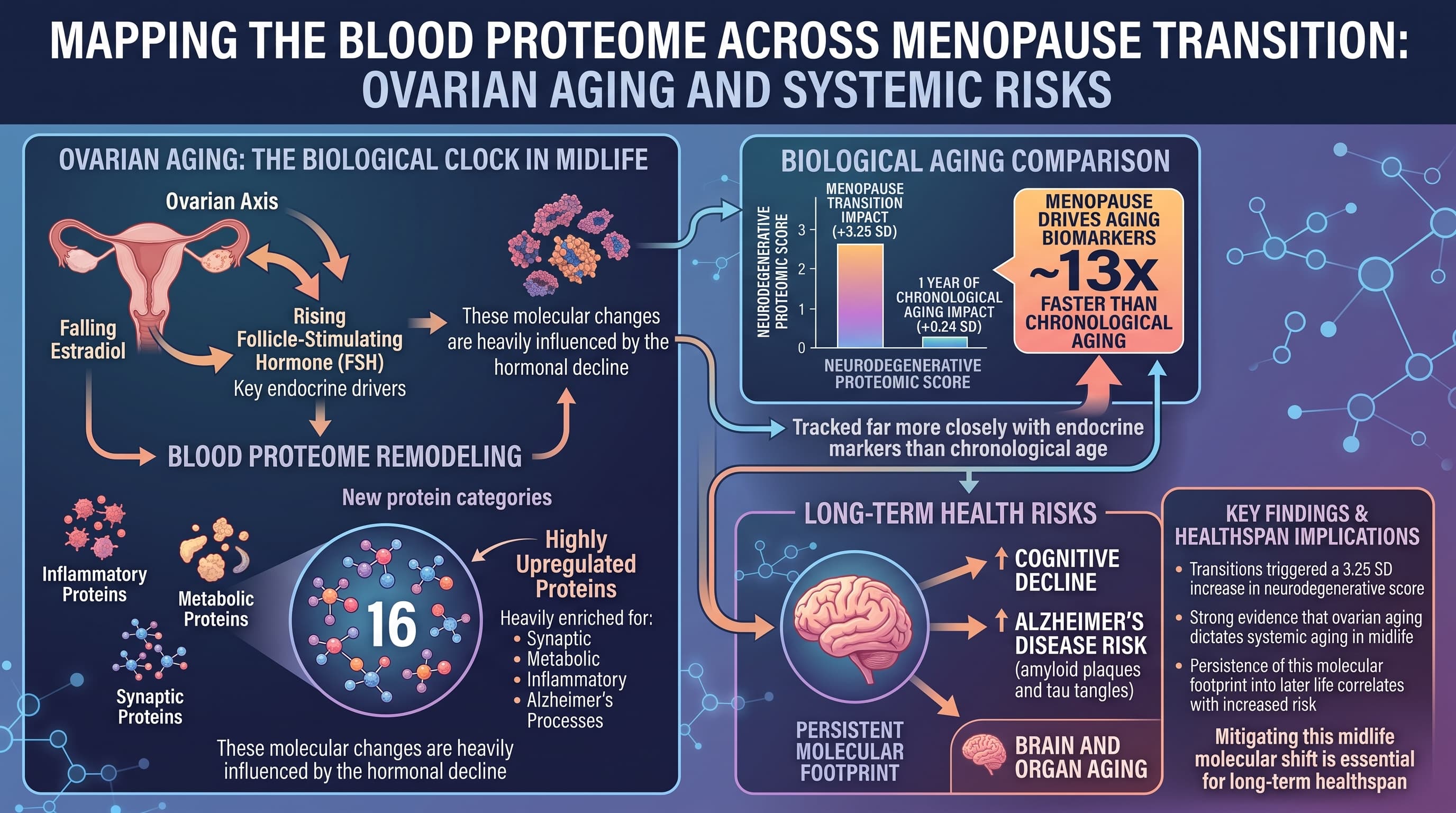
Researchers have mapped the blood proteome across the menopause transition, discovering that ovarian hormone decline triggers significant shifts in inflammatory, metabolic, and synaptic proteins. This proteomic signature, heavily influenced by rising follicle-stimulating hormone and falling estradiol, points to accelerated brain and organ aging. Importantly, this molecular footprint persists into later life, where it correlates with cognitive decline and an increased risk of Alzheimer’s disease.
The transition into menopause is a fundamental biological inflection point that extends far beyond reproductive senescence. Universal to midlife females, this period features a precipitous decline in ovarian hormones and a sustained increase in follicle-stimulating hormone. Accumulating data positions this endocrine shift as a primary driver of multisystem aging and a critical vulnerability window for neurological decline. Researchers utilized ultrasensitive nucleic acid linked immuno-sandwich assay proteomics to map the molecular footprint of this transition in a rigorously staged cohort of midlife women.
The investigation identified 16 specific proteins that become highly upregulated during the postmenopausal state. These molecules are heavily enriched for inflammatory, synaptic, metabolic, and Alzheimer’s disease biological processes. Critically, these proteomic shifts tracked far more closely with endocrine markers (specifically falling estradiol and rising follicle-stimulating hormone) than with chronological age. This strongly suggests that ovarian aging dictates the biological pace of systemic aging in midlife women.
Validation in a separate cohort of 2,814 women confirmed these findings and revealed a broader upregulation of catabolic pathways. Using proteomic aging clocks, the researchers demonstrated that postmenopausal status correlates with accelerated biological aging across multiple organ systems. The most pronounced age gaps were observed in the brain, the vascular network, and the immune system. At the cellular level, significant aging acceleration was documented in oligodendrocyte precursor cells, highlighting a specific structural vulnerability in the aging female brain.
The clinical relevance of this midlife molecular shift persists for decades. The researchers applied the identified menopause proteomic signature to four independent cohorts of older adults, tracking over 11,000 women. They discovered that higher menopause proteomic scores at baseline consistently predicted steeper trajectories of cognitive decline. Furthermore, a heavier proteomic signature correlated with an elevated risk of incident Alzheimer’s disease dementia up to 15 years later.
Vasomotor symptoms emerged as a potent clinical indicator of this underlying molecular turmoil. Women experiencing night sweats exhibited exaggerated increases in proinflammatory proteins, particularly CCL2. This suggests that severe menopausal symptoms are not merely temporary inconveniences but likely signal an aggressive, maladaptive physiological response characterized by vascular and systemic inflammation.
The big idea is that the foundational pathophysiology of female-biased neurodegeneration is established during the perimenopausal window. The hormonal withdrawal of menopause triggers an aggressive inflammatory and neurodegenerative proteomic cascade. Identifying these molecular changes provides a concrete framework for deploying targeted geroprotective interventions during midlife, rather than waiting for the clinical onset of dementia decades later.
Actionable Insights
For individuals focused on longevity optimization, these findings highlight midlife hormone transitions as critical intervention windows. Managing vasomotor symptoms is paramount. The data shows that night sweats strongly correlate with elevated systemic inflammation, specifically upregulating CCL2 and CXCL1. Treating these symptoms may mitigate downstream vascular and neurological damage.
Routine blood tracking should expand beyond standard lipid panels to include follicle-stimulating hormone during midlife. The analysis reveals that follicle-stimulating hormone elevation is uniquely associated with increases in the Alzheimer’s pathology marker BACE1 and synaptic degradation proteins. Interventions that suppress pathological follicle-stimulating hormone spikes warrant further investigation for neuroprotection.
The magnitude of the menopause transition dwarfs normal chronological aging. Transitioning to a postmenopausal state triggered a 3.25 standard deviation increase in the neurodegenerative proteomic score. For comparison, one standard year of chronological aging only increased this score by 0.24 units. The menopause transition effectively drives these specific aging biomarkers roughly 13 times faster than standard chronological aging. Furthermore, higher baseline menopause proteomic scores in older age translated to a 15 percent relative risk increase for developing Alzheimer’s disease (Hazard Ratio 1.15). Mitigating this midlife molecular shift is essential for long-term healthspan.
Context and Source
- Open Access Paper: Blood proteomics of menopause map to brain aging and dementia risk, Published: 22 September 2026.
- Institution: University of Toronto, University of California San Francisco, University of California Santa Barbara, and others
- Country: Canada and United States
- Journal Name: Nature Medicine
- Impact Evaluation: The impact score of this journal is 82.9, evaluated against a typical high-end range of 0–60+ for top general science, therefore this is an Elite impact journal.
Related Reading:
- A guide to extend longevity by delaying menopause (Age1)
- Women Taking Rapamycin for Enhanced Fertility / Menopause Prevention?
- Hormone Replacement Therapy Shows Targeted Dementia Protection in Critical 46 to 56 Age Window
- Mechanisms of Ovarian Aging: A Target for Geroprotection in Women, Yousin Suh, Columbia U
- The Body’s Hidden Metronome: Why Ovarian Aging Dictates Whole-Body Female Longevity Long Before Menopause
- Is Delaying Menopause the Key to Longevity? (NY Times)
- Later Menopause, Not Hormone Therapy, Predicts Better Cognitive Trajectories in Aging Women