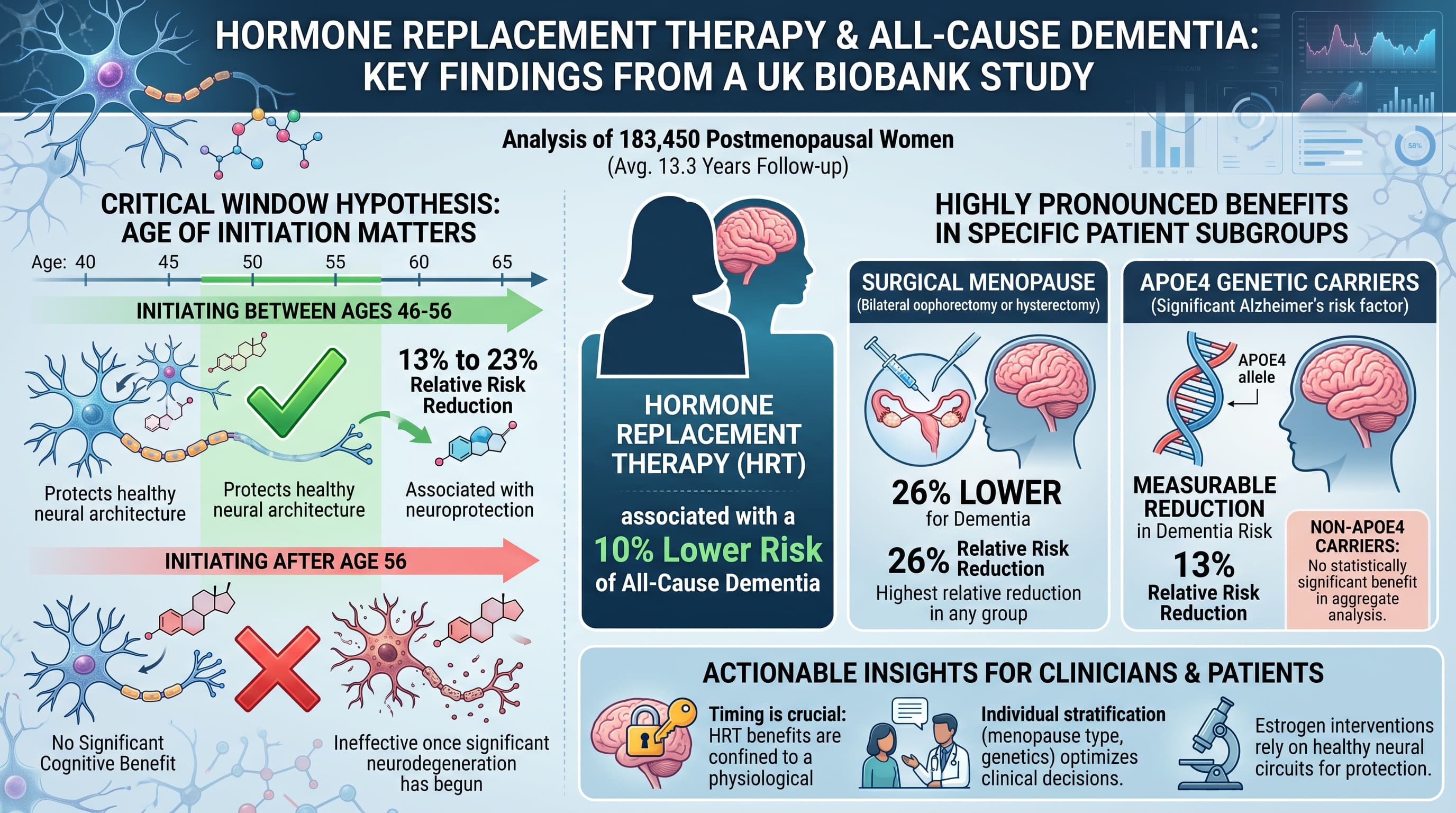
An analysis of 183,450 postmenopausal women in the UK Biobank reveals that hormone replacement therapy is associated with a 10% lower risk of all-cause dementia. The protective effects are highly dependent on patient subgroups, with surgical menopause patients, APOE4 genetic carriers, and those initiating treatment between ages 46 and 56 experiencing the most significant neurological benefits.
The relationship between hormone replacement therapy and cognitive decline has remained one of the most contested areas in neuroendocrinology. Early observational data suggested that estrogen protected the aging female brain, but the landmark Women’s Health Initiative Memory Study found that hormone replacement therapy actually increased dementia risk in women over 65. This conflicting data created decades of clinical hesitation. A new prospective analysis of the UK Biobank cohort provides a highly specific map of who benefits from hormone therapy and when those benefits accrue.
Researchers analyzed over 180,000 postmenopausal women tracked for an average of 13.3 years. Instead of treating all hormone therapy users as a monolithic group, the study stratified participants by menopause type, genetic risk factors, lifetime estrogen exposure, and the precise age they started treatment. The data shows that the timing of intervention dictates the outcome. Initiating hormone therapy between the ages of 46 and 56 is associated with reduced dementia risk, while starting after age 56 yields no significant cognitive benefit. This confirms the “critical window” hypothesis, suggesting that estrogen interventions require relatively healthy neural architecture to confer protection and may be ineffective or harmful once significant neurodegeneration has begun.
The protective association is exceptionally pronounced in specific clinical subgroups. Women who underwent surgical menopause (bilateral oophorectomy or hysterectomy) experienced a 26% lower hazard ratio for dementia when using hormone therapy compared to those who did not. Genetic factors also heavily influenced the outcomes. Carriers of the APOE4 allele, which is the most significant common genetic risk factor for Alzheimer’s disease, demonstrated a measurable reduction in dementia risk with hormone therapy use. Conversely, women without the APOE4 allele did not show a statistically significant benefit in the aggregate analysis.
The findings heavily favor precision medicine over generalized prescribing guidelines. The data strongly suggests that the female brain requires continuous estrogen exposure for metabolic and synaptic maintenance. When that exposure is cut short prematurely by surgery or late menarche combined with early menopause, the neurological deficit is severe. Hormone therapy appears to bridge this specific biological deficit. The study provides a foundational argument that hormone prescribing protocols should integrate a woman’s surgical history, genetic background, and exact age to maximize longevity and cognitive healthspan.
Actionable Insights The practical application of this data hinges on timing and individual risk stratification. For clinical practitioners and patients, the most actionable takeaway is that the neuroprotective benefits of hormone replacement therapy are confined to a specific physiological window. Initiating therapy between ages 46 and 56 yields a 13% to 23% relative risk reduction in all-cause dementia. Starting therapy after age 56 completely nullifies this benefit.
The magnitude of the intervention is highest for women who undergo surgical menopause. In this subgroup, hormone therapy is associated with a 26% relative risk reduction for dementia. For APOE4 carriers, hormone therapy provides a 13% relative risk reduction. To put this into absolute terms based on the cohort data, the baseline incidence of dementia over a 13-year period is roughly 2.1%. A 26% relative reduction (as seen in the surgical menopause group) translates to an absolute risk reduction of approximately 0.55%. While this absolute number appears small in a 60-year-old cohort, dementia incidence scales exponentially with age. Delaying or mitigating the onset vectors during the perimenopausal transition likely yields compounding benefits in later decades. If you have an APOE4 allele or experienced an early loss of endogenous estrogen, discussing perimenopausal hormone therapy with a clinician is a highly supported biohacking strategy.
Context/Source
- Open Access Paper: Hormone replacement therapy and dementia risk among postmenopausal women: Identifying responsive subgroups in the UK Biobank, published: 26 August 2026.
- Institution: University of Exeter Medical School, Norwich Medical School, University of Oxford
- Country: United Kingdom
- Journal Name: Alzheimer’s & Dementia
- Impact Evaluation: The impact score of this journal is 13.0, evaluated against a typical high-end range of 0 to 60 for top general science, therefore this is a High impact journal.