Measure Your Arteries, Not Your Telomeres: What the Stiffening Loop Says to Track

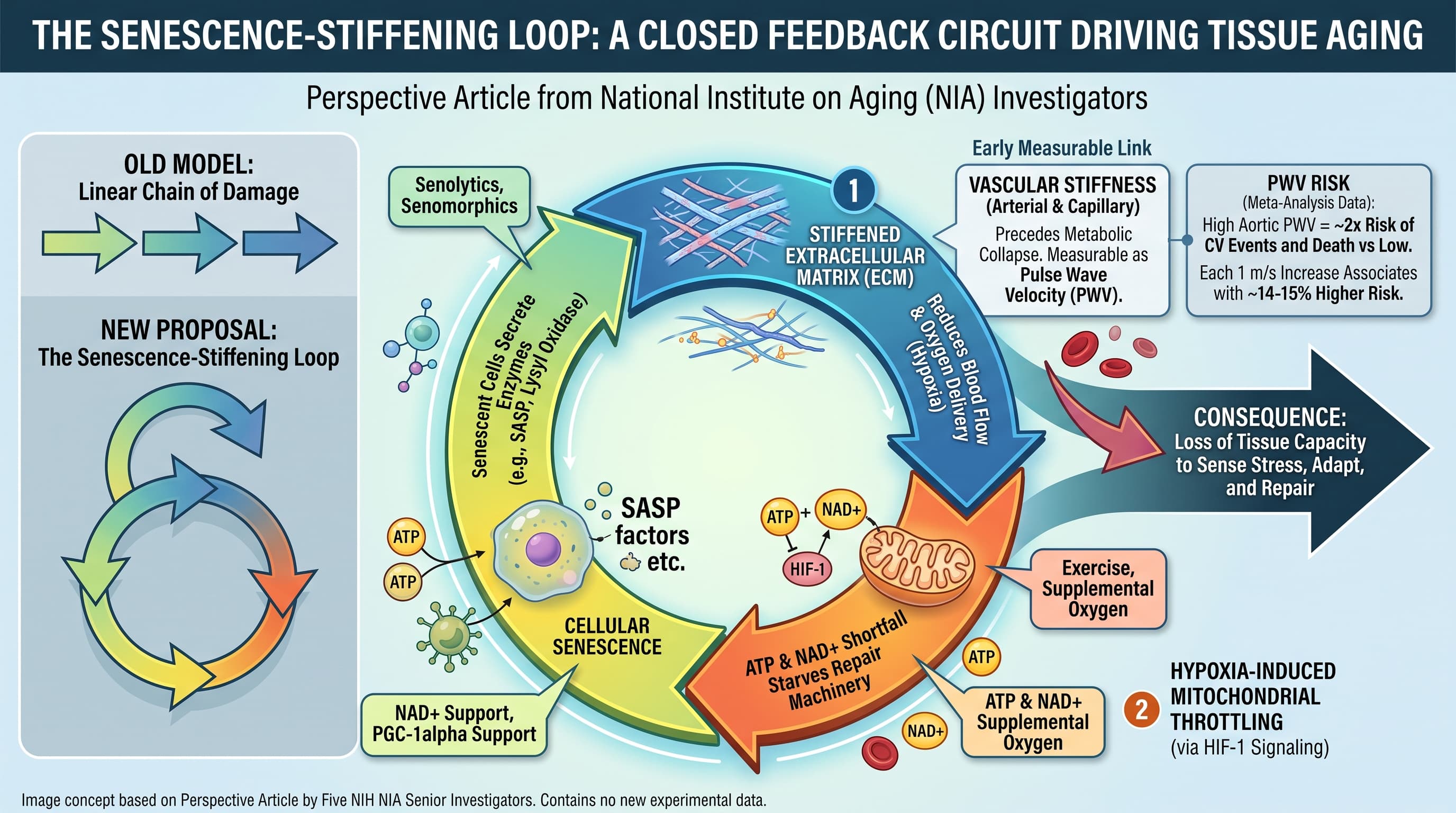
Five senior investigators at the US National Institute on Aging propose that tissue aging is driven not by a linear chain of damage but by a closed feedback circuit. Stiffening of the extracellular matrix reduces blood flow and oxygen delivery; the resulting hypoxia forces cells to throttle their own mitochondria via HIF-1 signaling; the ensuing ATP and NAD+ shortfall starves repair machinery and pushes cells into senescence; senescent cells then secrete the exact enzymes that stiffen the matrix further, closing the loop. The authors call this the senescence-stiffening loop and argue it explains why aging tissues lose the capacity to sense stress, adapt, and repair. This is a Perspective article. It contains no new experimental data.

Aging research has spent two decades cataloguing hallmarks. This Perspective from Luigi Ferrucci’s group at the National Institute on Aging attempts something different: it wires several of those hallmarks into a single circuit and argues that the circuit, rather than any one component, is what makes a tissue old.

The circuit starts with the extracellular matrix, the collagen and elastin scaffold that every cell sits inside. With age that scaffold stiffens. Lysyl oxidase enzymes weld collagen fibers together, sugars form permanent glycation cross-links, elastin fragments, capillary basement membranes thicken, and the endothelial glycocalyx thins. A stiff matrix means vessels cannot dilate on demand and new capillaries fail to sprout. Capillary density falls. Tissue oxygen supply falls with it.

Then comes the metabolic step, and this is the paper’s most interesting move. Low oxygen stabilizes HIF-1, which deliberately shuts mitochondria down: PDK1 blocks pyruvate from entering the TCA cycle, NDUFA4L2 suppresses complex I, and complex IV swaps subunits. That is a sensible short-term protective response and a catastrophic long-term one, because glycolysis cannot fund protein quality control, DNA repair, or the constant ion pumping that keeps cells alive. ATP and NAD+ decline, sirtuins lose their fuel, damaged mitochondria fragment and leak their DNA and oxidized cardiolipin, and those fragments trip the cGAS-STING and NLRP3 alarms. Cells go senescent. Their secretions include the matrix enzymes that started the story.

Two arguments lift this above a tidy narrative. The first uses human mitochondrial disease as a natural experiment: fast, Leigh-type disease kills neurons outright with little fibrosis, whereas slow mitochondrial disease of liver, muscle, and heart reliably produces fibrosis. That pattern suggests chronic energy failure actively drives matrix remodeling rather than merely accompanying it.

The second addresses a real puzzle. Population averages of cognition and mobility decline roughly linearly, yet individuals often report a cliff. The authors argue that redundancy buffers the loop invisibly for years until buffering capacity is exhausted, and that frailty is what that failure looks like from the outside.

Therapeutically, they point to entry points on every arc: senolytics and senomorphics, cross-linking inhibitors, anti-glycation compounds, glycocalyx repair, NAD+ and PGC-1alpha support, exercise, and even supplemental oxygen.

Insights

What it does change is which measurements matter. The loop’s earliest and most measurable link is vascular: arterial stiffness and capillary function precede the metabolic collapse. Arterial stiffness is cheaply measurable as pulse wave velocity, and the external literature the paper builds on is where the real magnitudes live. In pooled observational meta-analysis, people in the high aortic pulse wave velocity group carry roughly twice the risk of cardiovascular events and death compared with the low group, and each 1 m/s increase associates with roughly 14 to 15 percent higher risk.

The only intervention in the paper credited with acting on multiple arcs of the loop simultaneously is endurance exercise, which the authors say reverses microvascular rarefaction, improves glycocalyx integrity, and reduces matrix glycation in animals. Glycemic control matters for the same reason: glycation cross-links are permanent and cumulative.

Everything else listed, including senolytics, lysyl oxidase inhibitors, anti-glycation agents, and hyperbaric oxygen, is named as investigational. Treat it as a research agenda.

Context and Source

  • Open Access Paper: The senescence-stiffening loop: Extracellular matrix remodeling, hypoperfusion, and mitochondrial dysfunction drive tissue aging
  • Authors: Luigi Ferrucci, Stefano Donega, Allison B. Herman, Rafael de Cabo, Myriam Gorospe
  • Institution: National Institute on Aging, National Institutes of Health, Baltimore, Maryland.
  • Country: United States
  • Journal: Cell Metabolism, volume 38, September 1, 2026.
  • Impact Score: The impact score of this journal is 37.0 (most recently reported Journal Impact Factor; Scopus CiteScore 40.7), evaluated against a typical high-end range of 0 to 60+ for top general science, therefore this is an Elite impact journal.

Related Reading:

2 Likes

Umm, so it does have a start point. It answers the chicken eggness of this loop. If I fall off a mountain cliff, you can then go into a long chain of negative consequences, bone rupture, blood loss, hypoxia, and so on down the line - very nice. But, hello, it starts with my falling off the cliff, what happens once I hit the ground is of academic interest. I’d like to focus on the “not falling in the first place”, thanks. Spend more time there, instead of detailing all the gory consequences once you’re lying immobile on the rocks below. The talk should be all about staying on top of the cliff, how to not slide, slip, or take the wrong step. Instead, this is like a safety course that goes “it all starts with falling off the cliff, and when you hit the ground, a chain if complex processes disrupts the homeostasis of the organism in following ways blah, blah, blah…”. A hand goes up in the audience: “Hi, could you speak more as to how to avoid that first domino, the first step that results in falling off the cliff? Thanks!” - vigorous applause from the audience; the lecturer rustles his papers “uhm, good question, but this is not the focus of today’s lecture”. Sounds of chairs falling and notebooks shut as the audience files out, murmurs and shuffling feet.

Now, about that “with age that scaffold stiffens” - LOL, can we have more about that, please? Because that’s the falling off the cliff part, the rest is picking up the pieces. Inquiring minds want to know. YMMV.

1 Like

I’ll share my regimen, which seems to be yielding good results so far:

  • aerobic and resistance exercise up to 3x/week, your favorite
  • a statin
  • a GLP1 agonist
  • more recently, an SGLT2 inhibitor

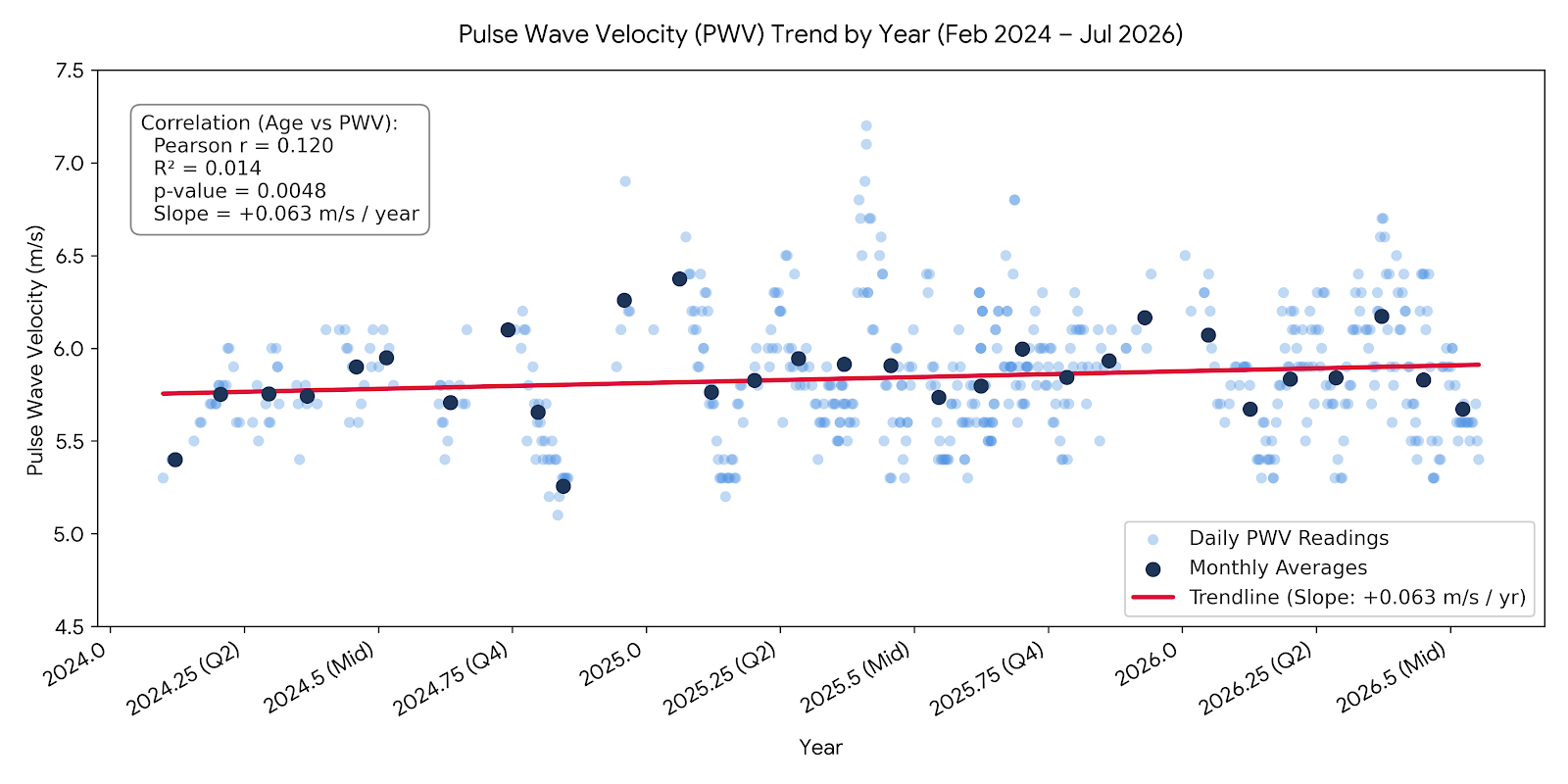
Here is my PWV trendline of year-vs-PWV from the last year or so:

So in my case, there is a very weak positive correlation between age and PWV over this 2-year observation window. The R^2 is 0.014, which means that age only accounts for 1.4% of the daily variations on PWV readings. In interpret this as: aging is not the main driving factor in my PWV values.

2 Likes

I asked Gemini to look into the possible therapeutic approaches to addressing these issues, as identified (senolytics and senomorphics, cross-linking inhibitors, anti-glycation compounds, glycocalyx repair, NAD+ and PGC-1alpha support, exercise, and even supplemental oxygen).

Here is that initial rating/ranking.

Evaluation and Ranking of Therapeutic Interventions

Ranking from highest level of evidence to lowest based on human clinical data and systemic safety.

  1. Exercise (Highest Proof) Exercise is the most potent modulator of the matrix-vascular-metabolic axis. It reverses microvascular rarefaction, improves glycocalyx integrity, and reduces advanced glycation end-products. The evidence base in human trials is absolute and undisputed.

  2. Senolytics and Senomorphics (Moderate to High Proof) Senolytics (dasatinib, quercetin, fisetin) and senomorphics (rapamycin, metformin) target senescent cells to reduce the senescence-associated secretory phenotype. Pilot studies in humans, such as the 2019 trial of dasatinib and quercetin for idiopathic pulmonary fibrosis, demonstrate clinical feasibility. Senomorphics like rapamycin have extensive human safety data and profound preclinical lifespan data.

  3. NAD+ and PGC-1alpha Support (Moderate Proof) Repleting NAD+ pools or activating sirtuins enhances mitochondrial quality control and reestablishes cellular energetic flexibility. Human trials demonstrate that NAD+ precursors can alter metabolic signatures, but translation to hard clinical longevity outcomes remains under investigation.

  4. Glycocalyx Repair (Low to Moderate Proof) Strategies using sulodexide or hyaluronan aim to restore the endothelial glycocalyx and improve shear stress mechanotransduction. Preclinical models show benefit, but human trials in older adults have yielded mixed results. Phase 3 clinical trials evaluating sulodexide for diabetic microalbuminuria have demonstrated some glycocalyx restoration, but longevity applications lack robust data.

  5. Anti-glycation Compounds (Low Proof, Safety Concerns) Compounds like aminoguanidine, pyridoxamine, and carnosine derivatives target the formation of advanced glycation end-products that stiffen the extracellular matrix. While mechanistically sound, human trials for aminoguanidine (Pimagedine) in diabetic nephropathy were halted due to safety concerns and lack of efficacy. Pyridoxamine shows safety in phase 2 trials but requires larger systemic validation.

  6. Cross-linking Inhibitors (Preclinical Only) Inhibitors of lysyl oxidase, such as PXS-5153A, relax collagen architecture to restore matrix compliance. These compounds are strictly confined to preclinical models of fibrosis and myocardial infarction. Safety Data Absent in human longevity applications.

  7. Supplemental Oxygen (Theoretical/Preclinical) Targeted oxygen support, such as hyperbaric or normobaric oxygen therapy, is proposed to counteract local hypoxia and boost mitochondrial oxidative phosphorylation. This remains largely theoretical for systemic anti-aging, with limited standardized human trials targeting the matrix-vascular axis.

Part 4: Actionable Intelligence (Deep Retrieval & Validation Mode)

Exercise

  • Feasibility & ROI: 4x4 high intensity interval training, rucking, and zone 2 steady state cardio are immediately accessible and completely free.
  • Sourcing: Available.
  • Cost vs. Effect: Zero monthly cost. Maximum marginal gain for improving VO2 max, endothelial shear stress, and reducing matrix glycation.

Senolytics and Senomorphics

  • Feasibility & ROI: Rapamycin (senomorphic) and Dasatinib (senolytic) require prescriptions. Quercetin and Fisetin are available over the counter.
  • Sourcing: Rx (Rapamycin, Dasatinib) and Supplement (Fisetin, Quercetin).
  • Cost vs. Effect: A weekly rapamycin protocol costs approximately $10 to $40 monthly depending on sourcing. Fisetin costs roughly $20 monthly. The ROI is high given the systemic suppression of the inflammatory secretome.

NAD+ Precursors (NMN / NR)

  • Feasibility & ROI: Widely available as dietary supplements.
  • Sourcing: Supplement.
  • Cost vs. Effect: $30 to $100 monthly. The marginal gain for overt structural matrix repair is theoretical, though mitochondrial energetic buffering is supported by biomarker shifts.

Glycocalyx Repair (Sulodexide / Hyaluronan)

  • Feasibility & ROI: Sulodexide is a prescription medication in some countries and a research chemical in others. Hyaluronan is an accessible supplement.
  • Sourcing: Rx / Research Chemical (Sulodexide); Supplement (Hyaluronan).
  • Cost vs. Effect: Sulodexide costs approximately $50 to $150 monthly. The ROI for non-diabetic individuals is unproven, as effects in healthy older adults are inconsistent.

Anti-glycation Compounds (Aminoguanidine / Pyridoxamine)

  • Feasibility & ROI: Aminoguanidine is available as a research chemical but carries unacceptable toxicity. Pyridoxamine is heavily regulated and difficult to source reliably. L-carnosine is a cheap, available alternative.
  • Sourcing: Research Chemical (Aminoguanidine); Supplement (Carnosine).
  • Cost vs. Effect: Carnosine costs $15 monthly. Aminoguanidine has a negative ROI due to halted clinical trials and adverse effect profiles.

Cross-linking Inhibitors (PXS-5153A)

  • Feasibility & ROI: Strictly a research chemical.
  • Sourcing: Research Chemical. Not approved for human consumption.
  • Cost vs. Effect: Safety Data Absent. ROI cannot be calculated. Do not consume.

Targeted Oxygen Therapy (HBOT)

  • Feasibility & ROI: Requires specialized clinical chambers. Soft-shell home chambers do not reach therapeutic atmospheres absolute.
  • Sourcing: Clinical Service.
  • Cost vs. Effect: $200 to $500 per session. Extremely low ROI for general longevity given the high cost and theoretical mechanism against matrix stiffening.