Luteolin Dental Gel Slashes Plaque and Inflammation in Canine Trial

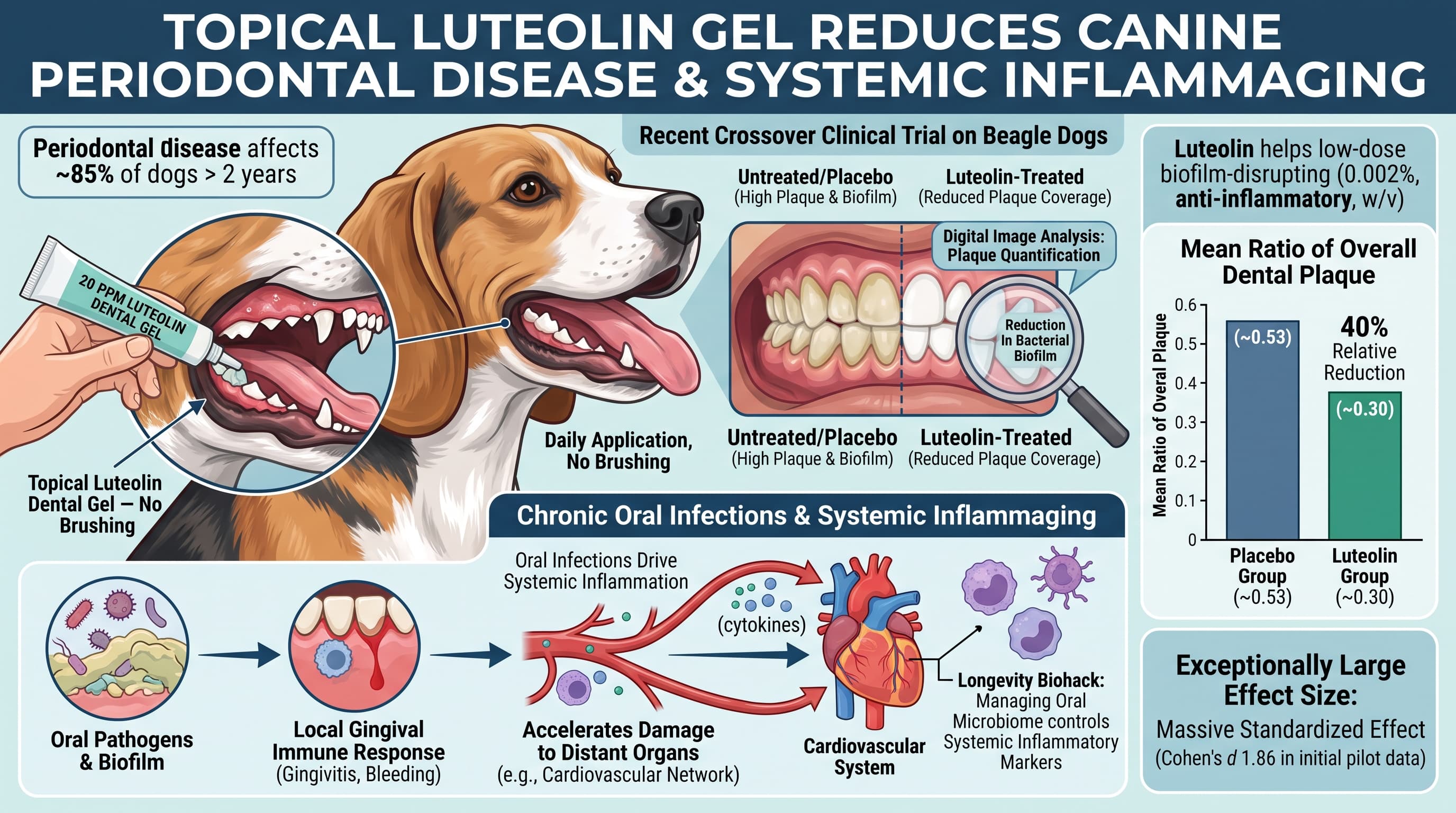
A recent crossover clinical trial demonstrated that a topical dental gel containing 20 ppm of the flavonoid luteolin significantly reduced dental plaque accumulation and gingival inflammation in beagle dogs over a 30-day period. By utilizing digital image analysis to quantify plaque coverage, researchers found that daily application of the luteolin formulation without mechanical brushing robustly inhibited both newly formed and mature bacterial biofilms.

Periodontal disease is a chronic inflammatory and infectious condition affecting roughly 85 percent of dogs over two years of age. However, it is not merely an isolated dental issue. Chronic oral infections drive systemic inflammation, contributing heavily to the biological aging process known as inflammaging. Oral pathogens and local gingival immune responses reliably elevate circulating pro-inflammatory cytokines, accelerating damage to distant organ systems, including the cardiovascular network. A new paper presents a promising intervention utilizing a naturally occurring flavonoid.

Researchers sought to evaluate the efficacy of luteolin, a bioactive compound extracted from Olea europaea (olive) pits, in combating canine dental plaque. Luteolin has attracted considerable scientific interest due to its documented ability to inhibit bacterial growth and downregulate key pro-inflammatory pathways. The study was designed as an in vivo crossover trial involving six healthy male beagle dogs. Following professional dental scaling and polishing under general anesthesia, the dogs received a daily topical application of a gel containing 20 ppm luteolin for 30 consecutive days without any concurrent mechanical brushing. After a subsequent professional cleaning, the dogs underwent a 30-day placebo phase where they received a gel containing identical excipients but lacking the luteolin.

The topical luteolin treatment significantly curtailed the accumulation of both newly formed and mature dental plaque. Furthermore, clinical assessments utilizing a standardized index for gingival bleeding showed marked improvements when the dogs were treated with the active luteolin formulation.

The biological rationale for these outcomes centers on luteolin’s established ability to disrupt anaerobic biofilm formation and inhibit key pro-inflammatory mediators in the gingival tissue. While the research focused exclusively on dogs, the underlying mechanisms of plaque formation and the host inflammatory response are highly conserved across mammalian species. Controlling the oral microbiome is a critical component of human and animal longevity protocols. Chronic periodontitis maintains the immune system in a persistently active state, increasing systemic oxidative stress. If a topically applied, low-concentration flavonoid can effectively halt biofilm maturation and gingival bleeding without mechanical abrasion, it represents a highly efficient strategy to lower the overall inflammatory burden. The fact that luteolin achieves these results at an exceptionally low concentration of merely 0.002 percent weight-by-volume suggests a highly potent localized mechanism of action. This trial provides early but compelling evidence that targeted botanical formulations can meaningfully alter periodontal disease progression.

Actionable Insights

For individuals looking to optimize their own, or their companion animals’ health, specifically those susceptible to periodontal disease, this study offers a highly practical intervention. Applying a 20 ppm luteolin dental gel daily without brushing significantly lowers microbial plaque load and gingival bleeding.

The effect size observed in this study is exceptionally large and clinically meaningful. The initial pilot data calculated a Cohen’s d of 1.86, representing a massive standardized effect. In the full trial, the mean ratio of overall dental plaque in the placebo group was approximately 0.53, while the luteolin group averaged roughly 0.30. This translates to a mean absolute reduction ratio of 0.216, effectively representing a 40 percent relative decrease in total plaque accumulation.

For longevity biohackers, the takeaway extends beyond canine health. Managing the oral microbiome is essential for controlling systemic inflammation and cardiovascular risk. Luteolin exhibits potent biofilm-disrupting and anti-inflammatory properties at an exceptionally low dose of 0.002 percent weight-by-volume. Formulating or sourcing a comparable low-concentration luteolin topical agent presents a low-risk, high-reward strategy to minimize chronic gingivitis and reduce systemic inflammatory markers.

Context/Source

Related Reading

3 Likes

DYI Luteolin Dental Gel

Creating a functional luteolin-based dental gel requires overcoming significant physical chemistry challenges, primarily regarding solubility, uniform dispersion, and oxidative stability.

Formulating a Simple Luteolin Dental Gel

The clinical trial achieved efficacy using an exceptionally low concentration of 20 ppm (0.002% w/v) luteolin isolated from Olea europaea pits. To replicate the vehicle used in the study, a formulation must balance abrasive, humectant, and surfactant properties while maintaining the flavonoid’s integrity. The researchers utilized a base of sorbitol, deionized water, PEG 1500, cellulose gum, hydrated silica, sodium lauroyl sarcosinate, and sodium fluoride.

A practical, reproducible base utilizing accessible laboratory or cosmetic-grade ingredients would require:

  • Active Agent: Luteolin powder (target: 20 mg per 1 kg of total gel mass to achieve 20 ppm).

  • Solvent/Humectant (40-50%): Sorbitol and Polyethylene Glycol (PEG) 1500 are necessary because luteolin is highly hydrophobic and exhibits poor aqueous solubility. The PEG acts as a critical co-solvent.

  • Aqueous Phase (20-30%): Deionized water.

  • Thickener/Binder (1-2%): Cellulose gum.

  • Abrasive (10-20%): Hydrated silica.

  • Surfactant (1-2%): Sodium lauroyl sarcosinate (a milder alternative to sodium lauryl sulfate).

Admixing Luteolin into Commercial Toothpaste

Simply mixing raw luteolin powder into an off-the-shelf commercial toothpaste is highly advised against due to three mechanical and chemical barriers:

  • Dispersion and Homogeneity: Achieving a 20 ppm distribution requires mixing exactly 2 mg of luteolin into a standard 100 g tube of toothpaste. Without a high-shear laboratory homogenizer, manual mixing will result in profound concentration gradients (“hot spots” of luteolin and areas with none).
  • Solubility Failures: Luteolin will not dissolve in the water phase of standard toothpastes. If it remains in crystalline powder form, it cannot adequately interact with the biological targets in the gingival tissue or penetrate the microbial biofilm. It must be pre-dissolved in a suitable solvent (like PEG or propylene glycol) before incorporation.
  • pH Incompatibility: Many commercial toothpastes—particularly those marketed for whitening or containing baking soda—maintain an alkaline pH (8.0 to 9.0). Flavonoids are highly unstable in alkaline environments and rapidly undergo ring-cleavage and autoxidation, rendering them biologically inert.

Shelf Stability and Degradation Kinetics

The exact shelf-life of the study’s experimental formulation is an identified knowledge gap, as the paper does not publish the stability data or degradation kinetics of their specific gel over months. However, flavonoids in aqueous solutions are susceptible to oxidative degradation, hydrolysis, and photodegradation.

Assuming proper stabilization in a sealed, opaque tube stored at room temperature, a properly formulated luteolin gel could remain stable for 3 to 6 months. Conversely, poorly mixed DIY formulations exposed to oxygen and light would likely see the luteolin degrade into inactive metabolites within weeks.

Required Preservatives and Stabilizers

To extend usability over several months, specific stabilizing agents are mandatory. The reference study utilized the following mechanisms to protect the formulation:

  • Antioxidants: The study incorporated tocopherol (Vitamin E) to scavenge free radicals and prevent the oxidative degradation of the luteolin.

  • pH Adjusters: Citric acid was included in the study formulation. Luteolin requires a slightly acidic to neutral pH (approximately 5.5 to 6.5) to maintain structural stability. Citric acid also acts as a chelating agent, sequestering trace metal ions that would otherwise catalyze flavonoid oxidation.

  • Antimicrobial Preservatives: Because the gel contains deionized water, it is susceptible to bacterial and fungal growth. While the study relied on the low water activity provided by high concentrations of sorbitol and the inherent properties of sodium lauroyl sarcosinate, commercial scalability for months-long storage typically requires explicit broad-spectrum preservatives, such as potassium sorbate or sodium benzoate, to ensure microbial safety.

Step by Step Instructions:

Standard Operating Procedure: 20 ppm Luteolin Dental Gel Formulation

The following protocol outlines the benchtop synthesis of a 100-gram batch of 20 ppm luteolin dental gel, replicating the formulation parameters established in the canine in vivo trial. Due to the extreme potency of the active ingredient at low concentrations, precise analytical measurements and sequenced phase mixing are required to prevent active compound degradation and ensure homogeneous dispersion.

Required Laboratory Equipment

(note: Home kitchen equivalents are identified further down in this post)

  • Analytical Balance (minimum 0.001g precision).
  • Heated magnetic stirrer with PTFE-coated stir bars.
  • Overhead high-shear laboratory mixer (necessary for proper cellulose gum hydration).
  • pH meter.
  • Glass laboratory beakers.

Reagents (100.00 g Yield Target)

Manufacturing Protocol

To execute this practically, you must replace direct measurement with a geometric dilution protocol (creating a liquid stock solution) and substitute laboratory hardware with specific kitchen appliances capable of controlled physical chemistry.

Laboratory to Residential Hardware Equivalents

Laboratory Equipment Practical Residential Substitute Rationale / Application
Analytical Balance Digital Milligram Scale Standard kitchen scales are useless here. A digital scale with 0.001 g (1 mg) resolution is mandatory to weigh the initial luteolin for the stock solution.
Heated Magnetic Stirrer Multicooker Water Bath Utilize a multicooker set to a low-temperature “keep warm” or fermentation setting (target 50°C) to gently melt the solvent without denaturing the active compounds.
High-Shear Overhead Mixer Immersion (Stick) Blender Required to properly hydrate the thickener (gum) into the water without forming impenetrable clumps.
Calibrated pH Meter Narrow-Range pH Strips Necessary to confirm the final product sits between 5.5 and 6.5. Alkaline environments rapidly destroy flavonoids.

Accessible Reagent Substitutions

  • PEG 1500 Co-Solvent: Substitute with food-grade Propylene Glycol (PG) or Vegetable Glycerin (VG). These are liquid at room temperature and highly effective at solubilizing hydrophobic flavonoids.
  • Deionized Water: Substitute with Distilled Water from a pharmacy. Do not use tap water; trace minerals will catalyze oxidative degradation of the luteolin.
  • Cellulose Gum: Substitute with Xanthan Gum, which is easily procurable at grocery stores and exhibits excellent shear-thinning gel properties.

The Dilution Workaround: Creating a 1% Luteolin Stock Solution

To bypass the impossibility of measuring 2 mg, you will formulate a concentrated liquid stock.

  1. Place a small glass vessel on the milligram scale and tare it to zero.
  2. Weigh exactly 0.100 g (100 mg) of luteolin powder.
  3. Add exactly 9.900 g of Propylene Glycol or Vegetable Glycerin to the vessel.
  4. Place the vessel in the 50°C multicooker water bath and stir continuously until the powder is entirely dissolved and the liquid is transparent. Note: This yields 10 grams of a 1% luteolin solution. You will only use a fraction of this for the toothpaste. The remainder can be stored in an amber dropper bottle in the refrigerator.

Step-by-Step Home Manufacturing Protocol (Yield: 100 g)

Phase 1: Active Phase Preparation

  1. Place a small glass bowl on the milligram scale.

  2. Weigh exactly 0.200 g of your 1% Luteolin Stock Solution. This delivers exactly 2 mg of actual luteolin, matching the 20 ppm target concentration.

  3. Add 0.500 g of liquid Vitamin E (tocopherol) to the bowl. Stir to combine and set aside.

Phase 2: Aqueous Base and pH

  1. In a tall mixing jar (suitable for the immersion blender), combine 36.5 g of Distilled Water and 40.0 g of liquid Sorbitol (or Xylitol syrup).

  2. Add 0.3 g of Citric Acid powder. Stir until dissolved.

  3. Test the liquid with a pH strip. It must read between 5.5 and 6.5.

Phase 3: Gelation

  1. Submerge the immersion blender into the water/sorbitol mixture and turn it on to a high speed.
  2. While blending, slowly sift 1.5 g of Xanthan Gum into the vortex.
  3. Blend for 2 to 3 minutes, moving the blender up and down, until a thick, uniform, clump-free gel forms.

Phase 4: Integration

  1. Pour the active mixture (Phase 1) into the thick gel (Phase 3).
  2. Blend on low speed for 30 seconds to disperse the luteolin evenly throughout the matrix.

Phase 5: Abrasive Addition

  1. Remove the immersion blender.

  2. Add 15.0 g of Hydrated Silica powder (cosmetic grade).

  3. Manually fold the silica into the gel using a silicone spatula. Mix vigorously by hand for 3 to 5 minutes until the powder is fully absorbed and a paste consistency is achieved. Do not use the immersion blender for this step, as it will incorporate excessive air and ruin the paste’s density.

Transfer the finished paste immediately into an opaque silicone travel tube or airless pump bottle. To mitigate oxidation, compress the tube to expel all ambient air before sealing. Store the product in a cool, dark cabinet and discard after 90 days.

Consumer Sourcing & Pricing for 20 ppm Luteolin Gel Reagents

Reagent Primary Function Consumer Purchasing Source Approximate Pricing (USD)
Luteolin Powder (98% Purity) Active Bioflavonoid Bulk Naturals Wholesale $16.95 / 10 g
Propylene Glycol (USP) Solvent (PEG 1500 Substitute) Bulk Apothecary $12.00 / 1 lb
Tocopherol (Vitamin E T-50) Antioxidant Stabilizer MakingCosmetics via Etsy $19.00 / 1 fl oz
Distilled Water Aqueous Base Local Grocery or Pharmacy $1.50 / Gallon
Sorbitol (70% Solution) Humectant Wholesale Supplies Plus $10.76 / 1 lb
Citric Acid (Food Grade) pH Adjuster / Chelator Bulk Apothecary $6.00 / 1 lb
Xanthan Gum (Clear) Thickener Lotioncrafter $7.95 / 2 oz
Hydrated Silica (Cosmetic/Dental) Abrasive MakingCosmetics $23.90 / 8 oz
Sodium Lauroyl Sarcosinate Surfactant Crafting Cosmetics $13.82 / 2 fl oz

Procurement and Handling Limitations

Minimum Viable Quantities: Cosmetic and chemical suppliers do not sell raw reagents in the micro-quantities required for a single 100-gram test batch. You must purchase minimum bulk sizes, which typically range from 10 grams for active extracts to 1 pound for humectants. The total upfront capital required to acquire the complete baseline inventory is approximately $110.00 to $130.00. However, this procures enough raw material to synthesize thousands of individual 100-gram batches.