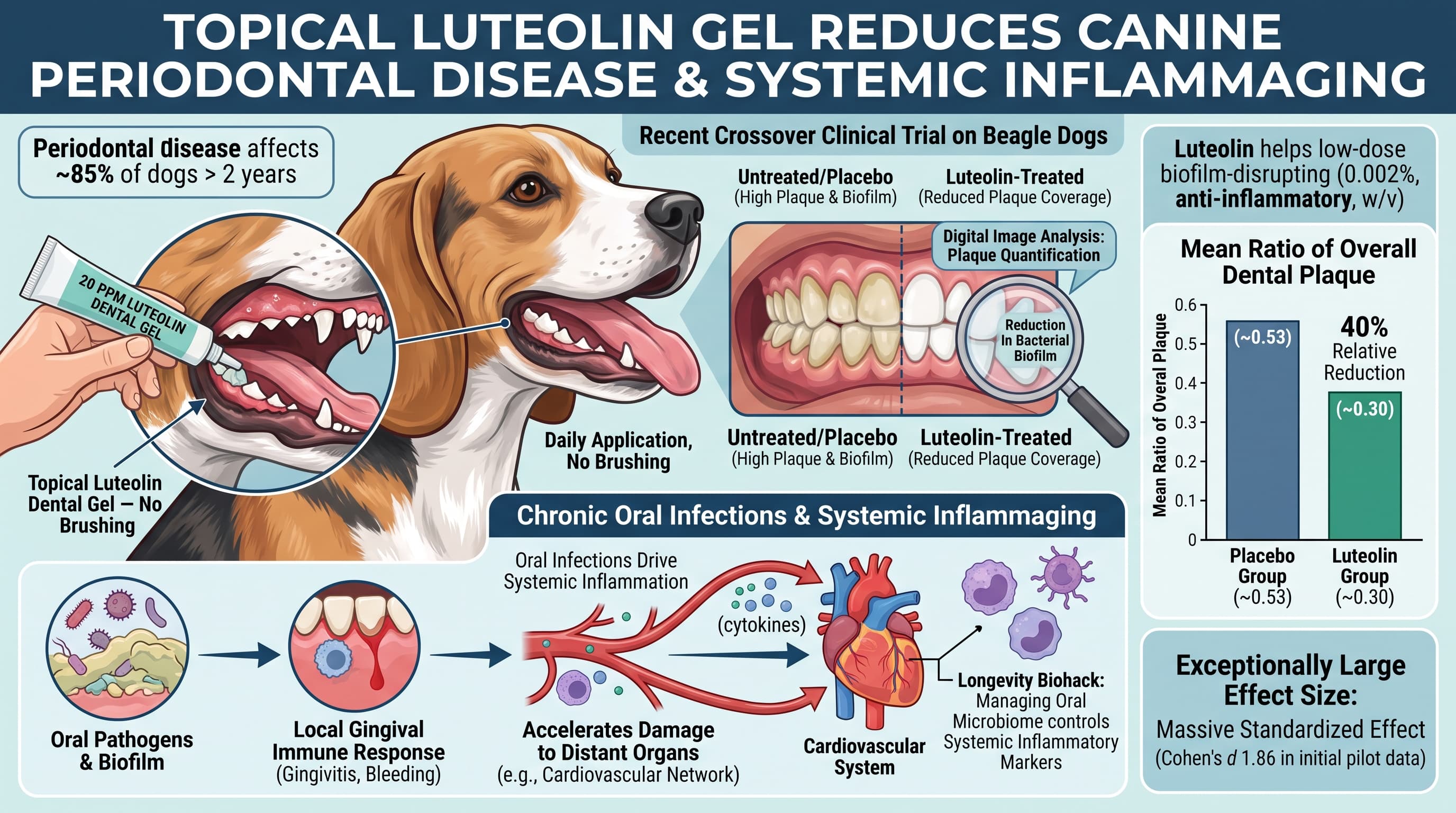
A recent crossover clinical trial demonstrated that a topical dental gel containing 20 ppm of the flavonoid luteolin significantly reduced dental plaque accumulation and gingival inflammation in beagle dogs over a 30-day period. By utilizing digital image analysis to quantify plaque coverage, researchers found that daily application of the luteolin formulation without mechanical brushing robustly inhibited both newly formed and mature bacterial biofilms.
Periodontal disease is a chronic inflammatory and infectious condition affecting roughly 85 percent of dogs over two years of age. However, it is not merely an isolated dental issue. Chronic oral infections drive systemic inflammation, contributing heavily to the biological aging process known as inflammaging. Oral pathogens and local gingival immune responses reliably elevate circulating pro-inflammatory cytokines, accelerating damage to distant organ systems, including the cardiovascular network. A new paper presents a promising intervention utilizing a naturally occurring flavonoid.
Researchers sought to evaluate the efficacy of luteolin, a bioactive compound extracted from Olea europaea (olive) pits, in combating canine dental plaque. Luteolin has attracted considerable scientific interest due to its documented ability to inhibit bacterial growth and downregulate key pro-inflammatory pathways. The study was designed as an in vivo crossover trial involving six healthy male beagle dogs. Following professional dental scaling and polishing under general anesthesia, the dogs received a daily topical application of a gel containing 20 ppm luteolin for 30 consecutive days without any concurrent mechanical brushing. After a subsequent professional cleaning, the dogs underwent a 30-day placebo phase where they received a gel containing identical excipients but lacking the luteolin.
The topical luteolin treatment significantly curtailed the accumulation of both newly formed and mature dental plaque. Furthermore, clinical assessments utilizing a standardized index for gingival bleeding showed marked improvements when the dogs were treated with the active luteolin formulation.
The biological rationale for these outcomes centers on luteolin’s established ability to disrupt anaerobic biofilm formation and inhibit key pro-inflammatory mediators in the gingival tissue. While the research focused exclusively on dogs, the underlying mechanisms of plaque formation and the host inflammatory response are highly conserved across mammalian species. Controlling the oral microbiome is a critical component of human and animal longevity protocols. Chronic periodontitis maintains the immune system in a persistently active state, increasing systemic oxidative stress. If a topically applied, low-concentration flavonoid can effectively halt biofilm maturation and gingival bleeding without mechanical abrasion, it represents a highly efficient strategy to lower the overall inflammatory burden. The fact that luteolin achieves these results at an exceptionally low concentration of merely 0.002 percent weight-by-volume suggests a highly potent localized mechanism of action. This trial provides early but compelling evidence that targeted botanical formulations can meaningfully alter periodontal disease progression.
Actionable Insights
For individuals looking to optimize their own, or their companion animals’ health, specifically those susceptible to periodontal disease, this study offers a highly practical intervention. Applying a 20 ppm luteolin dental gel daily without brushing significantly lowers microbial plaque load and gingival bleeding.
The effect size observed in this study is exceptionally large and clinically meaningful. The initial pilot data calculated a Cohen’s d of 1.86, representing a massive standardized effect. In the full trial, the mean ratio of overall dental plaque in the placebo group was approximately 0.53, while the luteolin group averaged roughly 0.30. This translates to a mean absolute reduction ratio of 0.216, effectively representing a 40 percent relative decrease in total plaque accumulation.
For longevity biohackers, the takeaway extends beyond canine health. Managing the oral microbiome is essential for controlling systemic inflammation and cardiovascular risk. Luteolin exhibits potent biofilm-disrupting and anti-inflammatory properties at an exceptionally low dose of 0.002 percent weight-by-volume. Formulating or sourcing a comparable low-concentration luteolin topical agent presents a low-risk, high-reward strategy to minimize chronic gingivitis and reduce systemic inflammatory markers.
Context/Source
- Full Title: Clinical evaluation of a luteolin-based dental gel on dental plaque accumulation and gingival inflammation in dogs
- Institution: Aristotle University of Thessaloniki; University of West Attica; University of Western Macedonia
- Country: Greece
-
Journal Name: Journal of Small Animal Practice
Impact Evaluation The impact score of this journal is 1.5, evaluated against a typical high-end range of 0 to 60+ for top general science, therefore this is a Low impact journal.
Related Reading
- Luteolin, an antioxidant in vegetables, may contribute to the prevention of hair graying
- Luteolin: A Flavonoid that Has Multiple Cardio-Protective Effects and Its Molecular Mechanisms
- New Study Funded: Towards reversing periodontal disease using Rapamycin
- DIY Rapamycin Toothpaste and Flossing Paste
- Your Mouth Could Hold the Secrets to a Longer and Healthier Life (WSJ)
- Routine oral health practices linked to all-cause mortality among older adults