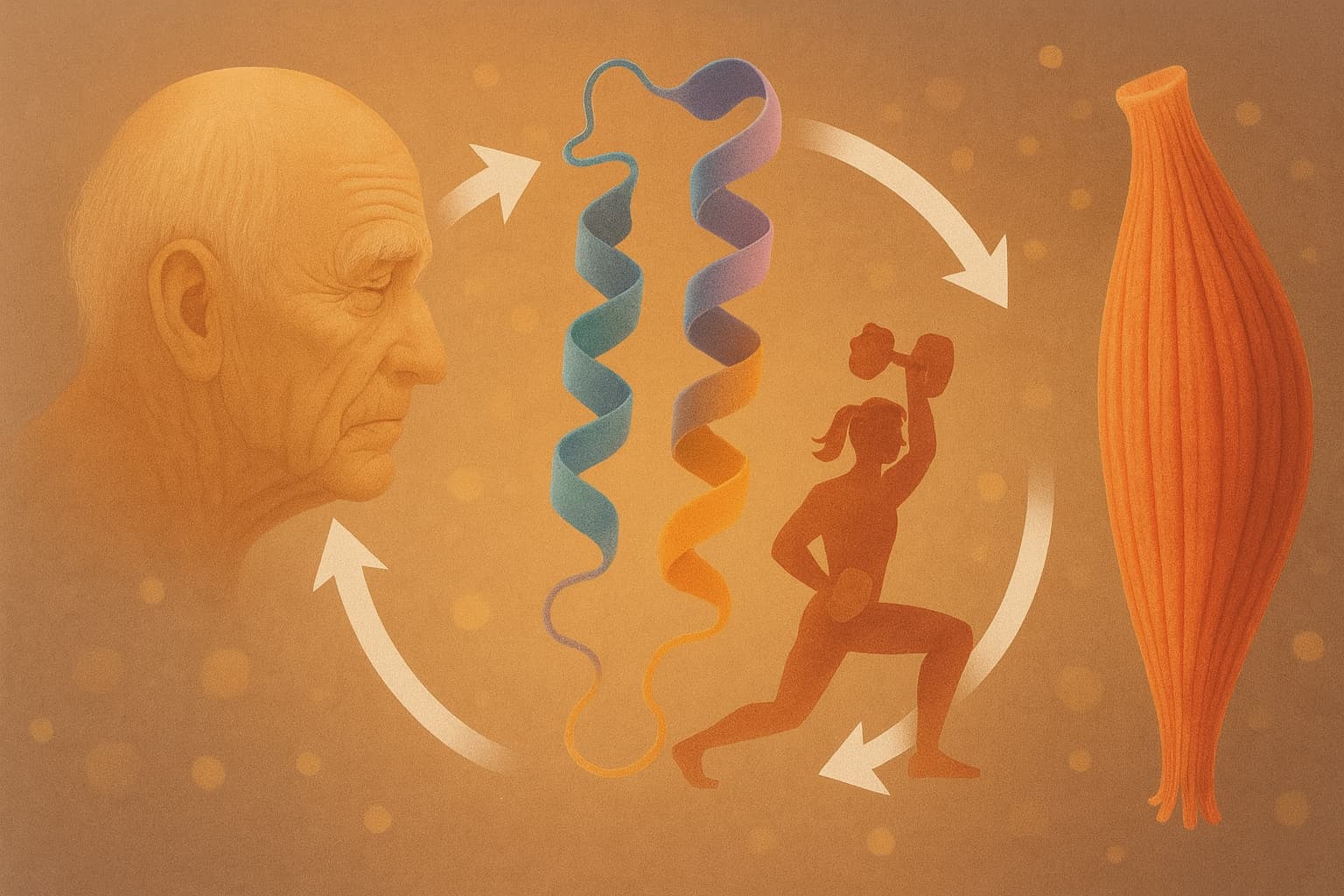
Lifelong Muscle Protection: The Key Factors are Aging, Protein, and Exercise

A new comprehensive review in Nutrients (Pérez-Castillo et al., 2025) delivers one of the clearest syntheses to date on why aging muscle becomes harder to maintain, why even lifelong athletes are not fully protected, and which nutrition–exercise strategies have the strongest mechanistic support for preserving muscle function across the lifespan. The paper focuses on “anabolic resistance”—the age-associated reduction in the muscle’s ability to build new protein in response to food and training—and reframes it as a preventable and modifiable hallmark of musculoskeletal aging rather than an unavoidable decline.

The central finding is blunt: most people over 40 experience a “right-shifted” response curve, meaning they need higher doses of anabolic stimuli—protein, essential amino acids, leucine, and training intensity—to achieve the same muscle-building signals that younger adults achieve with less. Stable-isotope tracer studies show that when older adults ingest small or moderate doses of protein, muscle protein synthesis rises less and rises more slowly. Even after resistance exercise, the synthetic response is blunted unless sufficient high-quality protein is consumed.

The review examines whether lifelong exercisers—so-called master athletes—escape this decline. The answer is more nuanced than commonly assumed. Lifelong endurance athletes exhibit superior insulin sensitivity, lower body fat, and better metabolic health than age-matched controls. Yet direct tracer studies show that their muscle protein synthesis response to exercise remains lower than in young athletes, and in some cases is no better than in untrained older adults. Lifelong fitness reduces secondary aging (inactivity, adiposity, poor glucose control), but does not eliminate the intrinsic age-related changes in muscle signaling.

Several modifiable drivers emerge as the most important accelerators of anabolic resistance: episodic inactivity, even for a few days; insulin resistance, which restricts amino acid delivery into muscle; and excess adiposity, which interferes with anabolic signaling pathways. These factors are common, cumulative, and fully amenable to lifestyle intervention.

On the nutritional side, the strongest evidence supports higher daily protein intakes—1.2 to 1.6 g/kg/day for active adults, up to ~2.0 g/kg/day during high training loads or recovery periods. Per-meal targets matter: older muscle requires 30–50 g of high-quality protein delivering at least 2.5–3 g leucine to reliably trigger robust synthesis. Leucine or essential-amino-acid enrichment can rescue sub-optimal meals, though long-term superiority over simply increasing total protein is unproven.

The review highlights EPA/DHA omega-3 fatty acids (~2–3 g/day) as a plausible enhancer of muscle protein synthesis and mitochondrial function, particularly in older women, though results vary across studies. HMB (3 g/day) shows protective effects in situations of immobilization or very high training stress, functioning more as an anti-catabolic buffer than a true anabolic signal.

For healthspan and longevity, the implications are direct. Maintaining muscle mass and strength is one of the strongest predictors of survival, independence, metabolic resilience, and late-life physical capability. This review reinforces a practical formula: combine progressive resistance training, vigilant avoidance of inactivity, optimized protein dosing, and targeted supplements when appropriate. Muscle aging is not inevitable; it is responsive to inputs. The biology of anabolic resistance may shift with age, but the pathway to preserving muscular longevity remains highly actionable.

Open Access Research (review) Paper: Age-Related Anabolic Resistance: Nutritional and Exercise Strategies, and Potential Relevance to Life-Long Exercisers

Note - Conflicts of Interest: Several authors are affiliated with Abbott Nutrition; the review leans heavily into protein supplements, leucine/HMB, and medical nutrition products.

Detailed ChatGPT5.1 Analysis of paper:

Related discussion thread: Are we wrong about the perfect protein intake?

4 Likes

So we are back too more protein? :stuck_out_tongue:

I am a huge supporter of more protein :muscle: in my daily diet and in my post muscle resistance workout meal.
Ah, I’d say it’s just one more data point on the protein issue. I was interested in it more for the overview of muscle aging standpoint… It has some weaknesses that are important to note.

Three of the five authors are from Abbot Nutrition; a company that sells lots of protein drinks and HMB products: HMB - Abbott Family. so the paper generally has a strong “protein and HMB” tilt that I’d ignore for dosing purposes.

2. Critical analysis

2.1. Strengths

  • Up-to-date, mechanistic synthesis: incorporates D₂O long-term MPS methods, not just short AV balance studies, and integrates work up to March 2025. MDPI
  • Clarifies primary vs secondary aging and the right-shifted dose–response paradigm for protein/leucine and exercise in older adults.
  • Explicit focus on master athletes, an under-discussed but clinically relevant cohort for “what is biologically possible” in aging muscle.
  • Balanced on n-3 and HMB: acknowledges mixed results and uncertainty rather than unqualified endorsement.

2.2. Limitations and potential biases

  1. Non-systematic narrative review
  • Search is described but not PRISMA-grade systematic; no risk-of-bias assessment or formal grading of evidence.
  • This opens the door to selection bias and over-emphasis on positive/interesting findings.
  1. Industry conflict of interest
  • Several authors are affiliated with Abbott Nutrition; the review leans heavily into protein supplements, leucine/HMB, and medical nutrition products.
  • HMB and specialized high-protein formulations are emphasized more than equally or better-supported alternatives (e.g., creatine, vitamin D, generic resistance-training programming), which are largely absent or peripheral.
  1. Surrogate endpoints vs clinical outcomes
  • The central outcome is MPS (fractional synthetic rate), a meaningful mechanistic marker but not validated as a direct surrogate for long-term muscle mass, strength, disability, or mortality.
  • Very few trials cited link these interventions to hard outcomes (falls, fractures, hospitalizations, long-term performance).
  1. Population and sex bias
  • Most MPS trials are small, short, and male-dominant; older women and non-white populations are under-represented. MDPI+1
  • Generalizing to the broader aging population, especially frail elders or women on GLP-1s/rapa, is speculative.
  1. Master athlete data are extremely sparse
  • The key conclusions about lifelong exercise not abolishing anabolic resistance are based on two small mechanistic studies with heterogeneous protocols.
  • There is no direct evidence on how different life-long training modalities (power vs endurance vs mixed) alter dose–response curves to protein/EAAs.
  1. Limited integration with broader geroscience
  • The review does not seriously engage with interactions between anabolic resistance and:
    • Chronic pharmacology (metformin, SGLT2i, GLP-1 RAs, rapamycin, AR antagonists).
    • Endocrine status (GH/IGF-1 axis, sex steroids) beyond brief mentions.
  • For a longevity-oriented audience, this is a glaring omission.

2.3. Where the evidence is strongest vs weakest

  • Strongest:
    • Age-related anabolic resistance is real and partially modifiable by higher protein/leucine doses and sufficient exercise intensity/volume. MDPI+2PubMed+2
    • Physical inactivity, disuse, adiposity, and insulin resistance exacerbate anabolic resistance.
  • Moderate:
    • n-3 PUFAs at ≥2–3 g/d EPA+DHA can enhance MPS and muscle quality in some older cohorts, especially women; effect sizes and reproducibility are modest and context-dependent. PMC+3MDPI+3PMC+3
    • HMB has moderate-certainty evidence for reducing exercise-induced muscle damage and preserving lean mass in older/immobilized adults; less clear that it meaningfully alters long-term function or mortality. PMC+1
  • Weakest/speculative:
    • Optimistic extrapolations that chronic leucine/EAA enrichment yields outcome advantages beyond what can be achieved with simply more total protein and high-quality sources.
    • Any implication that master athletes require substantially different nutritional rules than other highly active older adults; most recommendations generalize.
1 Like

I like having a few 50g protein meals daily. People can either gain, maintain, or lose weight using 50g protein meals as well.
Regarding HMB, I’ve tried it. Was not too impressed. Was more impressed with 50g of whey protein (or a extra lean protein source like chicken or plant protein powders) at a meal esp for the cost to performance aspect.
HMB is not cheap.
The other issue with adding HMB or other amino supplements such as BCAA’s (and perhaps leucine) is that it can lower dopamine and serotonin. More day time sluggishness.
Could consider adding more phenylalanine over tyrosine (at least for daytime amino type energy) as @DeStrider posted about recently on tyro vs phen issue.
I forget to add in that thread, that DL-phenylalanine is another cool amino acid as it is said to also boost endorphins. Not sure if that is 100% positive but it has good reviews on the DL version.
I didn’t like the D version as much, but I did like the L version and DL version.
There are probably a lot of other obscure aminos available.

So having all the aminos (like in meats, dairy etc), it’s probably the best options for amino balance.
Though, can also use a day vs night time amino ratio and maybe lower dopamine at night to get a better sleep… perhaps by adding more BCAA’s and/or collagen or glycine or taurine etc… stuff with low to no tyrosine, phenylalanine or other aminos that can boost certain energy pathways.

Creatine, beta alanine, citrulline, Gly/NAC are other good amino products to add to a big shake or meal.

Just be sure to get a high quality complete protein supplement as there’s been various consumer testing regarding heavy metals and/or not what’s on label in terms of amino acids or total protein etc.
3rd party tested supplements are a good option or web sites who test certain brands.

I think it’s a good way to do meal planning like 3 meals a day at 50g protein a meal, and adjust what % carbs and fats you want to add to it. Or even 2, 4, or 5 meals etc… and adjust the calories as what you are looking to accomplish with weight or muscle etc.

Another thing is the digestion time of various protein powders and amino supplements.
They might only last 1-2 hours for fast acting: whey isolate, whey hydrolysate, isolated amino acids.
So then one can mix various proteins together for a longer time for MPS, such as casein protein, whey concentrate etc.
There are graphs online that show the various digestion times of these.

Personally, I would pick these supplements for muscle, fitness, longevity in this order:
-whey protein concentrate (or whey isolate and micellar casein, though more $, or plant or collagen etc)
-multi vitamin & mineral (maybe extra vit D)
-creatine
-glucosamine (maybe with chondroitin) seems to test well in some longevity studies.
-not sure on the other rankings but isolated fats: omega 3 dha/epa or lecithin, gla etc,
plant extracts(protandim style, astaxanthin, or whatever you like), isolated amino acids, probiotics or prebiotics, various OTC hormones melatonin, dhea etc, isolated carbohydrates(complex, simple, fiber etc),
if at a pharmacy store can also consider NSAID’s, anti histamines, or anything else you like or tests well in longevity and/or muscles.

Prescription meds might include: testosterone, thyroid, hgh or igf-1, insulins, deca/nandrolone or other anabolic steroid, 5-AR inhibitors, metformin, glp1’s, cardiovascular meds, blood pressure meds, pde5-i’s,
whatever you enjoy really :smile:

3 Likes

They mentioned HMB in the study first posted in this thread and I saw this video so wanted to learn more (I’m not familiar with HMB), so here is the video/summary:

CGPT Video Summary:

A. Executive Summary

The video reviews β-hydroxy-β-methylbutyrate (HMB) as a supplement to mitigate age-related muscle loss, focusing on randomized controlled trials (RCTs) and meta-analyses in adults ≥50. Mechanistically, HMB is a leucine metabolite that modestly reduces muscle protein breakdown and may increase protein synthesis, with the net goal of preserving or increasing muscle mass and function.

Across ~20+ RCTs, pooled analyses in older adults show small but statistically significant improvements in muscle mass and physical function versus placebo or usual care. Effects are stronger and more consistent when HMB is combined with resistance training, and at doses around 3 g/day. Evidence in non-exercisers is weaker; several trials suggest little or no benefit without concurrent exercise.

However, the underlying evidence has important limitations: many trials are small, heterogeneous, and at moderate–high risk of bias; publication bias cannot be excluded; and most comparisons are against placebo rather than protein/leucine-matched controls. Direct head-to-head data vs leucine or optimized protein are sparse and inconclusive.

Formulation and dosage matter. Most clinical work uses 3 g/day of calcium-HMB; some pharmacokinetic data suggest differences between free-acid and calcium salt forms, but superiority in real-world outcomes remains unresolved.

The video concludes that HMB can modestly improve muscle mass and strength in older adults when dosed at ~3 g/day and paired with resistance training, but effect sizes are not large and it is not clearly superior to other muscle-supportive interventions. Creatine is highlighted as having a stronger evidence base and likely better overall risk–benefit for older adults when combined with resistance training.


Full video summary and evaluation:

2 Likes