HIV Medication Reverses Epigenetic Aging Markers in First Human Proof-of-Concept Trial

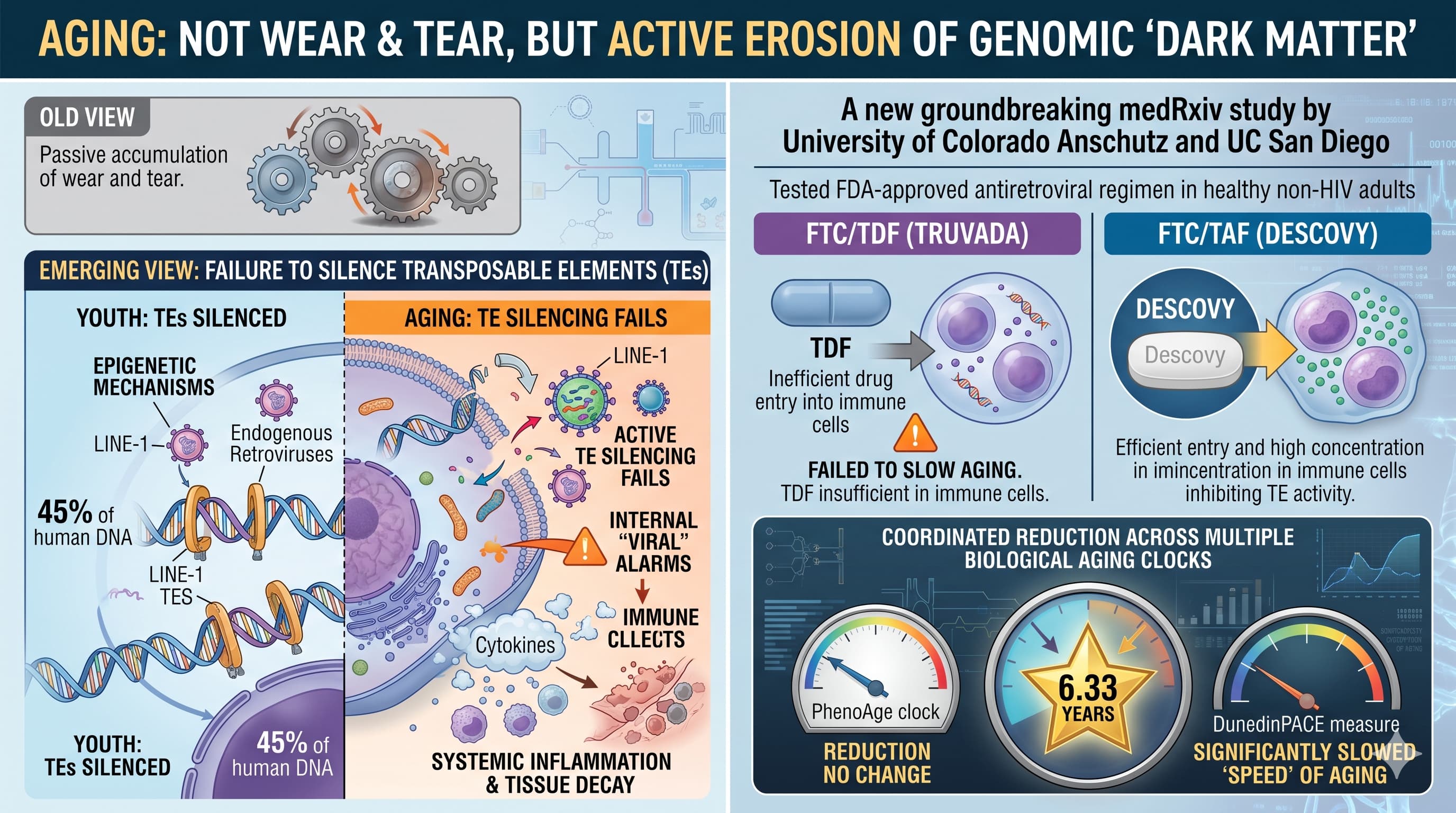
Aging is increasingly viewed not as a passive process of wear and tear, but as an active erosion of the “dark matter” in our genome. Roughly 45 percent of human DNA consists of transposable elements (TEs)—genetic “hitchhikers” like retrotransposons that are normally silenced by epigenetic mechanisms in youth. As we age, this silencing fails, allowing elements like LINE-1 and endogenous retroviruses to reactivate, triggering internal “viral” alarms that drive systemic inflammation and tissue decay.

A groundbreaking post-hoc analysis published on the preprint server medRxiv provides the first human evidence that pharmacological intervention can stall this process. Researchers from the University of Colorado Anschutz Medical Center and UC San Diego investigated the effects of two FDA-approved antiretroviral regimens—emtricitabine/tenofovir alafenamide (FTC/TAF, known as Descovy) and emtricitabine/tenofovir disoproxil fumarate (FTC/TDF, known as Truvada)—on healthy, non-HIV adults.

The results were formulation-specific and statistically significant. Participants taking FTC/TAF for 12 weeks demonstrated a coordinated reduction across multiple biological aging clocks. Most notably, the PhenoAge clock showed a reduction of 6.33 years (a reduction of 22% from the mean chronological age of the participants), and the DunedinPACE measure—which tracks the current “speed” of aging—slowed significantly. In stark contrast, the FTC/TDF group showed no such improvements, likely due to TDF’s inability to reach high enough concentrations inside the immune cells where retrotransposon activity occurs.

Beyond “clocks,” the TAF treatment shifted the immune system toward a more youthful state, increasing the pool of naive CD4+ T cells and reducing inflammatory markers like interleukin-6 (IL-6). By suppressing the reverse transcription of retroelements, TAF appears to lower the cellular “noise” that triggers the chronic inflammation of aging. There were no significant side effects or adverse events reported in this 12 week study in a healthy adults without HIV or chronic comorbidities. While exploratory, this study transforms a decades-old HIV drug class into a frontline candidate for longevity therapeutics.

Actionable Insights

For those seeking to leverage these findings for healthspan extension, the primary takeaway is the identification of tenofovir alafenamide (TAF) as a potent candidate for “geroprotection”. The study highlights a 12-week window as sufficient to observe measurable shifts in biological age markers, provided the compound achieves high intracellular concentration.

Practically, this research clarifies that not all reverse transcriptase inhibitors are equal; the TAF prodrug produces approximately seven-fold higher active metabolite levels in immune cells compared to TDF, despite using a lower systemic dose. This suggests that “intracellular loading” is the critical metric for suppressing the age-related inflammatory cascade.

The study’s use of healthy adults aged 18–50 suggests these pathways are active even before the onset of clinical old age. Individuals tracking their biological age via DNA methylation tests (like DunedinPACE) may find this mechanism—retrotransposon inhibition—a high-priority area for future clinical consultation.

Source

Study Design Specifications

  • Type: Post-hoc longitudinal analysis of two randomized, directly observed dosing (DOT) clinical trials.
  • Subjects: Healthy adults without HIV, aged 18–50.
    • FTC/TAF Group: N=36 (50% male, mean age 28.4 years).
    • FTC/TDF Group: N=43 (47% male, mean age 30.9 years).
    • Dosing: 12 weeks of continuous exposure (33%, 67%, or 100% of daily dosing).
  • Control Group: Both studies utilized baseline (pre-drug) measurements as internal controls for within-participant change.

Mechanistic Deep Dive

The study operates on the Retrotransposon-Inflammation Axis. The core finding is that TAF acts as a gerotherapeutic by targeting the cGAS-STING pathway indirectly.

  • cGAS-STING & SASP: Reactivated LINE-1 elements produce cytoplasmic DNA (cDNA). This cDNA is recognized by the cGAS sensor, triggering STING-mediated type I interferon signaling and the Senescence-Associated Secretory Phenotype (SASP).

  • Formulation Divergence: TAF is a lipophilic prodrug metabolized by cathepsin-A in immune tissues, leading to high intracellular levels of tenofovir-diphosphate (TFV-DP). TDF, conversely, is metabolized by plasma esterases, leading to high systemic (plasma) exposure but lower intracellular loading in the PBMCs where DNA methylation aging is measured.

  • Immune Rejuvenation: TAF specifically increased naive CD4+ T cells (p=0.008) and Regulatory T cells (Tregs) (p=0.049) while reducing neutrophils (p=0.048) . This indicates a shift from a pro-inflammatory myeloid-biased compartment toward a more youthful lymphoid-heavy profile.

  • Organ-Specific Priorities: System-specific clocks showed the most robust age reductions in Blood (-3.44 years, p<0.001), Metabolic (-3.38 years, p=0.005), and Heart (-3.23 years, p=0.009) systems .

Novelty

This is the first human proof-of-concept demonstrating that a specific NRTI (TAF) can systematically reduce multiple DNA methylation-based measures of biological age in healthy individuals. It bridges the gap between previous findings in SIRT6-deficient mice and human translation, specifically identifying intracellular pharmacokinetics as the “make-or-break” factor for NRTI-based longevity interventions.

Critical Limitations

  • Post-hoc Design: The studies were originally designed for pharmacokinetics, not aging; thus, they were not powered for these endpoints.
  • Short Duration: 12 weeks is a brief window for assessing biological aging. Long-term persistence or potential “rebound” effects are unknown.
  • Cohort Age: The participants were young (mean age approx. 29). It is uncertain if the effect size would be larger or smaller in an older cohort with higher baseline retrotransposon derepression.
  • No Placebo: Without a dedicated placebo arm, confounding factors (e.g., study-related lifestyle shifts) cannot be entirely ruled out.
  • Missing Data: The study lacks direct molecular readouts of LINE-1 mRNA or ORF1p protein levels to definitively prove that the clock changes were caused solely by retrotransposon suppression

Part 3: Claims & Verification

This section provides a rigorous external verification of the biological and medical claims presented in the study. Claims are evaluated based on a strict hierarchy of evidence, from human meta-analyses (Level A) to pre-clinical models (Level D).

1. Retrotransposon Reactivation as a Driver of Aging Hallmarks

  • Claim: The reactivation of Long Interspersed Element-1 (LINE-1) and endogenous retroviruses (ERVs) is a proximal driver of biological aging hallmarks, including the senescence-associated secretory phenotype (SASP).
  • Verification: Transcriptomic and methylomic datasets from large human cohorts show that the expression of most retrotransposon classes (except SINEs) correlates significantly with biological age-associated gene signatures Expression of Most Retrotransposons in Human Blood Correlates with Biological Aging (2024).
  • Evidence Level: Level C (Human Observational) / Level D (Pre-clinical).
  • Translational Gap: While the correlation is established in humans, the “proximal driver” status (causality) is currently supported primarily by transgenic rat and mouse models where functional LINE-1 increases pro-inflammatory markers and shortens lifespan The impact of LINE-1 retrotransposons on life span, SASP, and telomeres in vivo (2019).

2. NRTIs Suppress Age-Associated Inflammation in Pre-clinical Models

  • Claim: Nucleoside reverse transcriptase inhibitors (NRTIs) like lamivudine (3TC) suppress LINE-1 activity and reduce age-associated inflammatory signatures.
  • Verification: Lamivudine treatment in senescence-prone (SAMP8) mice has been shown to reverse age-related weight loss and improve spatial memory by downregulating transposable elements and type 1 interferon responses Lamivudine (3TC) - Alzheimer’s Drug Discovery Foundation (2021).
  • Evidence Level: Level D (Animal Models).
  • Translational Gap: No human trials prior to the current study have demonstrated preventative activity or longevity benefits of NRTIs in healthy, non-HIV populations.

3. FTC/TAF (Descovy) Reduces Biological Age in Humans

  • Claim: 12 weeks of FTC/TAF (200 mg/25 mg) reduces biological age (PhenoAge -6.33 years) and slows the pace of aging (DunedinPACE) in healthy adults.
  • Verification: This specific study Anderson et al. (2026) is the first to report this effect. There is currently no secondary independent RCT confirming these results in a healthy population.
  • Evidence Level: Level B (Human RCT - Post-hoc Analysis).
  • Confidence: Medium. The study is a post-hoc analysis with a small sample size (N=36 for TAF) and lacks a contemporaneous placebo group.

4. TAF Exhibits Superior Intracellular Loading Compared to TDF

  • Claim: Tenofovir alafenamide (TAF) achieves significantly higher intracellular tenofovir-diphosphate (TFV-DP) concentrations in immune cells compared to tenofovir disoproxil fumarate (TDF).
  • Verification: TAF preferentially loads peripheral blood mononuclear cells (PBMCs), resulting in approximately 7-fold higher intracellular TFV-DP concentrations than TDF, while maintaining 90% lower plasma tenofovir levels Tenofovir-diphosphate in PBMCs during low, medium, and high adherence (2021).
  • Evidence Level: Level B (Human RCT / Pharmacology).
  • Confidence: High. This pharmacokinetic divergence is well-documented and forms the basis for TAF’s clinical profile in HIV treatment.

5. FTC/TAF Reduces Inflammatory Proxies (IL-6 and CRP)

  • Claim: FTC/TAF exposure is associated with reductions in DNAm-derived IL-6 and C-reactive protein (CRP).
  • Verification: Clinical pharmacology studies confirm that TAF alters cellular bioenergetics and can reduce the inflammatory tone in immune cells, though most evidence currently exists within the context of HIV-positive patients switching from TDF to TAF Blood immune cells from people with HIV exposed to TAF versus TDF (2024).
  • Evidence Level: Level B (Human RCT).

6. Intracellular TFV-DP Exposure Determines the Gerotherapeutic Signal

  • Claim: Intracellular drug exposure is the critical determinant of the biological aging response, explaining why TAF worked and TDF did not.
  • Verification: EWAS modeling in the primary study showed that interindividual variation in intracellular TFV-DP was associated with DNA methylation changes at 8,350 repetitive element CpGs, supporting a dose-response relationship.
  • Evidence Level: Level B (Human RCT - Mechanistic Analysis).

Summary Table: Hierarchy of Evidence

Claim Supporting Evidence Hierarchy Level Confidence
TE Reactivation & Aging Human transcriptomics / Mouse models C/D Medium
NRTI Mechanism SAMP8 Mouse models D High (in mice)
TAF Pharmacology Human pharmacokinetic RCTs B High
TAF Biological Age Reduction Anderson et al. (2026) B (Preprint) Medium
TAF Immune Rejuvenation Anderson et al. (2026) B (Preprint) Medium

This analysis evaluates the percentage of biological age reduction observed in the FTC/TAF study group (N=36) relative to their mean chronological age of 28.4 years. Significant biological age reductions were observed exclusively in the FTC/TAF cohort after 12 weeks of exposure.

Biological Age Reduction Analysis (FTC/TAF Cohort)

The percentages below represent the degree of biological “rejuvenation” across various epigenetic clocks compared to the group’s baseline mean age. Negative values indicate a reduction in biological age, while positive values indicate an increase.

Biological Aging Clock Absolute Change (Years) Percent Reduction vs. Mean Age (28.4y) Significance (p-value)
PhenoAge -6.33 22.29% p = 0.008
AdaptAge -5.92 20.85% p = 0.027
Horvath -4.27 15.04% p = 0.023
PCHorvath2 -3.81 13.42% p = 0.020
PCHorvath1 -3.63 12.78% p = 0.015
SystemsAge (Whole Blood) -3.49 12.29% p = 0.008
Systems: Blood -3.44 12.11% p < 0.001
Systems: Metabolic -3.38 11.90% p = 0.005
Systems: Heart -3.23 11.37% p = 0.009
Systems: Hormone -3.05 10.74% p = 0.033
RetroClockv2 -2.78 9.79% p = 0.051
PCHannum -2.74 9.65% p = 0.081
PCPhenoAge -2.49 8.77% p = 0.145
Systems: Inflammation -2.42 8.52% p = 0.015
Hannum -2.37 8.35% p = 0.119
Systems: Brain -2.18 7.68% p = 0.039
Systems: Kidney -1.98 6.97% p = 0.147
PCGrimAge -1.39 4.89% p = 0.069
Systems: Musculoskeletal -1.28 4.51% p = 0.177
Systems: Liver -1.14 4.01% p = 0.317
Systems: Lung -0.78 2.75% p = 0.484
IntrinsicCapacity -0.56 1.97% p = 0.577
OMICmAge +0.35 1.23% (Increase) p = 0.638
DamAge +2.10 7.39% (Increase) p = 0.252

Pace of Aging Summary

The DunedinPACE clock measures the instantaneous rate of biological aging (years of biological decline per chronological year).

  • Baseline Rate: 1.0 (Standard aging pace).
  • Absolute Reduction: -0.061.
  • Percent Reduction in Aging Pace: 6.1% during the 12-week study period.

Contextual Limitations

  • Cohort Characteristics: These percentage reductions apply to a young, healthy population with a mean age of 28.4 years.
  • Translation Uncertainty: It is not yet known if the same magnitude of percentage reduction would occur in older adults, where baseline levels of transposable element reactivation (the target of the drug) are typically higher.
  • Duration: The study lasted only 12 weeks; the persistence of these epigenetic shifts after drug cessation has not been documented.

The Strategic FAQ

  1. “Why did TDF show no effect if it targets the same reverse transcriptase?” TDF is rapidly converted to tenofovir in the plasma, which is ionized and poorly enters cells. TAF’s lipophilic prodrug enters immune cells via Cathepsin A, achieving 7x higher intracellular levels where retrotransposons are active.
  2. “Is 12 weeks enough to see lasting epigenetic changes?” The study proved 12 weeks can move the markers, but epigenetic “clock” reductions often reflect transient metabolic/immune shifts rather than permanent genomic reprogramming.
  3. “Could this cause mitochondrial toxicity?” NRTIs can inhibit DNA polymerase-gamma, leading to mitochondrial depletion. TAF’s lower systemic exposure reduces this risk significantly compared to older NRTIs like AZT or 3TC.
  4. “Does this work if my LINE-1 is already well-silenced (e.g., in youth)?” Likely not. The “gerotherapeutic” effect depends on baseline retrotransposon derepression. In healthy 20-year-olds, the ROI is theoretically near zero.
  5. “What is the risk of ‘rebound’ inflammation if I stop?” In HBV-coinfected patients, stopping TAF causes severe flares. In healthy humans, a “rebound” of retroelement activity is a theoretical risk if natural silencing mechanisms haven’t improved.
  6. “Can I pulse this (e.g., 1 week on, 3 weeks off)?” The intracellular half-life of TFV-DP (~7 days) suggests pulsing could maintain target engagement while minimizing renal burden.
  7. “Is there a synergistic benefit with Rapamycin?” Unknown, but mechanistic overlap exists. Rapamycin inhibits the SASP, while TAF inhibits the trigger for that SASP (cGAS-STING). They may be complementary.
  8. “Does TAF increase lipids?” Yes, weight gain and modest LDL/Triglyceride increases have been noted when switching from TDF to TAF.
  9. “How should I monitor renal safety?” Track eGFR, serum phosphorus, and urine protein/glucose (Fanconi syndrome screening).

Interaction Check: Common Longevity Stack

  • Rapamycin: No interaction expected. Metabolism is distinct (CYP3A4 vs. Cathepsin A).
  • Metformin: Moderate Risk. Both drugs are renally excreted; metformin can increase tenofovir levels via OAT competition.
  • SGLT2i (Canagliflozin): Low Risk. No clinically significant interactions; may have additive cardiorenal benefits.
  • Acarbose: No interaction expected. Minimal systemic absorption.
  • 17-alpha Estradiol: Safety Data Absent. Likely low risk due to distinct metabolic pathways.
  • PDE5 Inhibitors (Sildenafil): Low Risk. Interactions only exist with “boosted” regimens containing Cobicistat (e.g., Genvoya), not TAF/FTC alone.

Highest quality Indian generics

The following pharmaceutical audit evaluates the highest quality Indian generic alternatives for the brand-name drug Descovy (Emtricitabine/Tenofovir Alafenamide or FTC/TAF). In the Indian market, this combination is primarily manufactured by firms with extensive US FDA and WHO regulatory footprints.

Part 1: Detailed Analysis

Descovy (Emtricitabine/Tenofovir Alafenamide)

Option 1: Tafero-EM by Hetero Drugs Limited

  • Available Dosages (Live Search):
  • Quality Rationale: Hetero is one of the world’s largest producers of anti-retroviral (ARV) drugs and possesses a high degree of vertical integration, manufacturing the Active Pharmaceutical Ingredients (APIs) for both Emtricitabine and Tenofovir Alafenamide in-house. This minimizes supply chain contamination risks. The company holds numerous US FDA approvals for ARV combinations and maintains a massive global footprint in HIV therapy.
  • Compliance Note: Hetero has faced past FDA observations (Form 483s) regarding environmental monitoring at specific units (e.g., Unit V and Unit IX), but has generally maintained its status as a critical global supplier for WHO-prequalified medicines. There are no recent systemic data integrity bans affecting the production of the Tafero line.

Option 2: Tafmune-EM by Cipla Ltd.

  • Available Dosages (Live Search):
  • Quality Rationale: Cipla is a global leader in HIV care, recognized for pioneering affordable ARV access. They operate several US FDA-approved facilities and emphasize bioequivalence in their “Value-Added Generics” portfolio. Cipla’s manufacturing standards are rigorous, frequently meeting EMA and WHO Prequalification standards. Their API sourcing is highly controlled, with significant internal capacity.
  • Compliance Note: Cipla has a strong compliance record, although like all major Indian manufacturers, they have received procedural Form 483 observations (notably at their Patalganga and Goa sites in recent years). They have historically been quick to remediate these issues without escalating to significant Import Alerts for their ARV portfolio.

Longevity Therapeutics Context

Descovy (FTC/TAF) is primarily an HIV-1 PrEP and treatment medication. While Tenofovir has been investigated in aging research—specifically regarding its potential to inhibit retrotransposon activity (LINE-1) which contributes to “inflammaging”—it is not currently a standard compound in most clinical longevity protocols. The 200mg/25mg dose is the standard therapeutic configuration; lower doses (e.g., 120mg/15mg) exist for pediatric use but are not typically utilized for the off-label modulation of inflammatory pathways in adults.


Executive Summary

Descovy

  • Tafero-EM by Hetero Drugs Limited - 200mg/25mg
  • Tafmune-EM by Cipla Ltd. - 200mg/25mg

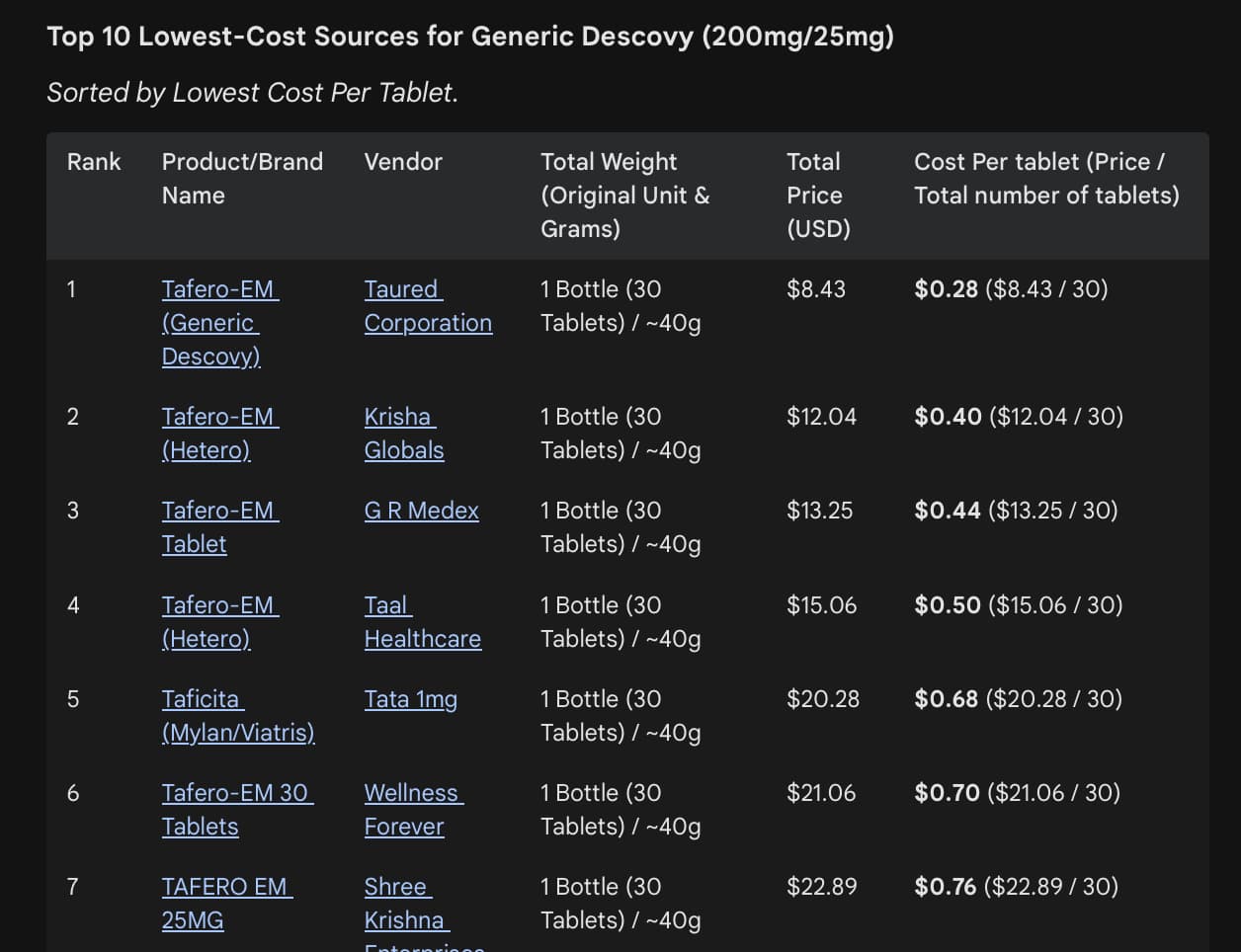
I asked Germini 3 Pro to get me some of the lowest pricing from Indian pharmacies on these products and this is what it came back with. I wouldn’t necessarily trust these vendors (they could be untrustworthy, compared to our regular list), but I just wanted to see what the realistic price range was. To duplicate the period of the study (12 weeks) would cost about $30 to $60, for the generic medications.

Safety / Side Effects Report

No side effects were reported during the 12-week study period. The study describes its population as healthy adults (aged 18–50) without HIV or chronic comorbidities.

The paper provides the following information regarding safety and monitoring in this population:

  • Laboratory Monitoring: Researchers conducted standard clinical laboratory assessments—including complete blood counts (CBC), comprehensive metabolic panels (CMP), phosphorus, and lipase—at screening and every four weeks during active dosing to ensure participant safety.
  • General Safety Profile: The authors state that the medications (FTC/TAF and FTC/TDF) have a “well-characterized safety profile” and are already FDA-approved for HIV treatment and prevention.
  • Regimen-Specific Risks: The paper acknowledges that the TDF prodrug is generally associated with “off-target renal and bone effects”. However, it notes that TAF achieves higher intracellular drug concentrations with 90% lower systemic (plasma) tenofovir exposure, which is intended to reduce these specific risks.
  • Study Limitations: The authors note that the 12-week follow-up period and modest sample size (N=79 total) limit the ability to assess the long-term persistence or generalizability of any effects.

While the baseline hematology and serum chemistry values are provided in Table 1 , the paper does not report any specific adverse events or changes in these markers following the treatment period