The science of molecular age prediction, known as biohorology, has experienced an aggressive shift away from first-generation chronological clocks toward next-generation models. Unlike their predecessors, which were merely trained to guess an individual’s calendar age, next-generation clocks like GrimAge, OMICmAge, and DunedinPACE are calibrated against clinical biomarkers, longitudinal health decline, and all-cause mortality risk. This training makes them far more sensitive to genuine biological fluctuations and lifestyle modifications. In a comprehensive systematic review published in Frontiers in Genetics, researchers Adiv A. Johnson and David A. Sinclair compiled data from 41 unique human interventional trials to evaluate which longevity therapeutics actually move the needle on these advanced aging metrics.
The meta-analysis shatters several mainstream longevity assumptions while validating fundamental health practices. The data demonstrate that next-generation clocks respond dynamically to established metabolic and inflammatory interventions. Most notably, the GLP-1 receptor agonist semaglutide emerged as a highly potent pharmaceutical intervention, driving down multiple age estimates—including a 9% reduction in the annual pace of aging measured by DunedinPACE. Similarly, consistent cardiovascular and structural improvements were logged from basic lifestyle adjustments. Plant-rich diets, caloric restriction, and structured endurance exercise consistently demonstrated statistically significant, multi-month reversals in biological age across independent cohorts. Targeted supplementation also yielded clear hits: daily high-quality omega-3 fatty acids and standard multivitamin-multimineral regimens successfully set back advanced clocks like GrimAge and PC DNAm PhenoAge.
Conversely, the review exposes glaring gaps between preclinical hype and human clinical efficacy. Highly publicized geroprotectors—including nicotinamide riboside (NR), rapamycin, and various senolytic cocktails (such as dasatinib, quercetin, and fisetin)—failed to produce any statistically significant reductions in next-generation human epigenetic clocks across the completed trials. Even more concerningly, certain heavily marketed clinical interventions produced actively deleterious effects. Multiple rounds of therapeutic plasmapheresis were shown to accelerate epigenetic aging, significantly increasing GrimAge and DunedinPACE scores. Ultimately, this comprehensive audit establishes a rigorous baseline for human biohorology. It moves the field closer to using molecular clocks as validated surrogate endpoints for clinical trials, while warning practitioners that technical noise, stress, and cell-type shifts can easily confound short-term readings.
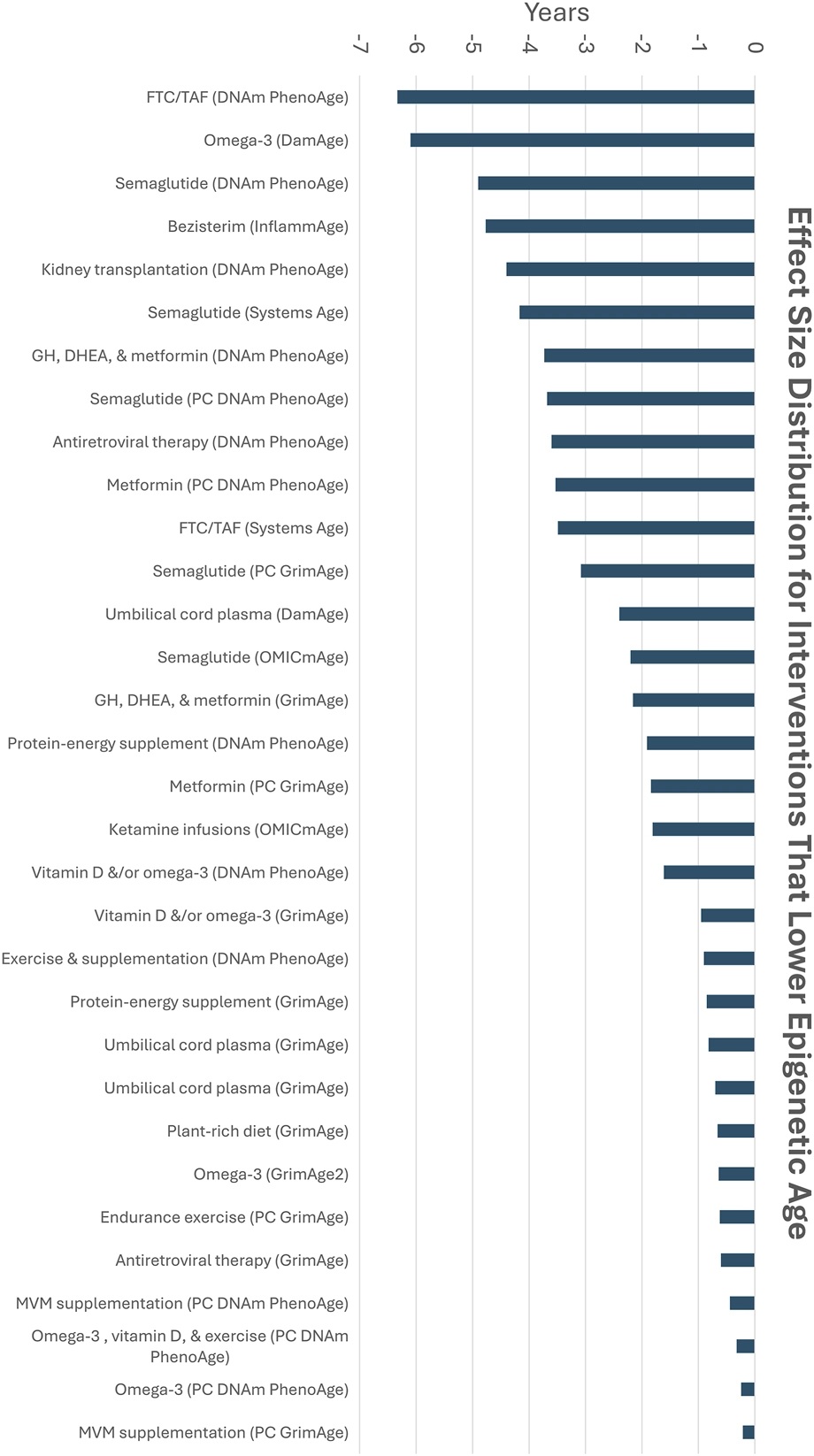
Ranked list of the interventions that decrease next-generation epigenetic aging clocks in humans
Based on the human interventional data compiled in the systematic review “fgene-17-1836446.pdf”, interventions that successfully decrease next-generation epigenetic clocks are split into two distinct horological metrics: Age-Output Clocks (which measure absolute biological age reduction in years) and Rate-of-Aging Clocks (which measure changes to the annual pace of biological decay).
The following lists rank these interventions from the most effective to least effective based on their documented absolute effect sizes.
1. Age-Output Clocks (Ranked by Favorable Years Reversed)
-
Emtricitabine-tenofovir-alafenamide (FTC/TAF): Reduced the DNAm PhenoAge clock by -6.33 years over a 12-week period in healthy adults without HIV. See: HIV Medication Reverses Epigenetic Aging Markers in First Human Proof-of-Concept Trial
-
Omega-3 Fatty Acids (Overweight Cohort): Decreased the damage-centric clock, DamAge, by -6.1 years after 6 weeks of supplementation.
-
Semaglutide: Lowered DNAm PhenoAge by -4.9 years, Systems Age by -4.17 years, PC DNAm PhenoAge by -3.68 years, and OMICmAge by -2.2 years over 32 weeks in patients with HIV-associated lipohypertrophy.
-
Bezisterim: Reduced the saliva-based inflammatory aging clock, InflammAge, by -4.77 years after 30 weeks of treatment in patients with probable Alzheimer’s disease.
-
Kidney Transplantation: Generated a -4.4 year reduction in DNAm PhenoAge when measured 1 year post-surgery in patients with chronic kidney disease.
-
Umbilical Cord Plasma Concentrate: Decreased the DamAge clock by -2.4 years and the GrimAge clock by -0.82 years after a 10-week clinical protocol in older adults.
-
Ketamine Infusions: Induced a -1.81 year absolute drop in the OMICmAge clock over 2 to 3 weeks of administration in patients with major depressive disorder or PTSD.
-
Omega-3 Fatty Acids and/or Vitamin D3 (Mild Cognitive Impairment Cohort): Decreased DNAm PhenoAge by -1.61 years and GrimAge by -0.95 years following a 2-year supplementation period.
-
Plant-Rich Diet: Lowered the GrimAge clock by -0.66 years relative to control groups over a 24-month lifestyle intervention.
-
Omega-3 Fatty Acids (Healthy Older Adults Cohort): Reduced GrimAge2 by -0.64 years and PC DNAm PhenoAge by -0.24 years over a 3-year trial period.
-
Cycling-Based Endurance Exercise: Generated a -0.62 year reduction in PC GrimAge relative to baseline measurements after 6 months of training.
-
Multivitamin-Multimineral Supplement: Reduced PC DNAm PhenoAge by -0.44 years and PC GrimAge by -0.21 years relative to a placebo group over 2 years.
-
Omega-3 Fatty Acids, Vitamin D, and Exercise Combination: Lowered PC DNAm PhenoAge additively by -0.32 years when all three modalities were paired together for over 3 years.
2. Rate-of-Aging Clocks (Ranked by DunedinPACE Reduction)
-
Semaglutide: Demonstrated the most prominent beneficial impact on the pace of aging, lowering the DunedinPACE algorithm by 9% (an absolute drop of -0.09 units/year) over 32 weeks.
-
Emtricitabine-tenofovir-alafenamide (FTC/TAF): Decreased the annual pace of aging by -0.061 units/year over a 12-week duration.
-
Internet-Based Parent-Child Interaction Training: Shaved -0.05 units/year off the DunedinPACE metric in young, developmentally delayed children after a 20-week psychosocial intervention.
-
Pitavastatin: Lowered the pace of biological aging by -0.035 units/year in a 2-year clinical trial evaluating individuals living with HIV.
-
Protein-Energy Supplement: Decreased DunedinPACE by -0.03 units/year in a long-term trial tracking early-life nutritional intervention.
-
Caloric Restriction: Slowed the pace of biological aging by 2% to 3% (an absolute reduction of -0.025 units/year) at both the 12-month and 24-month thresholds in non-obese adults.
-
Omega-3 Fatty Acids: Favorable down-regulated DunedinPACE by an absolute -0.0022 units/year when administered as an isolated monotherapy over a 3-year period.
Source:
- Open Access Paper: Turning back time: a comprehensive list of interventions that decrease next-generation epigenetic aging clocks in humans
- Institutions: Tally Health (New York, NY, USA) and the Paul F. Glenn Center for Biology of Aging Research, Department of Genetics, Blavatnik Institute, Harvard Medical School (Boston, MA, USA).
- Journal Name: Frontiers in Genetics.
- Impact Evaluation: The impact score of this journal is 3.7, evaluated against a typical high-end range of 0–60+ for top general science, therefore this is a Medium impact journal.