Continued the 10 additional repetitions per set… breezed through.
Arms and chest felt swole last night in bed and at gym today… solid. And, ass cheeks plump this morning in shower waahing all the bits and can feel them fill in the seat of my pants. Seriously , up another pound too on an empty colon and stomache… get my drift.
No post workout pain…kick those arthritic senescent cells to the curb.
I did not video because I didn’t see any staff, just medical students . Didn’t want to be creepy.
With staff is fine… students too…but paid to work. Hahaha
What are the inputs and assumptions AI used to compute these values? If I take my DeXA lean mass value and multiply it by AI’s “realistic” monthly gain in muscle mass, I get 124 lbs x .35% = .43 lbs per month gain for a guy that’s 5’ 7". Not nothing, but not that impressive.
I guess it depends on expectations a person has but gaining .43Lbs of lean muscle in one month by taking a pill and doing nothing else for it, to me sounds huge. Assuming the rate continues for a while (I have to assume it will subside at some point) say 12 months that would translate into about 5-6 lbs of lean muscle. I would be very happy if it were only 2 lbs, and extremely happy with 3-4 lbs.
These analysis tend to be quite lengthy, so I typically only post the summary. Here’s a synopsis of the factors considered: Translation Factors: Mouse to Human
Factor 1: Time Course Adjustment
Mouse treatment duration: 3 months Mouse lifespan: ~24-30 months Human equivalent by multiple methods:
Scaling Method
Mouse 3 Months → Human
Lifespan proportion (3/24 × 80)
~10 years
Metabolic scaling (mass^0.25)
~22 months
Protein turnover (7-10×)
~21-30 months
Empirical muscle adaptation (6-8×)
~18-24 months
Consensus: 3 months in aged mice ≈ 1.5-2.5 years in aged humans
Time scaling factor: 6-10×
Factor 2: Effect Magnitude Adjustment
Historical translation rates for muscle/body composition endpoints across drug classes:
Intervention
Mouse Effect
Human Effect
Translation Rate
Testosterone replacement
+15-20%
+5-8%
30-50%
Myostatin antibodies
+20-40%
+3-8%
15-25%
Resistance exercise
+15-25%
+5-10%
30-50%
Senolytics (D+Q, preliminary)
+15-25%
TBD
Est. 25-40%
GH/IGF-1
+10-20%
+2-5%
15-30%
Average translation rate for muscle mass: ~25-40%Average translation rate for functional outcomes: ~30-50%
Factor 3: Variability Adjustment
Mouse studies use inbred strains (identical genetics)
Human populations are heterogeneous
Expected SD increase in humans: 1.5-2.0×
This affects statistical power, not expected mean effect
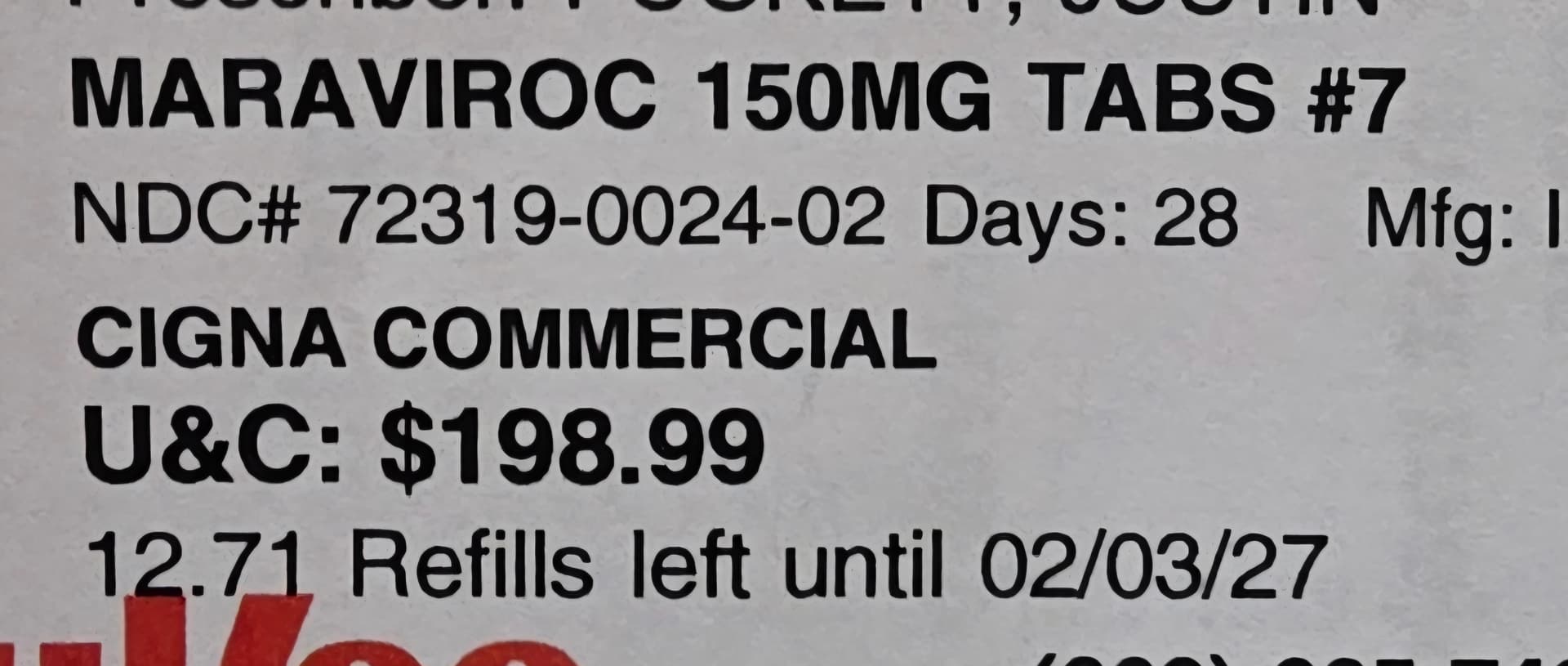
I took maraviroc for a decently long time because of Dr. Patterson’s group’s research. It seemed to be mildly effective for inflammatory issues. 300mg twice a day for some months. Eventually my liver enzymes were elevated so I went off of it. Likely related.
My doc said he wouldn’t give it to me because if I should get a side effect, he’d like to keep his license, but he is going to follow me while taking it.
On that note, I also contacted Maulik and it’s $120 for 60 pills of 150mg.
I think there is only one brand.
PS he has seen horrible side effects at the high dose… uneven fat deposits are what stood out to me!!
The uneven fat deposits are lipodystrophy. That has nothing to do with Maraviroc. That is a side effect of other HIV medications. HIV and Lipodystrophy | NIH
Hmm… It seems that @desertshores may be correct and that it probably has a greater effect once we have built up significant senescent cell loads. So this should be for only people over 60? 55? What’s the general consensus on when to begin treatment?
I thought I posted this evaluation of the build-up of senescent cells in people… but can’t find it here now … it depends on if you’ve had much extra weight, I think, and for how long. Around age 60 for a person who has been metabolically healthy, but sooner if not. And the data is not very clean… here is what I got from Gemini Pro:
Senescent Cell Accumulation in Human Skeletal Muscle
Bottom Line Up Front: The accumulation of senescent cells in human skeletal muscle is compartmentalized and nonlinear. Unlike adipose tissue, which shows robust, generalized senescence accumulation with age, skeletal muscle senescence is primarily restricted to the stem cell niche (Satellite Cells) and Fibro-Adipogenic Progenitors (FAPs).
Critical Confounder: Recent data explicitly decouples chronological age from senescence in muscle. High BMI and metabolic dysfunction are stronger drivers of p16INK4a expression than age alone.
Data Extraction for Graph Construction
The following table synthesizes key data points for plotting the trajectory. Note the explicit distinction between “Whole Tissue” (which dilutes the signal) and specific cell compartments.
A. Satellite Cells (MuSCs) - The Regenerative Block
Trajectory: Flatline from age 20 to ~60. Sharp exponential rise after age 70.
Mechanism: Geriatric satellite cells lose reversible quiescence. They de-repress p16INK4a, locking them in a pre-senescent state that prevents activation upon injury.
Key Finding: The absolute number of satellite cells declines with age (exhaustion), but the percentage of remaining cells that are p16-positive increases drastically, blocking repair.
Definitely strength has improved… muscles feel harder… gained some muscle weight too. Unfortunately traveling in Japan past week. so food and working out is altered. Will know more in 2 months. But so far … yes… seems to be working … and no side effects.
 at the gym.
 , up another pound too on an empty colon and stomache… get my drift.
 . Didn’t want to be creepy.