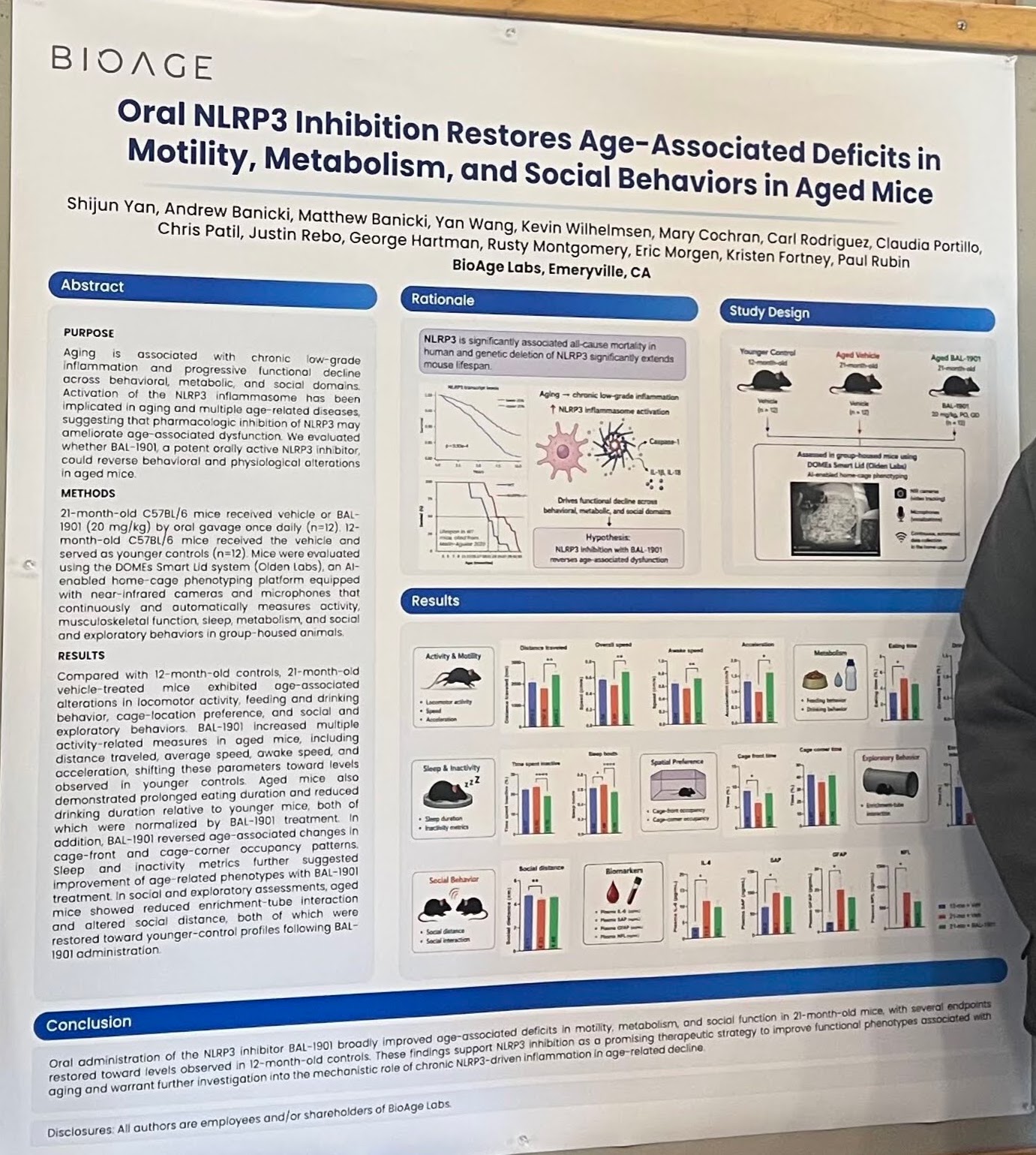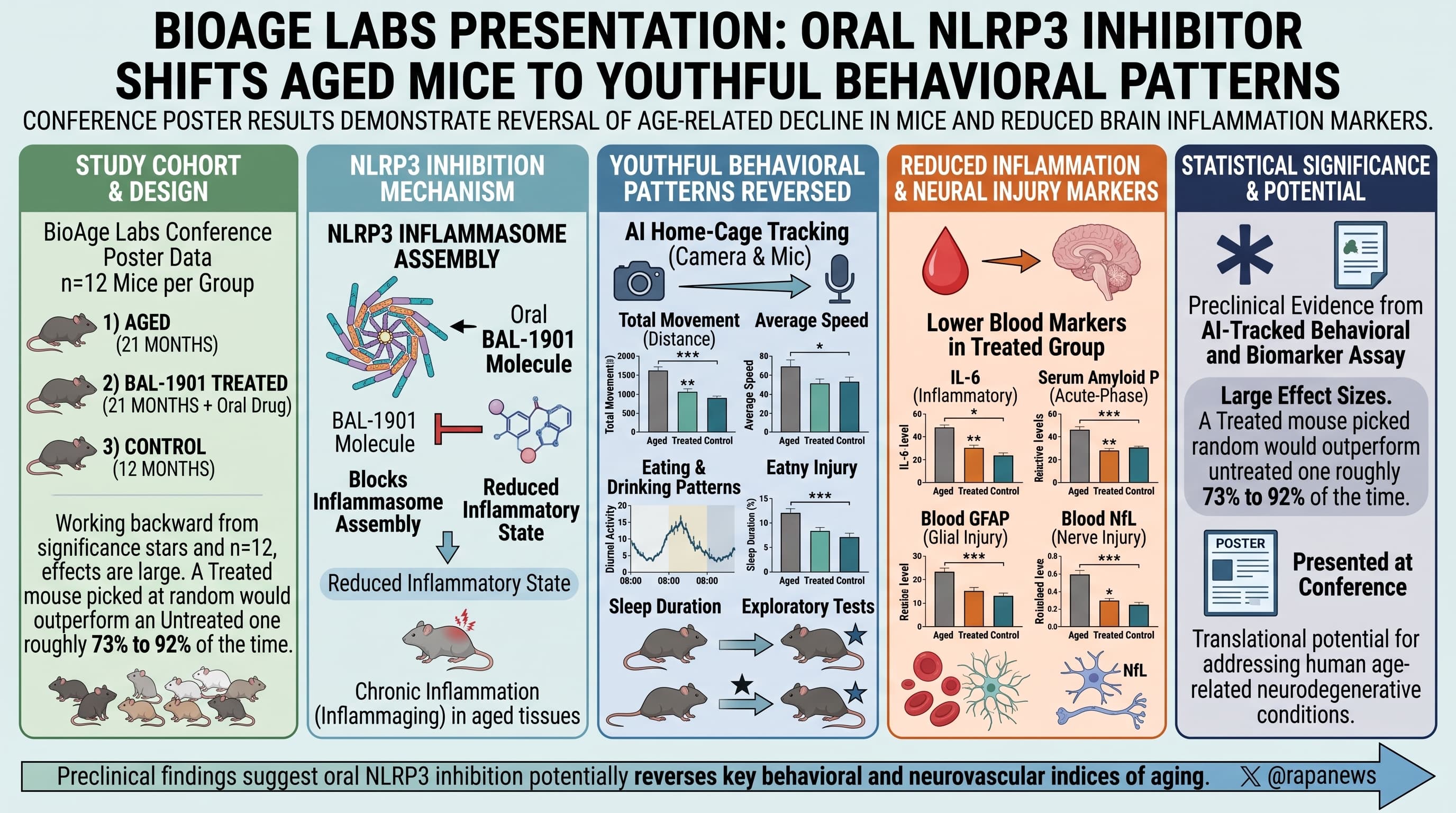
BioAge Labs presented a conference poster showing that BAL-1901, an oral drug that blocks the NLRP3 inflammasome, shifted a range of behaviors in 21-month-old mice toward those of 12-month-old controls. The treated mice moved more and faster, ate and drank in more youthful patterns, slept and rested differently, and behaved more like younger animals in social and exploratory tests. They also showed lower blood markers of inflammation (IL-6, serum amyloid P) and nerve and glial injury (GFAP, NfL). Behavior was tracked with an AI camera and microphone system inside the home cage. The data come from 12 mice per group, have not been peer reviewed.
Inflammation that simmers quietly for decades is one of the more plausible engines of aging. Researchers call it inflammaging, and one of its main ignition switches is NLRP3, a sensor protein inside immune cells. When NLRP3 detects cellular damage, including debris leaking out of stressed mitochondria, it assembles a molecular machine called the inflammasome, which releases the inflammatory messengers IL-1β and IL-18. Mice born without NLRP3 age more gracefully, and some studies report that they live longer. The practical question is whether a drug can reproduce that benefit when given late in life.
BioAge Labs, a publicly traded company in Emeryville, California, now says the answer may be yes, at least for behavior. Its scientists gave 21-month-old mice, roughly equivalent to people in their mid-sixties, a daily oral dose of an experimental NLRP3 blocker called BAL-1901. A comparison group of 12-month-old mice, closer to middle-aged humans, received a placebo.
Instead of relying on the usual short lab tests, the team housed the mice in cages fitted with a smart lid from Olden Labs. Infrared cameras and microphones logged movement, sleep, feeding, drinking, where animals spent their time, and how they interacted, around the clock and without human handling.
The old untreated mice behaved like old mice. They covered less ground, moved more slowly, spent longer eating, drank less, and kept more distance from cage mates. After treatment, many of these measures moved back toward the younger pattern. On several movement measures the treated old mice appear to outpace even the younger controls. Blood tests pointed the same way. Levels of IL-6, a general inflammation signal, and serum amyloid P, the mouse equivalent of the CRP that doctors measure in people, were lower in treated animals. So were GFAP and NfL, two markers that rise when the brain’s support cells are activated or nerve fibers are damaged.
The result matters mainly because of what BioAge is doing in people. The company’s lead NLRP3 drug, BGE-102, from the same chemical family, cut the inflammation marker hsCRP by more than 85 percent in a Phase 1 trial in people with obesity and is now in a Phase 2 cardiovascular risk study. A mouse poster showing broad functional improvement gives the company an aging story to go with its cardiology story.
The big idea still holds up as a hypothesis worth testing: that switching off one inflammatory sensor in old age can restore function rather than just slow its loss.
Actionable Insights
There is nothing here to act on directly. BAL-1901 is an internal research compound that is not yet available to anyone, and its human cousin BGE-102 is still in clinical trials.
What the study does support, weakly, is paying attention to chronic inflammation as a changeable part of aging. For readers, the practical steps are the familiar ones that lower NLRP3 activity and hsCRP: losing visceral fat, regular exercise, good sleep, avoiding smoking, and managing blood sugar. Asking your doctor for a high-sensitivity CRP test gives you a baseline. Levels under 1 mg/L are considered low risk, and levels above 2 mg/L consistently predict heart disease.
How big were the effects? The poster gives no averages or error bars that can be read (in the photo), so the true effect size is unknown. Working backward from the significance stars and the group size of 12, the smallest effects that could produce those stars are large. A treated mouse picked at random would outperform an untreated one roughly 73 to 92 percent of the time, depending on the measure. That sounds dramatic, but small studies routinely overestimate effects.
Context and Source
- Poster on X: Oral NLRP3 Inhibition Restores Age-Associated Deficits in Motility, Metabolism, and Social Behaviors in Aged Mice
- Institution: BioAge Labs, Emeryville, California
- Country: United States
- Journal: Poster Presentation
- Conflicts: All authors are employees or shareholders of BioAge Labs.
- Impact evaluation: The impact score of this journal is not applicable (unpublished, non-peer-reviewed industry conference poster)
Related Reading:
- BioAge Presentation (Longevity Summit, 2025): NLRP3, Apelin Targets
- The Pilot Light of Aging: How Your "Healthy" Diet May Be Fueling Silent Inflammation
- The Eye's Inflammatory Alarm Bell: Can Silencing NLRP3 Save Aging Vision?
- Shutting Down the Body's Master Inflammation Alarm (NLRP3)
- Running Down the NLRP3 Alarm: How Exercise Quiets the Brain's Inflammatory Trigger