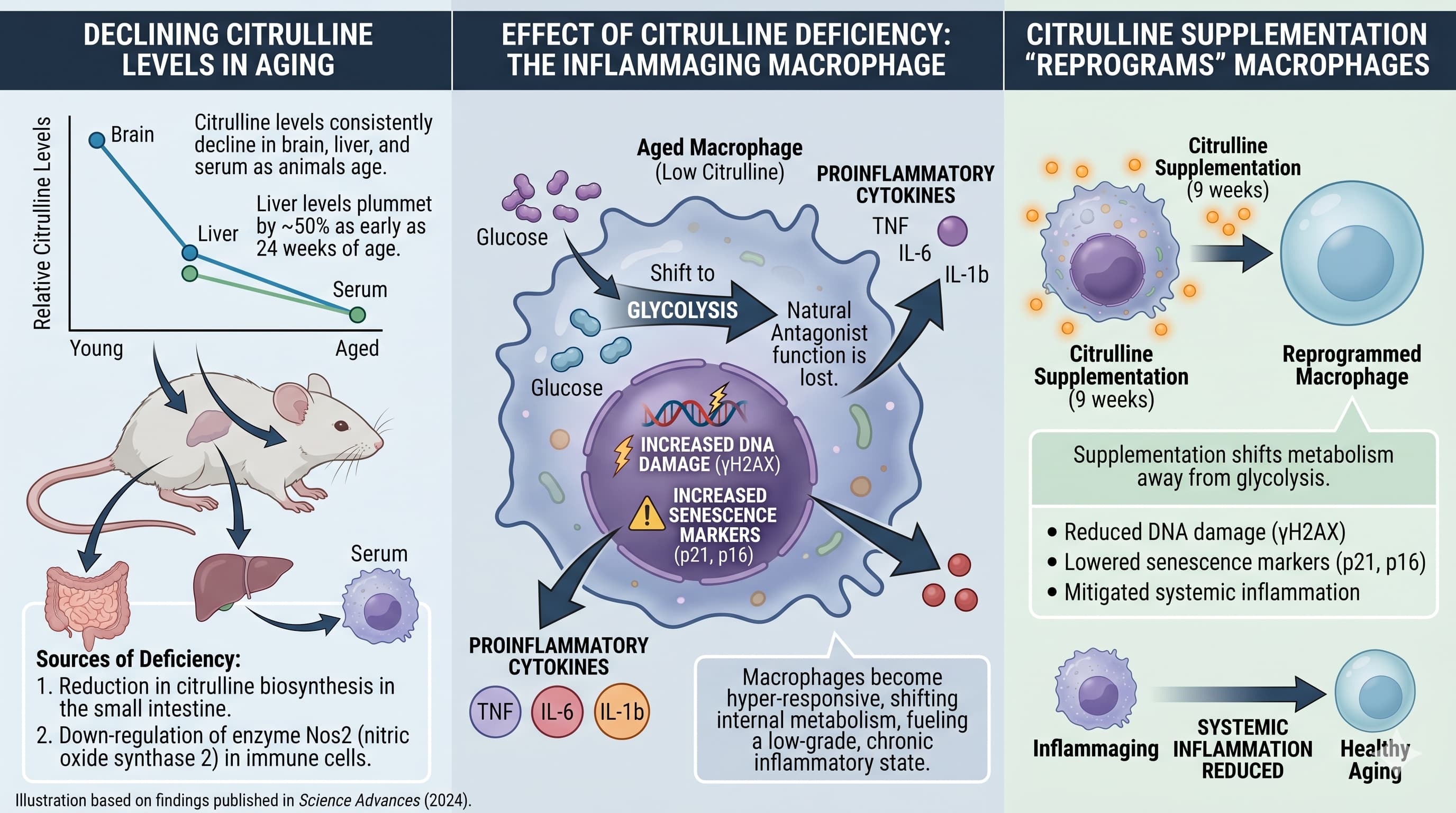
Recent research published in Science Advances identifies the amino acid citrulline as a critical endogenous factor in the aging process, specifically regarding the “inflammaging” phenotype—the low-grade, chronic inflammation that characterizes advancing age. While citrulline is traditionally known as a component of the urea cycle, this study reveals its broader role as a regulator of the immune system’s primary sentinels: macrophages.
The researchers utilized untargeted metabolomics to track changes in mice across their lifespan, discovering that citrulline levels consistently decline in the brain, liver, and serum as the animals age. In liver tissue, levels plummeted by approximately 50% as early as 24 weeks of age. This deficiency was traced back to two sources: a reduction in citrulline biosynthesis within the small intestine and a down-regulation of the enzyme Nos2 (nitric oxide synthase 2) within immune cells.
The biological consequences of this shortage are significant. The study found that citrulline acts as a natural antagonist to inflammation. When citrulline levels are low, macrophages become hyper-responsive, shifting their internal metabolism toward glycolysis —a process that fuels the secretion of proinflammatory cytokines like TNF , IL-6 , and IL-1b. Crucially, the researchers demonstrated that supplementing aged mice with citrulline for nine weeks effectively “reprogrammed” these macrophages. This intervention reduced markers of DNA damage (yH2AX ), lowered the expression of senescence markers (p21 , p16 ), and mitigated systemic inflammation.
Mechanistically, citrulline was found to inhibit the mTOR-HIF1a-glycolysis signaling pathway. By acting as an endogenous inhibitor of mTOR activation, citrulline prevents the metabolic shift that leads to macrophage dysfunction. While the researchers acknowledge that further work is needed to determine the exact sensing mechanism, the discovery of a metabolite that can naturally dampen mTOR-driven inflammation provides a new therapeutic target for extending healthspan.
Actionable Insights
-
Deficiency Recognition : Citrulline levels in immune cells (PBMCs ) decrease with age in humans, mirroring the mouse models. Note that plasma citrulline may paradoxically increase in the elderly due to declining renal function, making blood tests an unreliable proxy for intracellular immune levels.
-
Dosage Context : The mice received approximately 1 g/kg of body weight in drinking water. For a human, this scales to roughly 81 mg/kg daily (approx. 5.6 grams for a 70kg adult).
-
mTOR Modulation : Citrulline appears to be a unique endogenous metabolite that inhibits mTOR specifically in the context of inflammation and aging, potentially offering a “lighter” touch than pharmacological inhibitors like rapamycin.
-
Food Sources : While supplementation was used, citrulline is naturally occurring in cucurbits such as watermelon, cucumber, and pumpkin.
-
Broad Protection : Beyond inflammation, citrulline supplementation in aged mice led to reduced liver and spleen weights (often indicators of age-related fat accumulation or inflammation) and significantly lower systemic DNA damage markers.
Context
- Open Access Paper: Citrulline regulates macrophage metabolism and inflammation to counter aging in mice
- Institution: Interdisciplinary Research Center on Biology and Chemistry, Shanghai Institute of Organic Chemistry, Chinese Academy of Sciences.
- Country: China.
- Journal Name: Science Advances.
- Impact Evaluation: The impact score (CiteScore/JIF) of this journal is approximately 13–15, evaluated against a typical high-end range of 0–60+ for top general science journals; therefore, this is a High impact journal.