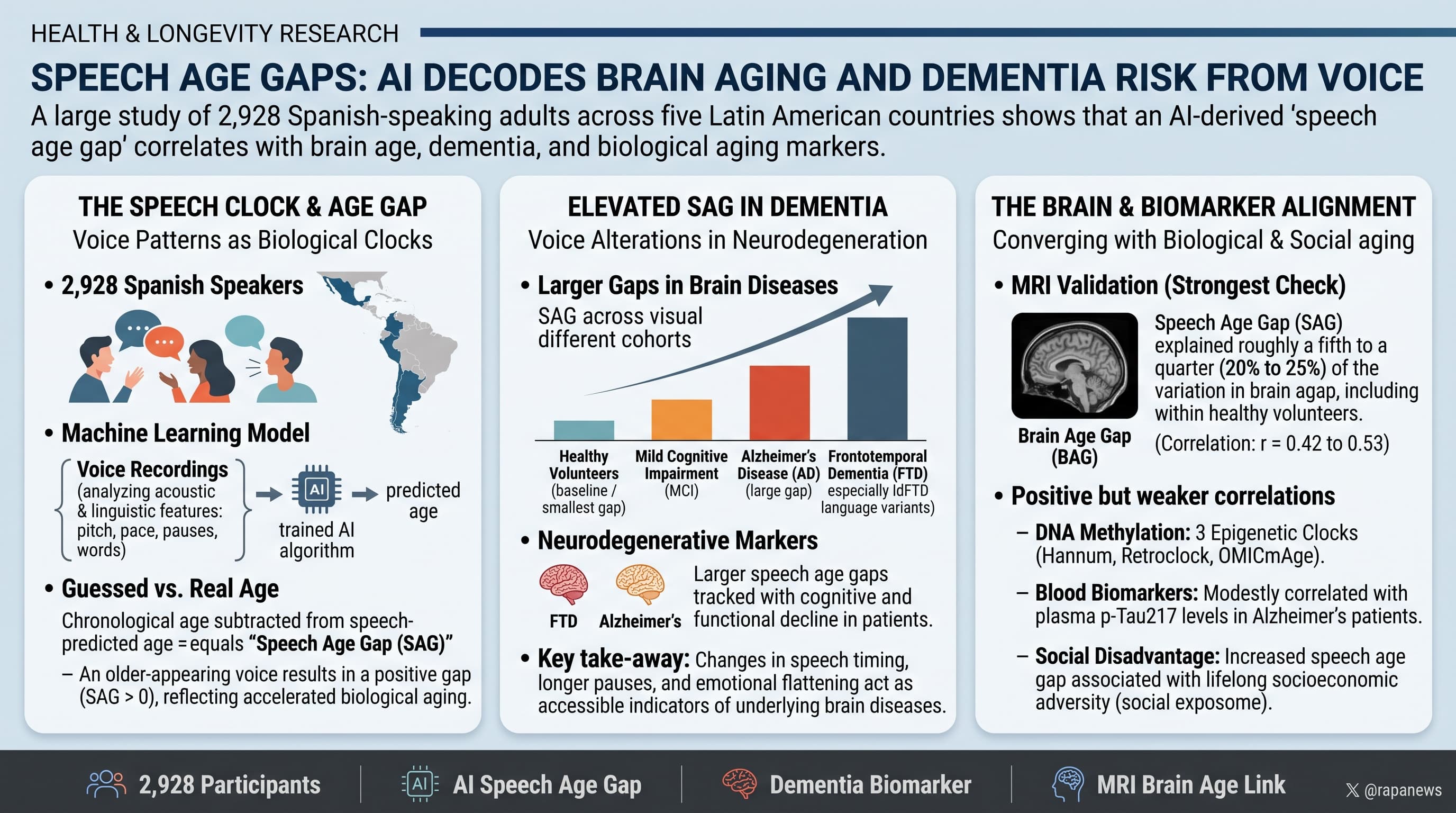
Researchers recorded 2,928 Spanish speakers in five Latin American countries and trained a model to guess each person’s age from how they spoke. The difference between guessed and real age, called the speech age gap (SAG), was larger in people with Alzheimer’s disease and frontotemporal dementia than in healthy volunteers. It tracked moderately with MRI-based brain age and weakly with plasma p-Tau217, three DNA methylation clocks and social disadvantage. The model misses true age by about 9 years on average. It is a research instrument, not a screening test.
Aging clocks estimate how old a body looks compared with its birth certificate. Most need blood or a brain scan, which keeps them out of the low-income regions where dementia is rising fastest. A consortium led from the Latin American Brain Health Institute in Chile asked whether a few minutes of recorded speech could do a similar job.
The logic is reasonable. Speaking draws on memory, attention, emotion and fine motor control at the same moment. Slower speech, longer pauses, flatter pitch and vaguer word choice are all known features of aging and dementia.
Participants narrated a short film, named animals and vegetables against the clock, listed words beginning with a set letter, and retold a short story twice. Software extracted more than 700 measurements and condensed them into seven scores covering timing, pitch, emotional tone, word choice and verbosity. A machine-learning model then predicted each person’s age.
As a clock, it is loose. The model explained 44 percent of the variation in age and missed by 9 years on average, in a cohort where most people were between about 54 and 76.
The gap still separated groups. Take one healthy volunteer and one patient at random, and the patient had the older-sounding speech between two-thirds and nearly nine-tenths of the time, depending on diagnosis. Language-dominant frontotemporal dementia, which attacks language directly, showed the largest gaps. The pattern held after matching for age, sex and education.
The most persuasive check came from MRI. Speech age gap explained roughly a fifth to a quarter of the variation in brain age gap, including within healthy volunteers. Links to the blood tau marker and to epigenetic clocks were far weaker, at about 4 percent of variation.
Three problems limit what can be concluded. First, the story-retelling task feeds both the speech clock and the memory score it is validated against. Someone who recalls less says less, so part of that correlation is one performance counted twice.
Second, education shaped the speech features more than any other background factor, and in healthy volunteers larger gaps tracked social disadvantage. Older-sounding speech may partly reflect fewer years of schooling instead of faster biological aging.
Third, the promise of cheap, scalable testing was not tested. Recordings were made in quiet rooms by neuropsychologists using studio-grade recorders, and transcripts were corrected by hand. Nothing was collected remotely, in conversation, or in another language.
There is also an undeclared interest. The paper states no competing interests, yet a corresponding author created the speech-analysis toolkit used here, which operates as an investor-backed startup.
Speech carries a signal that differs in dementia and echoes brain imaging. Whether it predicts anyone’s future remains unknown.
Actionable Insights
No intervention was tested, so it cannot say whether exercise, diet, drugs or cognitive training would change a speech age gap, or whether changing it would matter.
The size of the effects explains why. The model’s average error was 9 years, which is larger than the typical difference it found between patients and healthy people. A single person’s reading is therefore uninformative. At the group level, a patient sounded older than a healthy volunteer 66 to 88 percent of the time, where 50 percent would be a coin flip. That is a real difference between groups, but the paper gives no false-positive or false-negative rates, so its value for screening is unknown.
The agreement with blood markers was small. Speech gap explained about 4 percent of the variation in p-Tau217 and in epigenetic age, and 18 to 28 percent of MRI brain age gap.
Practical points:
- Be skeptical of any app offering a “voice age” on the strength of this study.
- Speaking more languages was not shown to help. The association was tiny and not statistically significant.
- A noticeable change in word-finding or fluency deserves a clinical evaluation. That advice predates this paper.
Context and Source
- Open Access Paper: Speech clocks decode dementia phenotypes, social exposome, and biological aging
- Lead institutions: Latin American Brain Health Institute (BrainLat), Universidad Adolfo Ibáñez, Chile; Cognitive Neuroscience Center, Universidad de San Andrés, Argentina
- Journal: Science Advances (AAAS), published 30 September 2026
- Impact evaluation: The impact score of this journal is 13.9 (Journal Impact Factor), evaluated against a typical high-end range of 0 to 60+ for top general science, therefore this is a High impact journal.