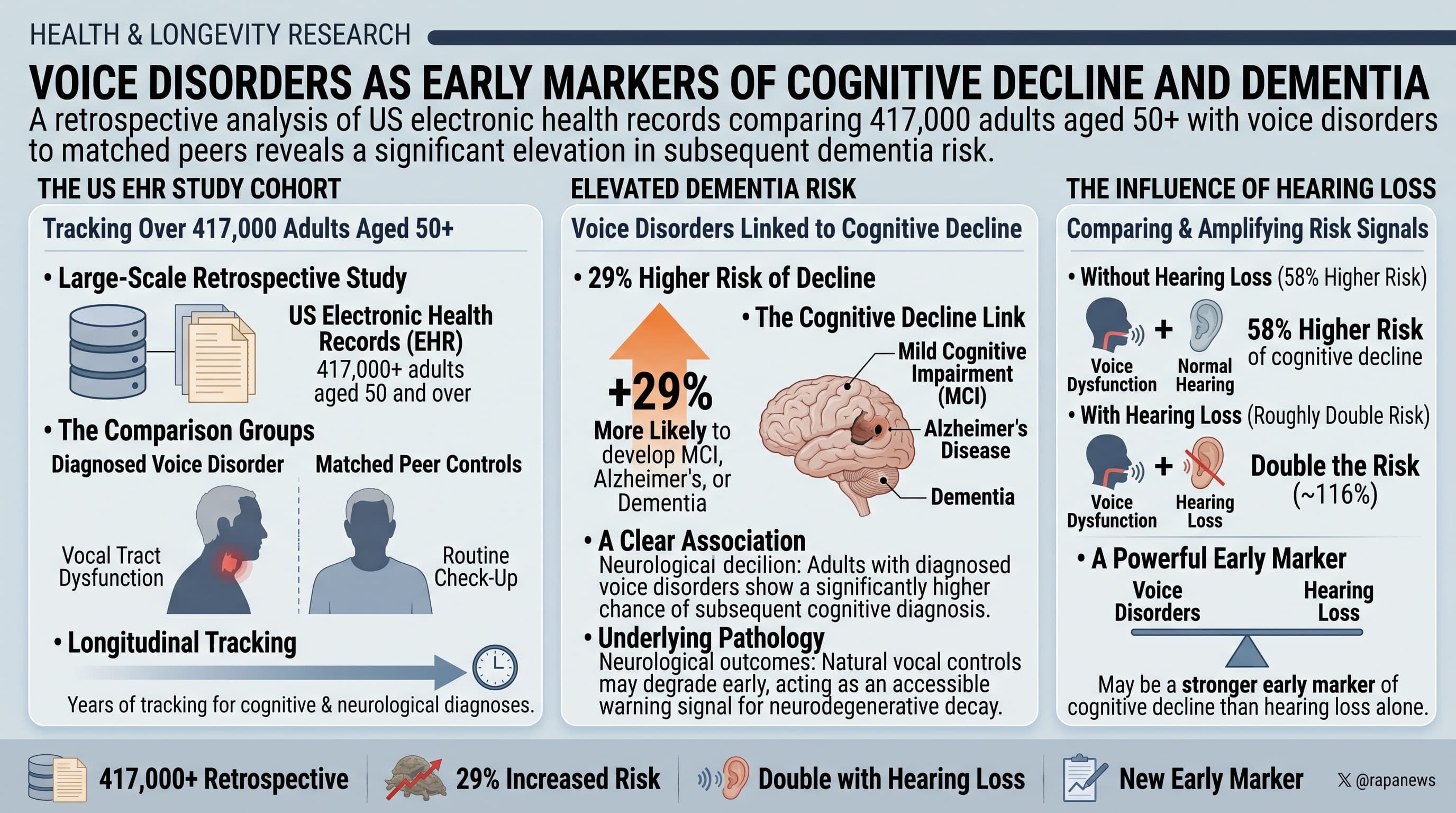
A retrospective analysis of US electronic health records compared about 417,000 adults aged 50 and over who had a diagnosed voice disorder with matched adults who had a routine check-up. Those with a voice disorder were 29 percent more likely to later be diagnosed with mild cognitive impairment, Alzheimer’s disease or dementia. The figure was 58 percent for voice disorders without hearing loss and roughly double for voice disorders with hearing loss. The authors argue voice disorders may be a stronger early marker than hearing loss. The data are observational, absolute risks are small, and the paper does not test whether treating the voice changes anything.
Hearing loss has spent the past decade as the headline modifiable risk factor for dementia. A team at Drexel University College of Medicine in Philadelphia now proposes that the other half of conversation, the voice, deserves similar attention.
Using TriNetX, a platform that pools anonymized records from US health systems, the researchers identified adults aged 50 and over who received a first diagnosis of dysphonia, aphonia or a related voice disorder between 2016 and 2026. Each was paired with a similar person whose index visit was a general medical exam. Pairs were matched on age, sex, race, ethnicity and six cardiovascular risk factors. Anyone with existing dementia, Parkinson’s disease, stroke, multiple sclerosis or ALS was excluded, and the first year after diagnosis was ignored to reduce the chance that the voice problem was simply an early symptom of something already underway.
Across 833,417 people, a voice disorder was associated with a 29 percent higher rate of later cognitive diagnoses. Hearing loss, run through the same pipeline in 3.3 million people, came out at 27 percent. When the voice group was split, people with a voice disorder and no recorded hearing loss had a 58 percent higher rate than their controls, and those with both conditions had roughly twice the rate.
The authors offer two explanations. The first is that the voice is an early casualty of brain disease. In Parkinson’s disease, abnormal protein deposits appear in the brainstem nuclei of the vagus nerve, which controls the larynx, years before tremor begins. The second is social. People who struggle to be heard may withdraw from conversation, and reduced social engagement is itself linked to dementia.
The appeal is practical. Voice diagnoses already sit in medical records, so no new test is needed to find these patients.
The caveats are substantial. The paper reports no event counts. Its survival curves suggest that only about 1.5 percent of controls received a cognitive diagnosis over ten years, far below what population studies find at this age, which implies many cases were never coded. In that setting, people who see more specialists are more likely to have a memory problem noticed and recorded. The matching ignored education, depression, alcohol, reflux, lung disease and how often people visit doctors.
The claim that voice beats hearing loss rests on subgroups compared against different control populations. The paper’s own forest plot appears to show no significant difference between the full voice cohort and the hearing loss cohort.
The finding is a plausible, hypothesis-generating signal that a persistent voice change in later life may travel with elevated neurological risk. It is not evidence that voice problems cause dementia, or that voice therapy prevents it.
Actionable Insights
- Persistent hoarseness deserves a medical look regardless of this paper. Existing ENT guidance recommends examining the larynx when a voice change lasts beyond about four weeks, mainly to rule out cancer, nerve injury and neurological disease.
- Keep the size of the risk in proportion. Relative increases of 29 to 104 percent sound large, but the baseline is low. If about 15 in 1,000 matched controls received a cognitive diagnosis over ten years (my reading of the paper’s curves), then a voice disorder corresponds to roughly 19 in 1,000, voice disorder without hearing loss to about 24, and voice plus hearing loss to about 30. That is 4 to 15 extra diagnoses per 1,000 people over a decade. Converted to a standardized scale, these are small effects (Cohen’s d of roughly 0.14 to 0.39, where 0.2 is conventionally “small”).
- There is no evidence here that voice therapy protects the brain. The study did not examine treatment.
- Use a late-life voice change as a prompt to check better-supported dementia risk factors: hearing, blood pressure, LDL cholesterol, diabetes, physical activity and social contact.
- If you have both a voice disorder and hearing loss, a baseline cognitive screen is a reasonable, low-cost conversation to have with a clinician.
Context/Source
- Open Access Paper: Voice Disorders as Early Biomarkers of Cognitive Decline
- Institution: Drexel University College of Medicine, Department of Otolaryngology Head and Neck Surgery, Philadelphia
- Country: United States
- Journal: Journal of Voice (Elsevier, on behalf of The Voice Foundation)
- Impact evaluation: The impact score of this journal is approximately 2.4, evaluated against a typical high-end range of 0–60+ for top general medical and science journals, therefore this is a Low impact journal. Within its niche it is mid-ranked.