Katalyst is a full-body workout that stimulates all major muscle groups (arms, legs, back, chest, core, glutes) at the same time, even hard-to-reach muscles like back stabilizers. The impulses can reach up to 90% of the fibers within each muscle, more than twice what you could engage with conventional training.
Some people ask us about training certain muscles, such as calves and forearms. Directly stimulating these muscles with Katalyst would be difficult and potentially cause you to lose your balance. They are, however, indirectly stimulated through exercise movements and the nerves that run through your upper extremities.
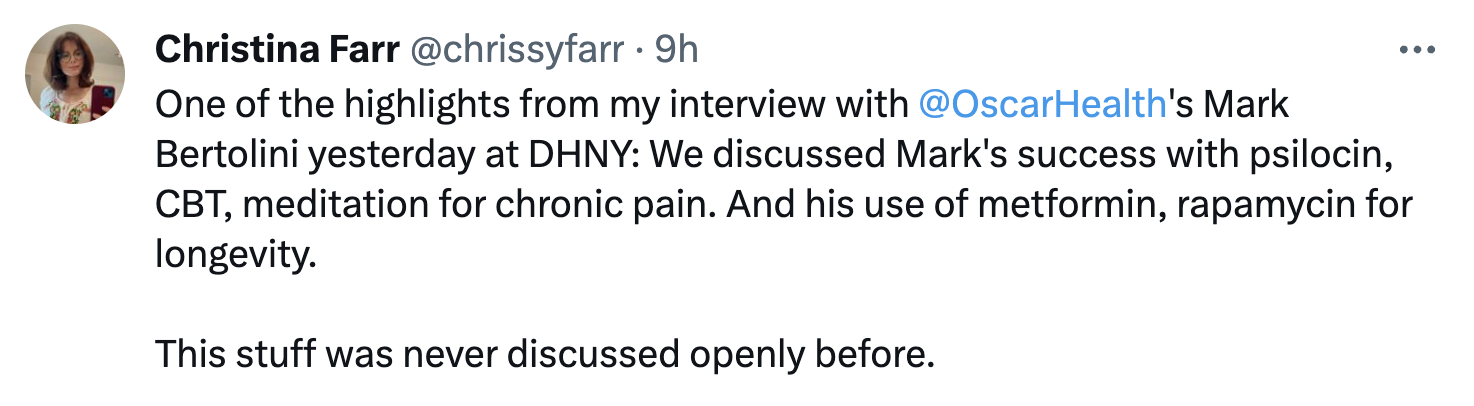
Mark T. Bertolini (born 1956) is an American businessman who is the Co-CEO of Bridgewater Associates, one of the world’s largest hedge funds. He was previously the CEO of Aetna
Wow - @Krister_Kauppi , you want to add this guy to the list.
But - the Wiki article is old - he’s now at a company called Oscar Health, a health insurance company (that, as people in that twitter thread point out, does not cover rapamycin for longevity applications):
Because?
“People with psychopathy crave power and dominant positions, experts say. But they are also chameleons, able to disguise their ruthlessness and antisocial behavior under the veneer of charm and eloquence”
“One route to grabbing power for the highly intelligent psychopath is to climb the corporate ladder.”
@Jonas & @RapAdmin It would be great if we could find his dose regime. I have asked Christina where I can find the interview. Lets see if she answers. Google search did not help in finding the article.
He is waiting for the dog study to finish showing positive result on lifespan at 2026. He is in pretty good shape (55), so he has plenty time. He also has the personality of being extremely systematic and through so it makes sense that he is waiting.
Just saw this on business insider… more public interest. Businessman Dr. Peter H. Diamandis (born 1961): This American engineer is best known as the founder and chair of what is now the Ansari X-Prize Foundation. A native of the Bronx, Diamandis holds a Bachelor of Science in molecular genetics and Master’s degree in Aeronautics and Astronautics, both from Massachusetts Institute of Technology. He later attended Harvard Medical School, where he earned his M.D.
He is what you might call a longevity chaser… touting muscle resistance, rapamycin, metformin… and a heavy protein diet .
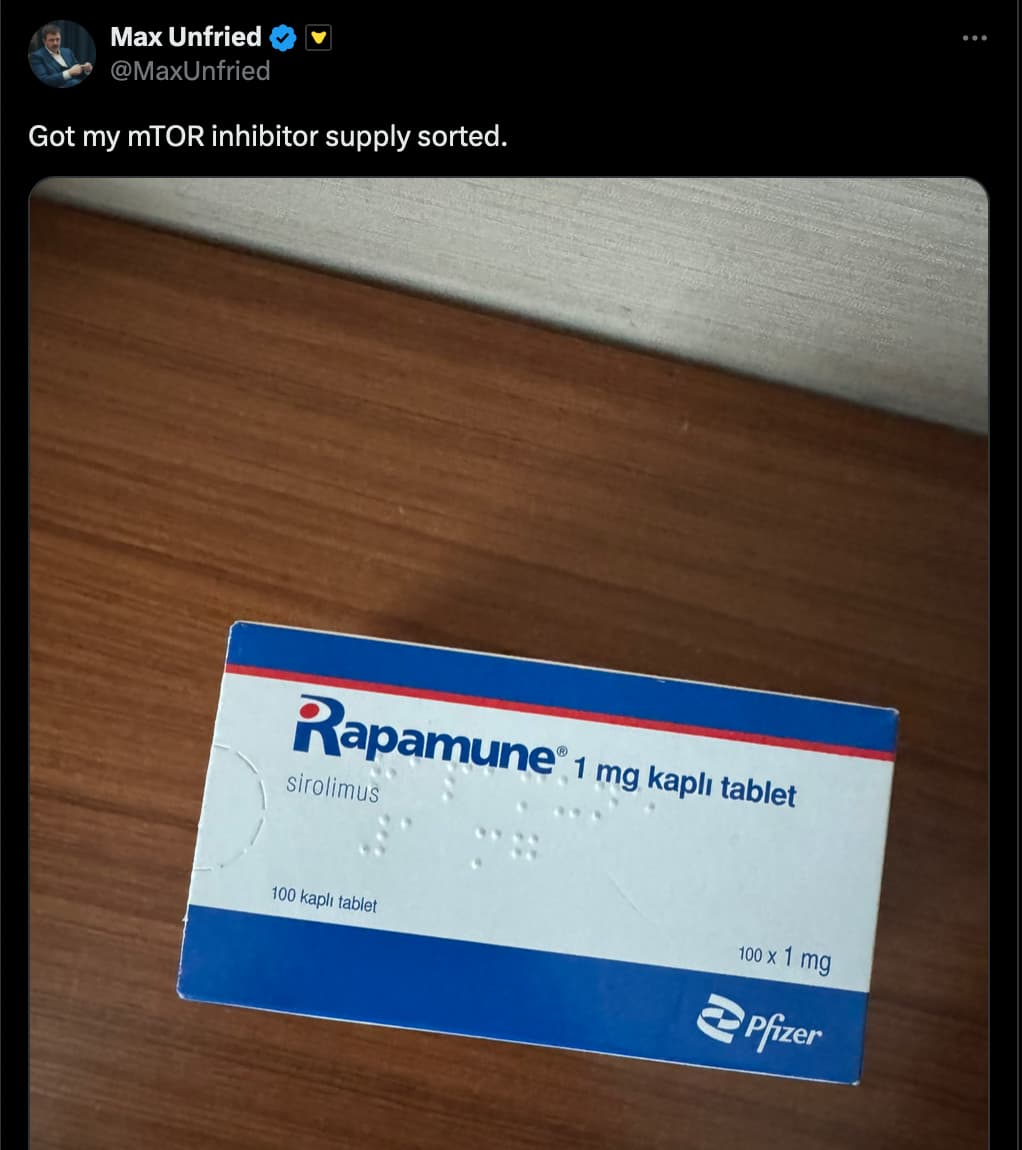
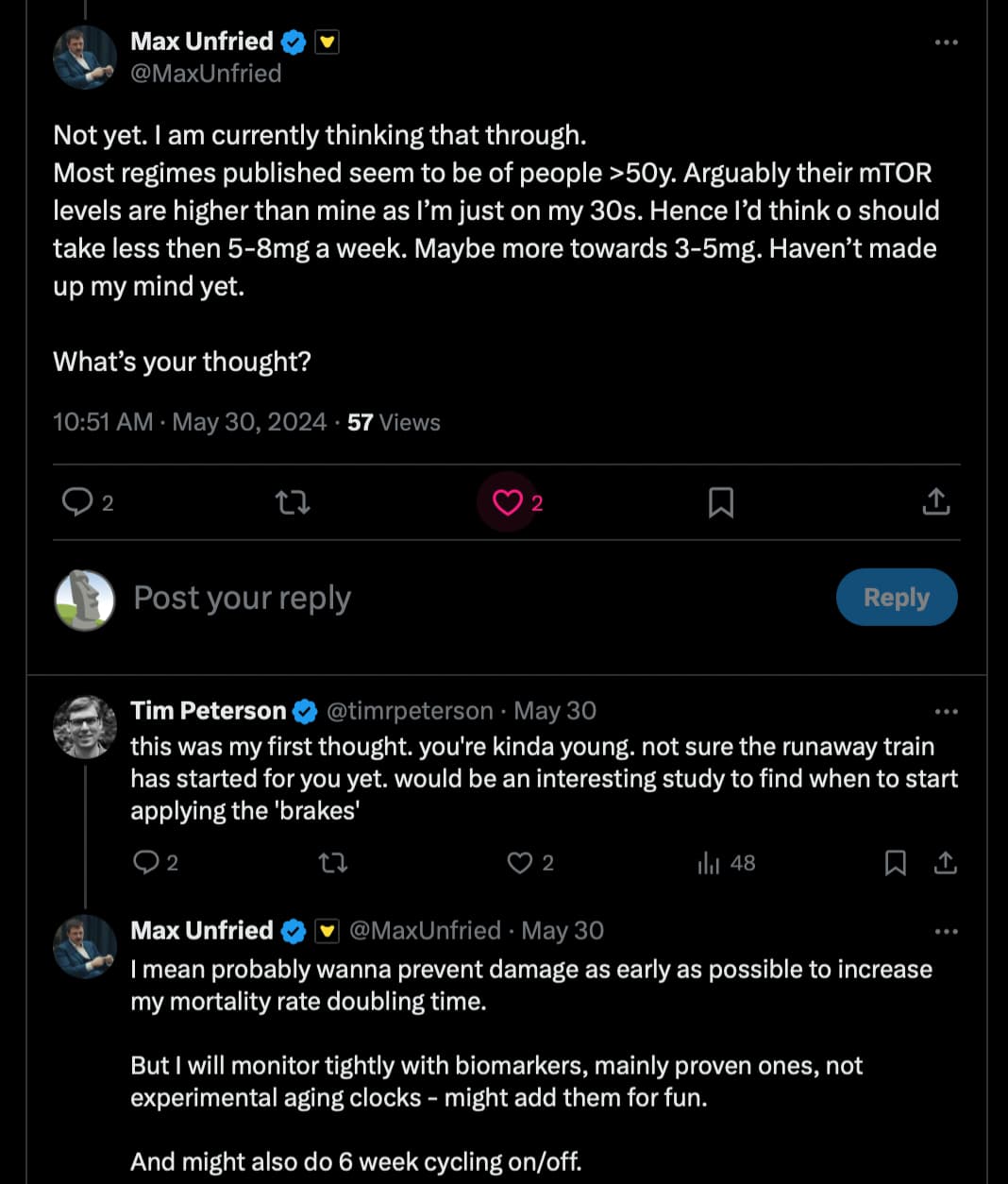
Another Longevity scientist (in his 30’s) joins the rapamycin user list today.
Max Unfried
Geroscientist, National University of Singapore
Max Unfried holds a position as a longevity scientist at the esteemed Center for Healthy Longevity at the National University of Singapore. In the dynamic field of longevity science, he has carved a niche with his focused research on the systems biology of aging, delving deep into biomarkers of cellular health, and investigating the pivotal role of psychedelics in advancing healthy longevity medicine. His innovative research approach is a confluence of Artificial Intelligence, Complex Systems, and Molecular Biology, working synergistically to unravel the complexities of aging. In addition to his academic role, Max is a key figure in the Decentralized Science movement, and holds a pivotal position within VitaDAO, a global collective committed to promoting and financing pioneering longevity science research on a worldwide scale.
With his expertise in bridging the world between academic science and the business of science, he serves as a trusted scientific advisor to startups, venture capital firms, and family offices. A respected voice in the longevity community, Max often shares his insights and findings as a speaker and panelist at notable longevity conferences worldwide. His dedication to the field has not only fostered rich discussions and propelled the science forward but also earned him awards recognizing his significant contributions to the longevity field.
Again, I’m posting this yt video not because I agree with the speaker, but as an example of the level of discourse we often encounter when discussing rapamycin in the longevity context. The speaker here is a fully accredited and credentialed professor doing active research. Somewhat discouraging insofar as level of analytical power this gentleman brings to the subject.
70: Rapamycin and Longevity: What the Research Really Says with Dr. Ben Bikman (via Ben Bikman)
Dr. Benjamin Bikman—Professor of Cell Biology, Academic Qualifications & Training
B.S. in Exercise Science – Brigham Young University (2003)
M.S. in Exercise Physiology – Brigham Young University (2005)
Ph.D. in Bioenergetics – East Carolina University (2008)
Postdoctoral Fellowship in Cardiovascular and Metabolic Diseases – Duke-NUS Graduate Medical School, Singapore (2008–2011)
Current Teaching & Academic Affiliation
Brigham Young University (BYU) (Provo, Utah): Full Professor in the Department of Cell Biology and Physiology (formerly Physiology and Developmental Biology), where he has been on the faculty since 2011 (promoted to Full Professor in 2022). He teaches undergraduate and graduate courses in cell biology and physiology (e.g., CELL 305, CELL 365, CELL 565) and directs the Laboratory of Obesity and Metabolism / BYU Diabetes Research Lab.
I. Executive Summary
In this lecture from The Metabolic Classroom, Dr. Benjamin Bikman—Professor of Cell Biology and biomedical researcher—provides a skeptical, metabolically focused critique of rapamycin as a human longevity therapeutic. Bikman acknowledges the robust preclinical literature demonstrating that rapamycin-mediated inhibition of the mechanistic target of rapamycin (mTOR) induces autophagy and extends lifespan in model organisms (e.g., yeast, nematodes, flies, and rodents by up to 60%). However, he argues that the off-label translation of rapamycin to humans for healthy lifespan extension is fraught with unjustified clinical risk, highlighting that pharmacological mTOR inhibition directly compromises muscle protein synthesis, induces metabolic derangements, and ignores the primacy of hyperinsulinemia in driving pathological mTOR overactivation.
Bikman contends that the anti-aging community’s vilification of dietary protein is biologically flawed. While amino acids stimulate mTOR via nutrient-sensing pathways, Bikman asserts that insulin is a vastly more potent, chronic activator of mTOR in human physiology. Restricting dietary protein to blunt mTOR risks accelerating sarcopenia and frailty—two of the strongest clinical predictors of all-cause mortality in aging populations—especially given that epidemiological and clinical data associate higher protein intake (particularly animal protein) with reduced mortality and preserved functional independence in adults aged 65 and older.
Crucially, Bikman posits that individuals seeking the longevity benefits of mTOR downregulation do not require an immunosuppressive pharmacological agent. Instead, he advocates for dietary carbohydrate restriction and intermittent fasting to lower fasting insulin, thereby naturally cycling mTOR down and disinhibiting autophagy without pharmacological side effects (such as dyslipidemia, impaired glucose tolerance via mTORC2 disruption, or blunted muscle hypertrophy). While Bikman’s emphasis on avoiding sarcopenia and maintaining insulin sensitivity is strongly backed by human clinical data, his complete dismissal of low-dose intermittent rapamycin fails to acknowledge the distinct pharmacokinetics of pulsed vs. continuous dosing, and his assertion that protein has negligible effects on insulin oversimplifies postprandial endocrine dynamics.
II. Insight Bullets
Dr. Benjamin Bikman examines rapamycin through a cell biology lens, arguing that its clinical risks in healthy humans outweigh the speculative longevity benefits.
The mechanistic target of rapamycin (mTOR) is an evolutionary conserved intracellular serine/threonine protein kinase governing cell growth, anabolism, and protein synthesis.
Preclinical rodent models consistently demonstrate that pharmacological mTOR inhibition via rapamycin extends median and maximal lifespan by up to 60%.
mTOR inhibition directly disinhibits cellular autophagy, facilitating the catabolism and lysosomal recycling of damaged organelles and misfolded proteins.
Bikman emphasizes that skeletal muscle mass and functional strength are primary physiological determinants of healthspan and survival in elderly cohorts.
Dietary amino acids activate mTOR to drive muscle protein synthesis, making chronic mTOR inhibition counterproductive for sarcopenia prevention.
The longevity hypothesis advocating dietary protein restriction to suppress mTOR risks inducing muscle wasting and frailty in older adults.
In populations aged 65 and older, observational data link higher protein consumption—specifically animal protein—with reduced all-cause mortality.
Bikman argues that systemic hyperinsulinemia, rather than physiological dietary protein consumption, is the dominant chronic driver of pathological mTOR overactivation.
Consuming refined starches and simple sugars drives sustained insulin spikes, maintaining continuous mTOR activation while suppressing basal autophagy.
Bikman asserts that taking rapamycin while maintaining a high-carbohydrate, hyperinsulinemic diet represents an illogical and counterproductive metabolic strategy.
Intermittent fasting and dietary carbohydrate restriction naturally lower circulating basal insulin, allowing cyclic downregulation of mTOR and permissive autophagic flux.
Centenarian cohorts and long-lived familial lines consistently demonstrate exceptional insulin sensitivity and low fasting insulin concentrations.
Long-lived animal models, such as the naked mole-rat, exhibit high baseline insulin sensitivity and tightly regulated glycemic control.
Bikman references pioneer gerontologist Cynthia Kenyon’s early lifespan work in Caenorhabditis elegans to highlight how nutrient limitation extends lifespan.
Continuous high-dose rapamycin therapy, as utilized in solid-organ transplantation, is clinically linked to impaired wound healing, aphthous stomatitis, and dyslipidemia.
Bikman highlights that pharmacological mTOR inhibition disrupts normal endocrine signaling and lipid handling in peripheral metabolic tissues.
Muscle protein synthesis requires episodic peaks in mTOR activation, meaning continuous suppression impairs muscular adaptation to resistance training.
Bikman concludes that lifestyle-mediated insulin suppression achieves the cellular benefits of mTOR modulation without pharmacological toxicity.
The speaker cautions against adopting off-label pharmaceutical longevity interventions that lack validated, randomized, long-term human endpoint trials.


 .
.