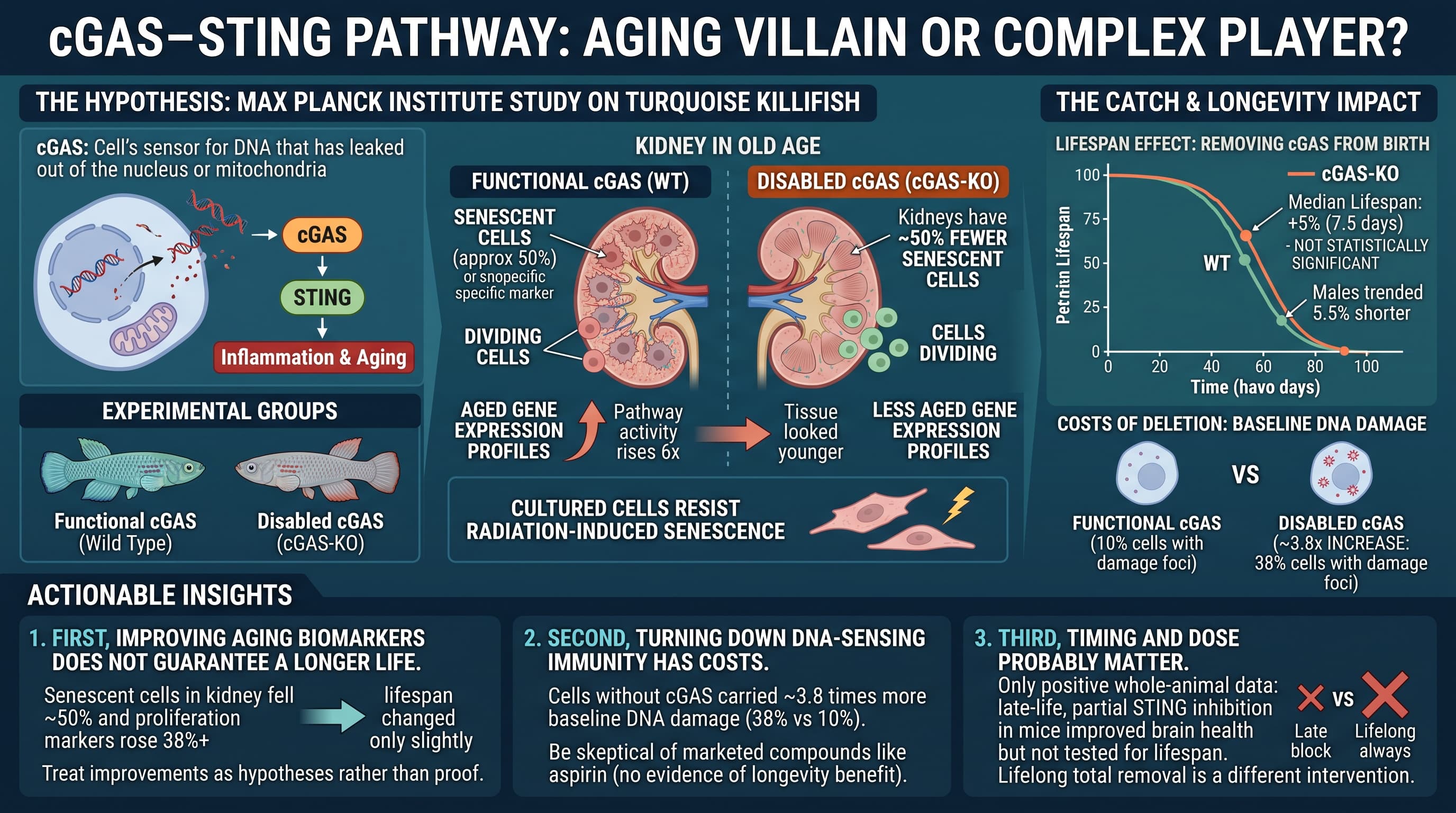
Researchers at the Max Planck Institute for Biology of Ageing disabled cGAS, the cell’s sensor for DNA that has leaked out of the nucleus or mitochondria, in the turquoise killifish, a short-lived vertebrate. The fish looked younger at the tissue level. Their kidneys had about half as many senescent cells, more cells were still dividing, and gene expression profiles looked less aged. Cultured cells resisted radiation-induced senescence. Removing cGAS from birth for the whole life did not extend lifespan, and it came with a cost: more baseline DNA damage. The study also found that pathway activity in the kidney rises about sixfold in old age. That pattern suggests cGAS-STING mainly causes harm late in life, which fits the positive whole-animal data so far: partial STING inhibition started late in life improved brain health in mice. The takeaway is that when and how much you block this pathway probably matters more than whether you block it.
The cGAS-STING pathway has become a leading target in aging biology. When DNA leaks into the interior of a cell, whether from a damaged nucleus or a stressed mitochondrion, the enzyme cGAS detects it and produces the messenger molecule cGAMP. cGAMP activates STING, which triggers an interferon alarm. This defense is essential against viruses. Over decades, though, chronic activation drives inflammaging, the low-grade inflammation linked to neurodegeneration, heart disease and frailty. It also powers the inflammatory secretions of senescent cells.
Adam Antebi’s group in Cologne asked the most direct question possible: what happens if cGAS is removed completely, from conception, in a vertebrate that ages within months? The African turquoise killifish lives about 4 to 8 months and shows many features of vertebrate aging along the way, which makes it well suited for this kind of test.
The biology responded clearly. In fish cells without cGAS, radiation-induced senescence fell by more than half, and the cells kept dividing when normal cells stalled. In live fish, the kidney’s response to radiation damage was muted. By old age, knockout kidneys had about half the senescence staining of normal kidneys, more dividing cells, and gene activity that looked less aged. Programs for DNA replication and repair were less shut down, and the complement and clotting signals typical of inflammaging were less pronounced. The pathway is clearly an active driver of cellular aging signatures in this animal.
Lifespan, however, did not change. Knockout and normal fish died on essentially the same timetable. The key question is why, and the paper’s own data point to an answer.
First, pathway activity is time-dependent. In normal fish, kidney cGAMP levels rose roughly sixfold between youth and old age. For most of the animal’s life the alarm is quiet, so a lifelong knockout pays costs during years when there is little to gain.
Second, total removal has side effects. Killifish cGAS turns out to protect DNA, much as it does in naked mole rats. Knockout cells carried almost four times more baseline DNA damage. The fish also partly compensated by increasing expression of STING and other downstream immune genes, which is a typical response when a component is missing from development onward.
Third, senescence is not purely harmful. It supports wound repair and tumor suppression, so eliminating the signal entirely removes helpful effects along with harmful ones.
Together, these findings fit the more encouraging evidence from mice. In 2023, partial STING inhibition started in old animals reduced brain inflammation and slowed cognitive decline. That approach differs in every important respect: it is late-life rather than lifelong, partial rather than total, and it targets STING rather than cGAS. The killifish result tests the bluntest possible version of the intervention and shows that it is not the right one. It leaves the more refined strategy open, and arguably strengthens the case for it.
Actionable Insights
This paper supports a clear strategic principle: in this pathway, timing and dose probably matter more than total suppression.
First, the target becomes more active with age. In normal fish, kidney cGAMP rose about sixfold from youth to old age. Blocking the pathway early in life brings mostly costs, while late-life intervention aims at the period when the pathway is most active.
Second, total loss has a measurable cost. Cells without cGAS showed about 3.8 times more baseline DNA damage (38 percent vs 10 percent of cells with damage foci). Partial inhibition that keeps some cGAS activity could avoid most of this.
Third, the benefits at the tissue level are real. Kidney senescence fell by about 50 percent and proliferation markers rose by 38 percent or more. A carefully timed intervention would aim to keep these gains without the costs.
Practically, the best evidence still comes from late-life, partial STING inhibition in mice, which improved brain health but was not tested for lifespan. For now, avoid products marketed as broad cGAS or STING blockers for lifelong use. Aspirin, for example, blocks cGAS in cell studies, but there is no longevity evidence for that mechanism. Instead, watch for clinical STING inhibitors being tested in specific late-life inflammatory or neurodegenerative conditions.
Context and Source
- Open Access Paper: Loss of killifish cGAS attenuates age-related signatures but does not affect organismal life span
- Institution: Max Planck Institute for Biology of Ageing and CECAD, University of Cologne
- Country: Germany (with collaborators in the USA and France)
- Journal: EMBO Reports (published online 9 September 2026)
- Impact evaluation: EMBO Press reports that the 2025 JIF for EMBO Reports was erroneous and gives a corrected official figure of 6.4. The impact score of this journal is 6.4, evaluated against a typical high-end range of 0 to 60+ for top general science (Nature, Science and Cell sit roughly between 40 and 65), therefore this is a Medium impact journal.
Related Reading:
- Key Approaches to Lowering cGAS-STING-driven Inflammaging: The State of the Science
- cGAS-STING: The DNA Alarm That Turns From Guardian to Arsonist as You Age
- Rewiring DNA Repair — Naked Mole-Rat cGAS as a Playbook for Slowing Human Aging
- Exercise in a Pill? Ketone Body β-Hydroxybutyrate "De-Ages" the Liver via cGAS-STING Inhibition