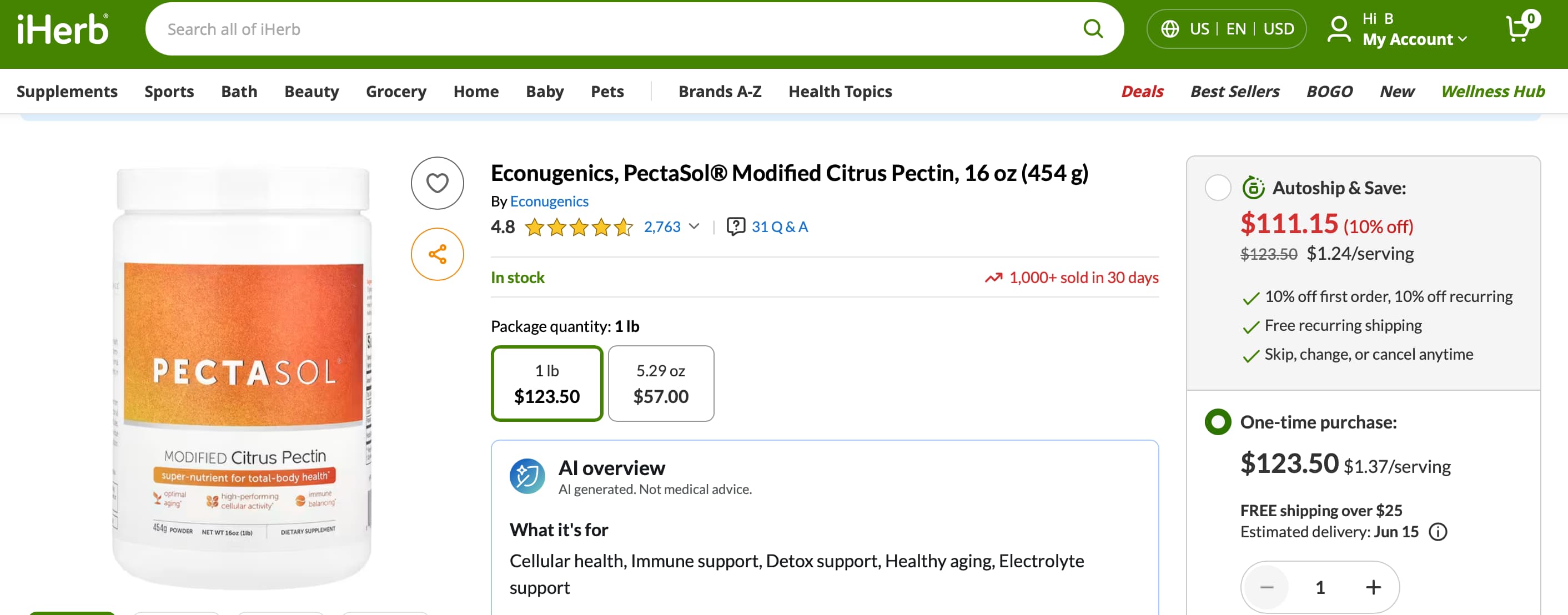
PectaSol-C: Flavor, Mixing, Food Use, and Interaction Profile
Flavor and Sensory Profile
The unflavored PectaSol-C powder elicits divided user opinion. The majority of iHerb reviewers describe it as mild, bland, and neutral — background citrus bitterness with no strong taste, tolerable in most liquids without significantly affecting the flavor of the drink. A minority find it more assertively bitter — one commonly quoted description is “lightly sour/citrus rind” — which is consistent with the galacturonic acid content of the pectin backbone.
The texture when not fully dissolved is the more consistent complaint: chalky or slightly powdery if inadequately mixed, particularly in cold water without agitation. Proper technique eliminates this almost entirely (see below).
ecoNugenics now offers flavored alternatives:
-
Lime Infusion powder (available in 184g) — reviewed as noticeably more palatable with light citrus taste and improved mixability
-
Tangerine Infusion chewable tablets — highest palatability ratings; useful for those who find powder mixing inconvenient
Mixing Kinetics
The correct technique is critical — PectaSol-C’s low MW (<10 kDa) makes it water-soluble, but it requires mechanical agitation to hydrate fully. Here is what actually works:
Recommended method:
- Add powder to a dry shaker bottle or glass
- Add a small splash of cool/room-temperature liquid first (~50 mL)
- Stir or shake vigorously for 30–60 seconds until smooth
- Top up to full volume (250–350 mL) and mix again
- Drink immediately — extended sitting time allows settling and minor viscosity increase
Why this order matters: Adding powder to a full glass of liquid leads to clumping at the surface. Adding a small amount of liquid first and pre-wetting the powder prevents this.
Temperature is important: ecoNugenics explicitly instructs cool or room-temperature liquids only. This is not arbitrary. PectaSol-C is a low-methoxyl (DE ≤5%), low-MW polysaccharide. At temperatures typical of hot coffee or tea (85–95°C), several degradation processes occur:
-
Beta-elimination: Breaks the pectin backbone at ester bonds, destroying the galactose-rich side chains that are the functional binding moiety for galectin-3. The thermal degradation literature shows this is temperature- and pH-dependent and becomes significant above 75°C with prolonged exposure
-
Calcium-induced gelation: Low-methoxyl pectin gels in the presence of divalent cations — hot milk or high-calcium liquids combined with heat could cause visible thickening
-
Demethoxylation: Further reduces DE, changing the pectin’s physical properties
Brief exposure to a hot beverage (stirring into coffee and drinking immediately) is likely less damaging than the worst-case published degradation studies, which typically involve sustained heating for 30–300 minutes. However, since the product’s entire clinical value depends on structural integrity of the galactose residues reaching systemic circulation intact, there is no upside to using hot liquids and meaningful downside risk. Use cool or room-temperature liquid as directed.
Can It Be Mixed in Coffee or Tea?
Hot coffee/tea: Not recommended. The thermal concerns above apply, plus the absorption window is already constrained by the need to take PectaSol-C on an empty stomach — coffee and tea are frequently consumed with or after meals, which would simultaneously violate the timing recommendation.
Cold brew coffee or iced tea: Acceptable from a temperature standpoint, though the caffeine/tannin combination adds no benefit and the timing issue (empty stomach) still applies if these are consumed with food.
Practical reality: Most users who take this long-term default to plain cold water or diluted fruit juice taken 30 minutes before breakfast — the simplest, most reliable approach with no confounding variables.
Can It Be Mixed in Fruit Smoothies?
Yes, with one important caveat: timing. Smoothies that contain no fat, minimal calcium, and are consumed on an empty stomach are fine. In practice, most people have smoothies as a meal with fat (nut butter, avocado) and calcium-rich ingredients (dairy, high-calcium plant milk). In that context:
- The fat content interferes with intestinal absorption of the polysaccharide
- The empty-stomach requirement is violated
- The calcium content in dairy or fortified plant milks could interact with the low-methoxyl pectin (see gelation note above)
If using smoothies: best reserved for a low-fat, low-calcium, mid-morning smoothie taken well after your last meal and at least 60–90 minutes before the next. A water-banana-berry blend with no added dairy or protein is the cleanest option in this format.
Can It Be Incorporated into Foods?
In principle, yes — in practice, significant caveats apply.
PectaSol-C as a low-methoxyl, low-MW pectin has the following behaviour in food matrices:
Hot foods (oatmeal, soups, sauces): Heat degrades the bioactive polysaccharide (see above). Stirring into hot oatmeal is equivalent to adding it to hot liquid — not recommended for a product you intend to be pharmacologically active.
Cold foods (yogurt, pudding): Dairy presents a double problem. High calcium in yogurt can crosslink the low-methoxyl pectin chains via the egg-box model — the same mechanism used to make low-sugar jams. Depending on the amount of calcium and pH, this can cause partial gelation in the food itself, reducing effective dissolution and likely reducing intestinal absorption. The presence of fat and protein in yogurt further complicates absorption. Additionally, taking it with food (even cold food) violates the empty-stomach timing.
Cold smoothie foods (smoothie bowls, overnight oats): Same concerns as above.
The honest assessment: PectaSol-C was designed as a dissolve-in-water supplement, not a food ingredient. Its pharmacological efficacy depends on intact low-MW polysaccharide reaching the intestine dissolved in aqueous solution, not embedded in a food matrix. Incorporating it into food for palatability convenience is likely to reduce bioavailability meaningfully. For the longevity application, where you are paying ~$4/day for a specific molecular target engagement, the small palatability convenience is not worth the likely reduction in efficacy.
Interactions: Foods, Medications, and Supplements
Timing Baseline Rule
ecoNugenics instructs: take at least 30 minutes before food or 90 minutes after food, and separate from all medications and other supplements. This is the foundation for everything below.
Food Interactions
Fat and fat-soluble nutrients: Pectin interferes with micelle formation in the small intestine — the packaging system that enables absorption of fats and fat-soluble compounds. Research published in Nutrition Research Reviews (Cambridge Core) and Journal of Nutrition (Oxford Academic) confirms that soluble fibers including pectin reduce absorption of:
-
Carotenoids (beta-carotene, lycopene, lutein): 33–74% reduction when taken simultaneously — this is substantial
-
Alpha-tocopherol (Vitamin E): Significant reduction
-
Vitamin A (from beta-carotene conversion): Reduced hepatic storage
This means: Do not take your fat-soluble vitamins (A, D, E, K), carotenoid supplements, astaxanthin, CoQ10, or similar with PectaSol-C. Take those with a fat-containing meal. Take PectaSol-C on its own, away from food.
Calcium-rich foods: Low-methoxyl pectin is structurally responsive to calcium — high-calcium environments trigger ionic crosslinking. Taking PectaSol-C immediately after consuming a calcium-rich meal (dairy, fortified foods, calcium supplements) may partially complex the pectin in the GI tract, reducing free polysaccharide available for absorption.
Drug Interactions
No CYP450 inhibition or induction: This is a meaningful safety advantage. Unlike quercetin, grapefruit, or many plant compounds, pectin has no interaction with the cytochrome P450 drug-metabolising enzyme system. This means it does not affect blood levels of rapamycin, statins, anticoagulants, or essentially any CYP-metabolised drug through that mechanism.
No P-glycoprotein interaction: Confirmed. No known transporter-mediated drug interactions.
Physical GI binding — the real drug interaction concern: As a polysaccharide fiber in the GI lumen, PectaSol-C can physically bind to oral medications, reducing their dissolution and absorption. This is a class effect of dietary fibers, not specific to pectin. The Memorial Sloan Kettering integrative medicine database on pectin and RxList flag the following specific interactions:
| Drug |
Interaction |
Recommended Separation |
|
Digoxin (Lanoxin) |
Fiber reduces digoxin GI absorption; can reduce efficacy and affect cardiac control |
4 hours before or 1 hour after digoxin |
|
Tetracycline antibiotics (doxycycline, minocycline) |
Physical binding reduces antibiotic absorption |
2 hours before or 4 hours after tetracycline |
| Oral chemotherapy |
General precaution; no specific data for most agents |
1–2 hours separation |
| Metformin |
Fiber slows glucose absorption; additive glucose lowering; generally beneficial but monitor |
Take with meals (metformin), MCP on empty stomach — timing separates naturally |
| Oral iron supplements |
Pectin chelates divalent metals including iron |
2 hours separation; take iron with food |
| Thyroid medications (levothyroxine) |
Any fiber can reduce levothyroxine absorption |
4 hours separation; always take levothyroxine on empty stomach 30–60 min before food |
Blood thinners (warfarin, apixaban, rivaroxaban): No known pharmacokinetic interaction. No clinical reports of adverse effects. Pectin does not have significant anti-platelet or anticoagulant activity at supplemental doses. No specific separation required, though the general empty-stomach timing naturally separates them from most anticoagulant dosing schedules.
Supplement Interactions
Essential mineral supplements (calcium, magnesium, zinc, iron): The heavy metal detox data from Eliaz et al. 2006 showed essential minerals were not significantly depleted at the doses studied (15–20 g/day over 5–6 days), suggesting a selectivity for heavy metal binding over essential minerals. However, as a precaution, separate essential mineral supplements by at least 1–2 hours from PectaSol-C. Do not take calcium, magnesium, or zinc supplements at the same time.
Fat-soluble supplements (CoQ10, vitamins A/D/E/K, astaxanthin, curcumin, omega-3s): As noted above — take these with meals containing fat. PectaSol-C on empty stomach. The timing naturally separates them.
Probiotics: No known interaction; PectaSol-C may actually function as a prebiotic for some beneficial bacteria, making them potentially synergistic. Timing is flexible.
NR/NMN: No interaction. Both are water-soluble; timing is flexible though optimal NR/NMN absorption may also benefit from empty-stomach dosing based on the gut microbiota conversion mechanism — in which case take them at different times.
Quercetin (if in your stack): Quercetin is a CYP3A4 inhibitor — no interaction with PectaSol-C itself, but if you are using quercetin alongside rapamycin, the rapamycin interaction is the concern (as covered in the main interventions report). No direct PectaSol-C/quercetin interaction.
Practical Protocol Summary
| Timing |
Action |
| Wake (empty stomach) |
5 g PectaSol-C in cool water (Dose 1) |
| Wait 30 min |
Breakfast + fat-soluble vitamins, CoQ10, fish oil, mineral supplements |
| ~90 min after breakfast |
5 g PectaSol-C in cool water (Dose 2) — if mid-morning snack free |
| 30 min before lunch |
5 g PectaSol-C in cool water (Dose 3) — or take after sufficient post-breakfast gap |
The capsule form (270 caps, 6 caps = 4.8g) avoids all mixing issues at the cost of swallowing 6 capsules per dose (18/day total), but the powder is significantly more economical and equivalent in bioavailability.
GI Side Effects and Titration
Starting directly at 14–15 g/day commonly causes transient bloating, gas, and loose stools — not from toxicity but from the gut microbiome adapting to a sudden large polysaccharide substrate load. The practical approach:
-
Week 1: 5 g/day (one dose)
-
Week 2: 10 g/day (two doses)
-
Week 3+: 15 g/day (three doses)
Most people adapt fully within 2–3 weeks. Long-term use at 15 g/day is well tolerated with no safety signals in published clinical trial data.
 CRITICAL PRODUCT DISTINCTION — READ BEFORE PURCHASING
 Direct mechanism
 Different pharmacokinetics