Another interesting paper in this Orexin series…
Brain’s Wakefulness Switch Reverses Metabolic Aging in Mice
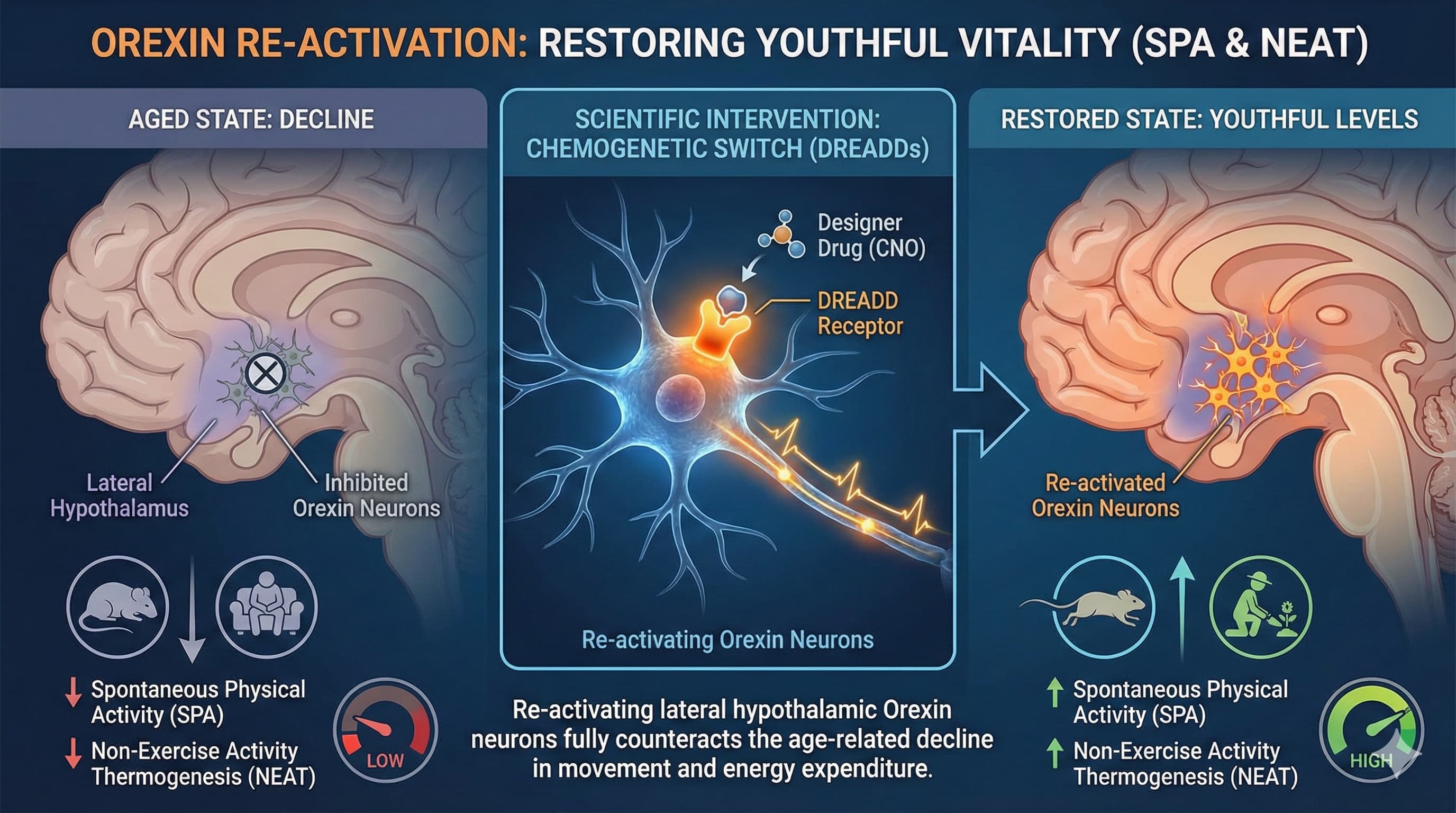
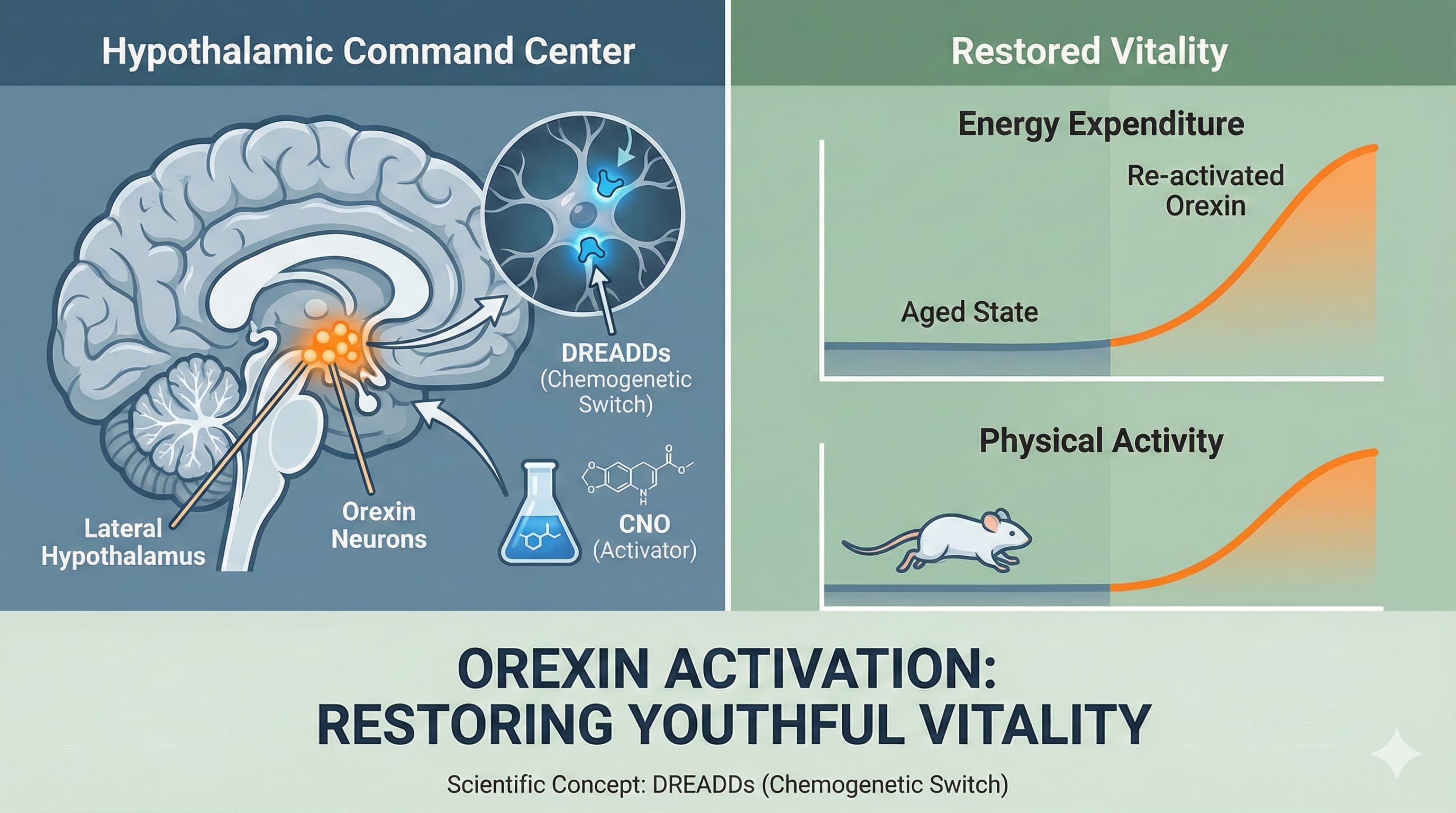
Researchers at the University of Minnesota used a genetic on-switch to artificially fire a small cluster of hypothalamic neurons that produce orexin, a wakefulness and activity peptide known to decline with age. In 12-month-old female mice, switching these neurons on reversed several signatures of early aging: the animals moved 44 to 64 percent further in behavioral tests, more than tripled their spontaneous fidgeting activity, and raised total energy expenditure by roughly 38 percent, back to levels seen in 5-month-old mice. Working memory was unaffected. The study measured no lifespan, no molecular aging markers, and used five to ten animals per group. Its lasting contribution is not the behavioral panel but the demonstration that surviving orexin neurons in an older brain remain fully responsive to stimulation, which frames age-related orexin decline as a signaling deficit rather than an irreversible loss of circuitry.
Somewhere around middle age, most mammals start to move less. Not because of injury or illness, but as a quiet, cumulative drift: fewer steps, less fidgeting, less spontaneous getting-up-and-doing. That drift matters more than it sounds. The energy burned through non-exercise movement is a large slice of daily metabolism, and its erosion tracks with the fat gain, insulin resistance, and functional decline that define the transition out of biological youth.
A team led by Catherine Kotz asked whether that drift has a specific, addressable cause. Their candidate was orexin, also called hypocretin, a peptide made by a few thousand neurons packed into the lateral hypothalamus. Orexin is the brain’s arousal and activity throttle. People who lose these neurons develop narcolepsy. Animals without them become sedentary and gain fat despite eating less. And in normal aging, in both rodents and humans, orexin output falls.
The team used chemogenetics, a technique that installs an artificial receptor into a defined neuron population so that an otherwise inert drug becomes a dedicated on-switch for just those cells. They put the switch into orexin neurons of 5-month-old and 12-month-old female mice, then compared the animals with and without the activating drug.
The middle-aged animals had, as expected, drifted. They carried about 40 percent more body mass and roughly two and a half times the fat mass of the young mice. They covered 29 to 43 percent less ground in open arenas. Their spontaneous physical activity during the active night hours had collapsed by around two thirds, and their energy expenditure had fallen by about a quarter.
Turning on the orexin neurons largely undid this. Nighttime activity in the middle-aged animals rose more than threefold, overshooting young untreated controls. Energy expenditure climbed back to young levels. Locomotion in both test arenas returned to the young range. The effects were consistently larger in the older animals than in the young ones, and they appeared almost exclusively in the dark phase, when mice are naturally active.
Two findings complicate the tidy story. Working memory, already intact in the older mice, was unchanged by the intervention. And the anxiety-related measures moved in a direction the authors had to work to interpret: the older mice were less anxious than young ones at baseline, and stimulation made both age groups more anxious, not less.
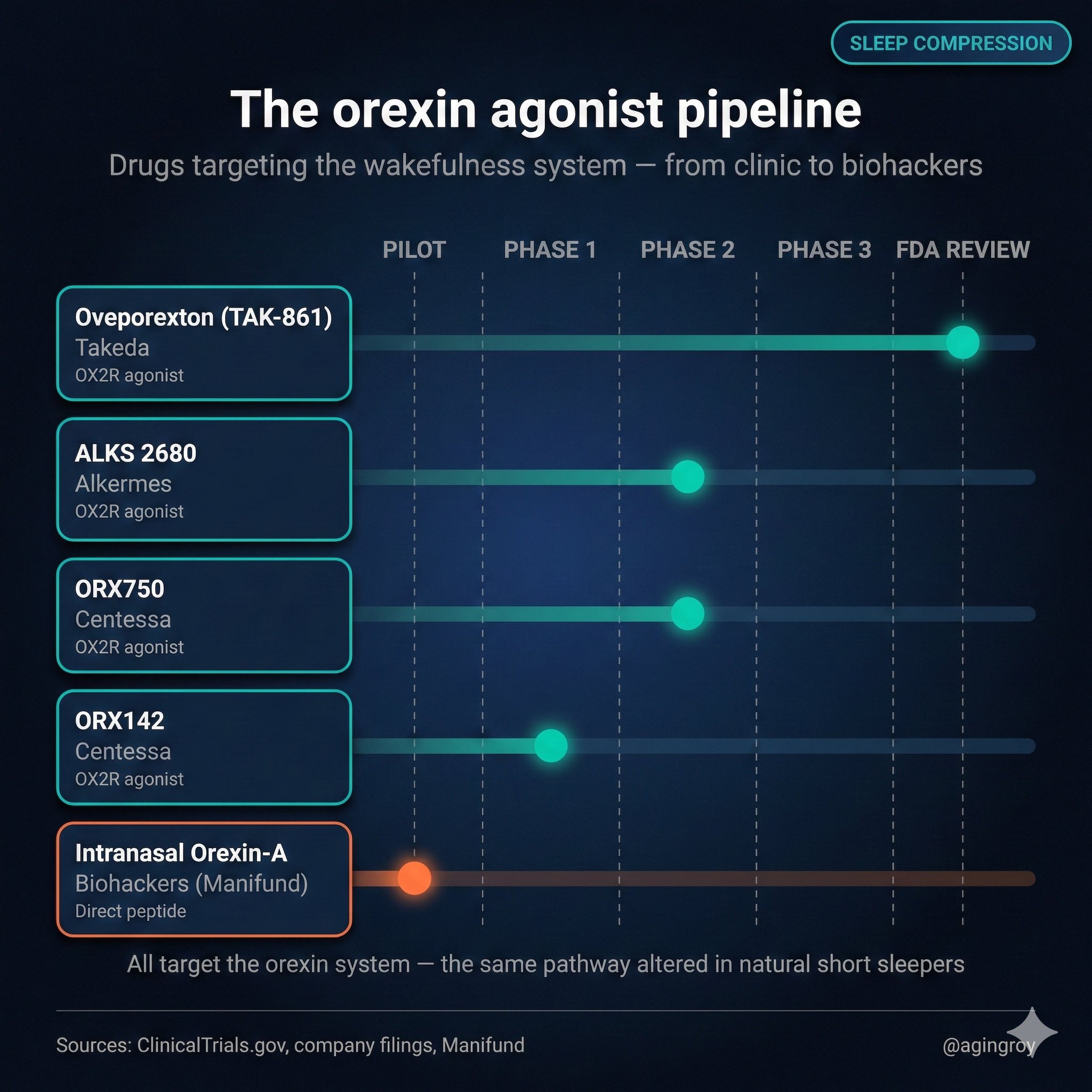
The mechanistic message is the one worth carrying forward. The old orexin neurons were not dead or refractory. They fired on command and drove a young-animal metabolic phenotype. That distinction, between a circuit that has lost cells and a circuit that has lost tone, determines whether a pharmacological fix is plausible at all. Seven years after publication, the first orexin receptor agonist reached the clinic, which makes this an unusually relevant piece of preclinical groundwork.
Actionable Insights
The measured variable was not exercise. It was spontaneous physical activity: unstructured, low-intensity movement, the kind people do without deciding to. In the middle-aged mice, stimulating orexin raised this by roughly 230 percent and total daily energy expenditure by roughly 38 percent, which works out to about 4 extra kilocalories per day in an animal burning 11 to 12. Scaled crudely to a 2,000 kcal human, a 38 percent shift would be several hundred kilocalories daily, though that scaling is illustrative only and almost certainly optimistic.
The standardized effect sizes for the activity and energy endpoints are very large, in the range of Cohen’s d of 2 to 5. For context, a d of 0.8 is conventionally a large effect. With five to six animals per group, these numbers are upper bounds and should be mentally discounted by half or more.
The transferable point: spontaneous movement is a large, declining, and apparently restorable component of aging metabolism. Anything that raises baseline non-exercise activity, including standing, pacing, and protecting the alert phase of your day, targets the same output pathway. Orexin agonists now exist, but they are approved for narcolepsy, not for metabolism or aging.
Context and Source
The Biohacker Analysis
Study Design Specifications
-
Type: In vivo (Pre-clinical gene therapy study).
-
Subjects: Female C57BL/6J mice.
-
Young Group: 5 months (n=7−9).
-
Middle-Aged Group: 12 months (n=7−10).
-
Genotype: Orexin-Cre (allows genetic targeting of orexin neurons).
-
Control Group: Saline-injected DREADD mice and non-DREADD controls.
-
Lifespan Context: The study uses 12-month-old mice as “middle-aged.” Based on survival data from the Intervention Testing Program (ITP) and Jackson Labs, C57BL/6J mice typically live 26–30 months (800–900 days). Therefore, 12 months represents the onset of decline (equivalent to a human in their 40s), not geriatric aging.
Mechanistic Deep Dive
-
The Target: Orexin (Hypocretin) neurons in the Lateral Hypothalamus (LH). These neurons are sensors for energy balance, activated by low glucose, ghrelin, and lactate, and inhibited by leptin and glucose.
-
The Intervention: DREADD (hM3Dq) technology. A modified muscarinic receptor was expressed solely on Orexin neurons via viral vector (AAV2). The inert ligand Clozapine-N-Oxide (CNO) was used to selectively depolarize and fire these neurons.
-
Pathway Activation:
-
Metabolic Flux: Activation increased Spontaneous Physical Activity (SPA) and Non-Exercise Activity Thermogenesis (NEAT).
-
Circadian Gating: The effect was time-dependent, boosting metabolism specifically during the active (dark) phase, suggesting it reinforces circadian amplitude rather than causing indiscriminate hyperactivity.
-
Anxiety Modulation: Contrary to the fear that “waking up” the brain causes anxiety, activation reduced the abnormal avoidance behavior seen in middle-aged mice, normalizing their exploration to youthful levels.
Novelty
Previous research showed Orexin declines with age Age-related loss of orexin/hypocretin neurons (2011). This paper proves causality: specifically replacing this lost neural drive reverses the age-associated drop in metabolic rate. It identifies the brain’s “arousal deficit” as a primary driver of middle-aged weight gain.
Critical Limitations
-
Translational Gap (Methodological): The DREADD system is a research tool requiring intracranial viral injection. It is not a viable human therapy.
-
Age Definition: 12-month-old mice are not “old.” They are equivalent to 40-year-old humans. The study does not prove this works in geriatric (24+ month) animals, where neuronal loss might be irreversible.
-
Sex Bias: The study used only female mice. Orexin system sensitivity is known to be sexually dimorphic.
-
Ligand Purity: CNO can metabolize into Clozapine (an antipsychotic) in vivo, which could confound sedation results, although the authors included controls to rule this out.
Claims & Verification
1. “Orexin tone and neuron density decrease with normal aging.”
-
Hierarchy: Level C (Human Post-mortem & Animal Data).
-
Verification: Confirmed. Human post-mortem studies show up to 40% loss of Orexin neurons in aged individuals, distinct from Narcolepsy or Alzheimer’s.
-
Sources:
2. “Activation of Orexin neurons increases Energy Expenditure (EE) and Spontaneous Physical Activity (SPA).”
-
Hierarchy: Level D (Pre-clinical).
-
Verification: Confirmed in mice. Orexin signaling promotes “NEAT” (Non-Exercise Activity Thermogenesis).
-
Sources:
3. “Chemogenetic activation ameliorates age-related anxiety-like behavior.”
-
Hierarchy: Level D (Pre-clinical).
-
Verification: Translational Uncertainty. High levels of Orexin are typically associated with panic and stress responses in humans. The study’s finding that it reduced anxiety in middle-aged mice may be specific to the “apathy” phenotype of aging mice, rather than generalized anxiety.
-
Sources: