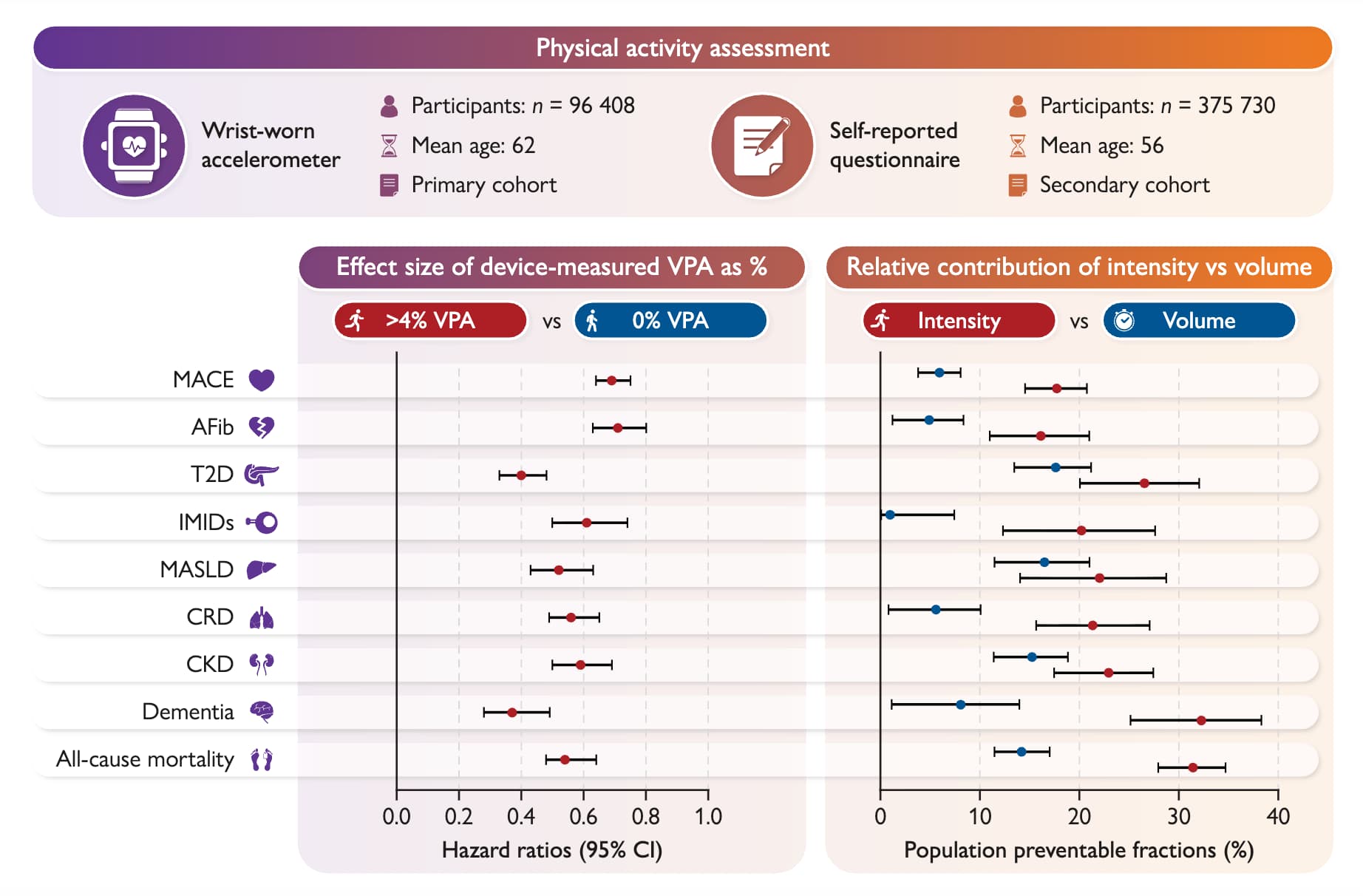
For decades, public health guidelines have treated physical activity volume as the primary metric for longevity, often equating long walks with short sprints under the broad umbrella of energy expenditure. A massive new prospective analysis published in 2026 definitively challenges this volume-centric paradigm. By leveraging wearable accelerometer data from nearly 100,000 adults, researchers have established that the intensity of physical activity—specifically the proportion of vigorous physical activity (%VPA)—is a vastly superior predictor of chronic disease prevention than total exercise volume.
The study reveals a non-linear, inverse dose-response relationship between %VPA and the incidence of eight major non-communicable diseases, alongside all-cause mortality. Participants who substituted just over 4% of their total physical activity volume with vigorous exertion saw a 29% to 63% reduction in the hazard ratios for conditions ranging from major adverse cardiovascular events (MACE) and dementia to immune-mediated inflammatory diseases (IMIDs). Notably, these protective effects plateaued at around 4% to 5% VPA for cardiovascular and neurological outcomes, suggesting an easily achievable biological threshold for maximum return on investment.
Crucially, the data disaggregates disease categories by their sensitivity to exercise intensity versus volume. Immune-mediated and inflammatory conditions are almost exclusively intensity-dependent; vigorous activity accounted for a 20.3% population preventable fraction for IMIDs, compared to a mere 1.0% for total activity volume. Conversely, metabolic conditions like type 2 diabetes and metabolic dysfunction-associated steatotic liver disease (MASLD) require a combined approach, responding equally well to cumulative energy expenditure (volume) and metabolic stress (intensity). The actionable takeaway is clear: to optimize longevity and healthspan, individuals must cross the vigorous intensity threshold regularly, rather than merely accumulating low-intensity movement.
Context:
-
Open Access Paper: Volume vs intensity of physical activity and risk of cardiovascular and non-cardiovascular chronic diseases
Investigators: This research was led by investigators at the Department of Social Medicine and Health Management at Central South University in Changsha, China, utilizing data from the UK Biobank. The study was published in the European Heart Journal. - Impact Evaluation: The impact score of this journal is 39.3, evaluated against a typical high-end range of 0–60+ for top general science, therefore this is an Elite impact journal.
Related Reading:
- Pedaling Back the Epigenetic Clock: 6-Month Endurance Training Reverses GrimAge in Middle-Aged Adults
- Maintaining VO2Max as We Age: Possible Strategies, Drugs and Supplements
- The Chair is a Lethal Exposure: Why Your Gym Habit Cannot Erase Your Desk Job
- Vigorous exercise can reverse damage from heart aging (UT Southwestern)
- HIIT and the Exerkine Explosion: A Molecular Map for Longevity