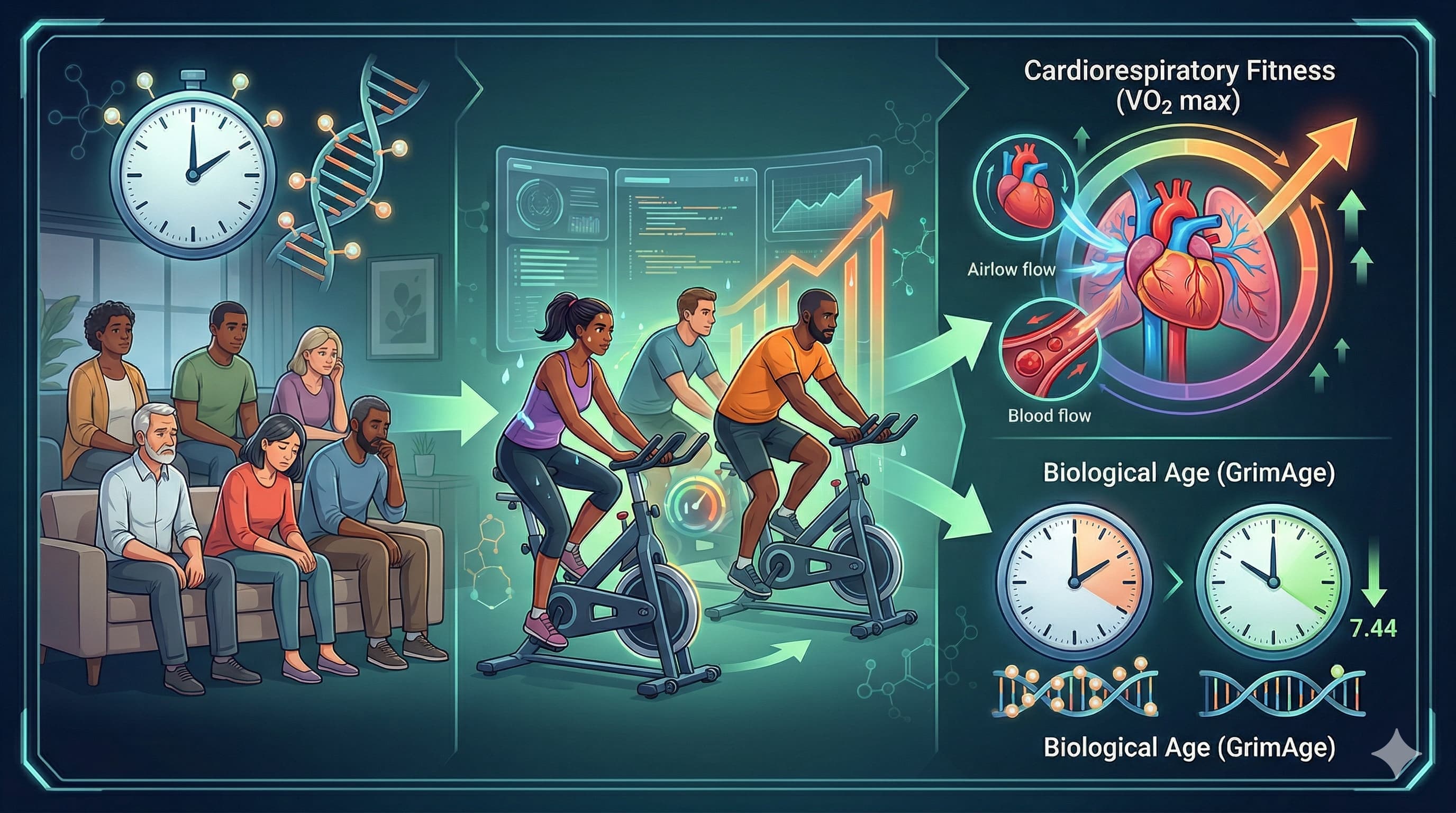
While the longevity and biohacking fields are heavily focused on experimental pharmacologics and cellular reprogramming, proving that foundational lifestyle interventions can molecularly reverse biological aging remains a persistent clinical hurdle. Epigenetic clocks—specifically second-generation models like GrimAge, which are trained to predict mortality risk and physiological healthspan rather than mere chronological age—offer a quantifiable metric of biological decay. However, their real-time responsiveness to short-term, non-pharmacological interventions in generally healthy human cohorts has historically lacked clear consensus.
A new clinical pilot study provides compelling evidence that targeted, progressive cardiovascular effort has a rapid and measurable impact on these molecular biomarkers. Researchers implemented a six-month, personalized, cycling-based endurance exercise training (EET) program for 42 physically inactive adults between the ages of 35 and 65. The trial data demonstrated that participants who successfully adhered to the protocol experienced a highly significant 20% increase in cardiorespiratory fitness, measured via maximum oxygen consumption (VO2 max). More importantly, their biological age, as calculated by the GrimAge clock, decreased by an average of 7.44 months relative to their expected chronological aging trajectory.
Crucially, the research team identified that this epigenetic deceleration was tightly correlated with the improvements in VO2 max, rather than mere changes in body weight or fat composition. Furthermore, the study exposed a major confounding biological variable in epigenetic testing: shifts in the immune system. Specifically, fluctuations in the fraction of circulating neutrophils accounted for a massive 74% of the variance in the GrimAge changes. When the statistical models were adjusted to control for these leukocyte shifts, the epigenetic age reduction remained robust and additionally aligned with improved training adherence and body fat reduction.
Interestingly, while the cardiovascular metrics dramatically improved, the participants exhibited a slight decline in bone density and handgrip strength. This clearly signals that cycling alone is an incomplete anti-aging protocol; it requires complementary resistance training to preserve musculoskeletal integrity. Ultimately, this trial underscores that second-generation epigenetic clocks can capture the real-time physiological benefits of endurance exercise, bridging the gap between clinical fitness metrics and molecular longevity.
Source:
- Paywalled Paper: Epigenetic age deceleration reflects exercise‑induced cardiorespiratory fitness improvements
- Institution: Ghent University and Ghent University Hospital
- Country: Belgium
- Journal: GeroScience (Epigenetic age deceleration reflects exercise-induced cardiorespiratory fitness improvements | GeroScience | Springer Nature Link), Published Dec. 2025.
- Impact Evaluation: The impact score of this journal is 5.4, evaluated against a typical high-end range of 0–60+ for top general science, therefore this is a Medium impact journal.