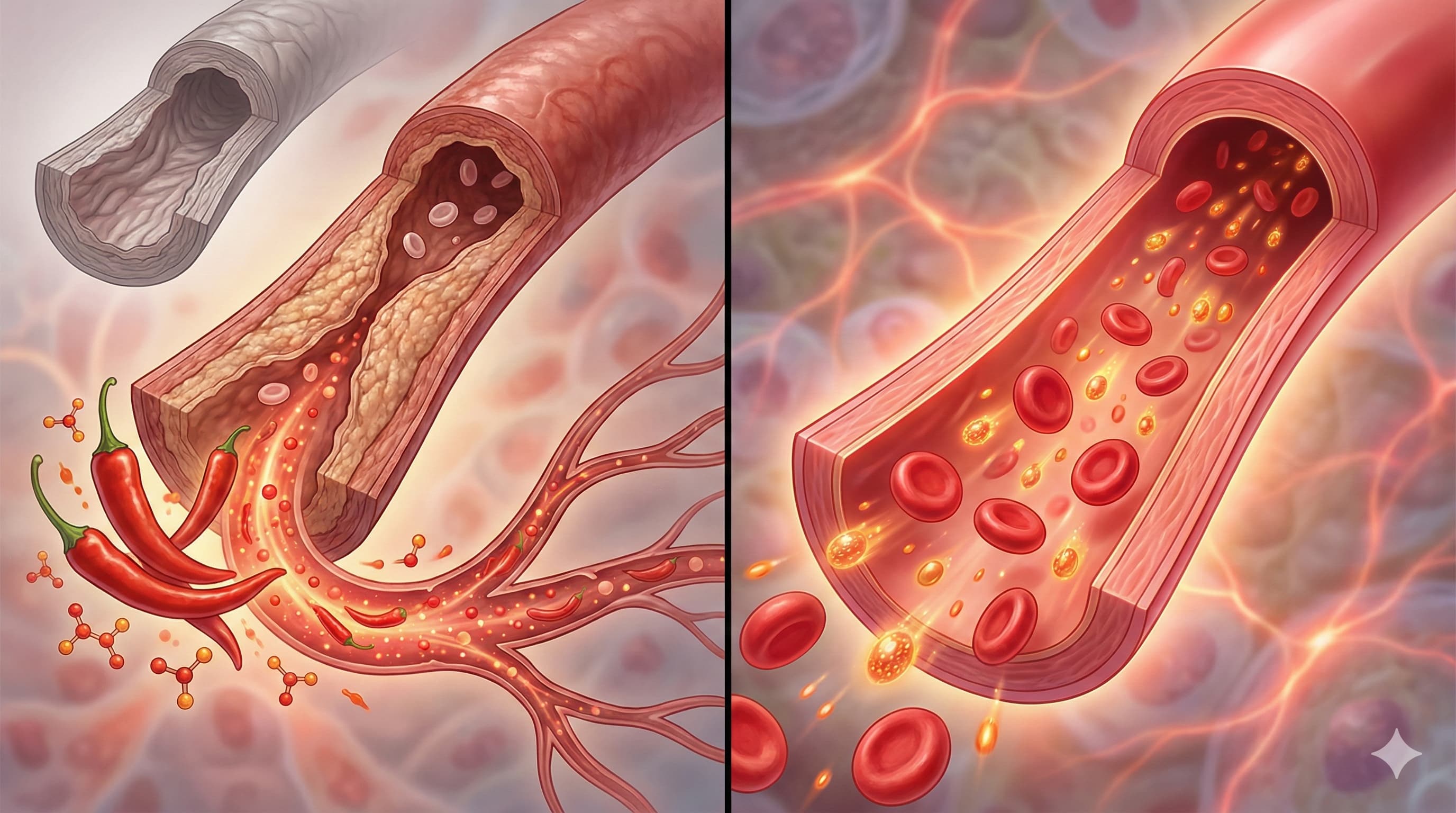
Recent research increasingly positions the “Western diet” as a primary accelerant of biological aging, yet a specific component of global cuisines—the pungent alkaloid capsaicin—may offer a potent counter-measure. This comprehensive review, spearheaded by researchers at Central South University, China, and published in the journal Aging and Disease, synthesizes a decade of evidence suggesting that capsaicin does more than just trigger a “heat” response; it serves as a master key for the Transient Receptor Potential Vanilloid 1 (TRPV1) channel, a critical regulator of vascular health.
The “Big Idea” is the transition of capsaicin from a culinary curiosity to a legitimate geroprotective agent. As we age, our blood vessels undergo a transformation: endothelial cells (the inner lining) become senescent and stop producing nitric oxide (NO), while vascular smooth muscle cells (the outer layer) begin to calcify and stiffen. This “vascular aging” is a precursor to nearly all cardiovascular diseases. The review highlights that chronic TRPV1 activation by capsaicin triggers a calcium-dependent signaling cascade that increases the phosphorylation of endothelial Nitric Oxide Synthase (eNOS). This results in sustained vasorelaxation and a reduction in systemic blood pressure. Beyond simple mechanics, the paper details how capsaicin suppresses the Senescence-Associated Secretory Phenotype (SASP), effectively “silencing” the pro-inflammatory signals that aged cells broadcast to their neighbors. While dietary pepper consumption has long been linked to reduced all-cause mortality in large-scale human cohorts, this paper provides the mechanistic roadmap required to move toward standardized clinical protocols for vascular rejuvenation.
Paper and Journal:
Open Access Paper: Capsaicin and TRPV1: A Novel Therapeutic Approach to Mitigate Vascular Aging
Journal: Aging and disease
The impact score of this journal is 7.0 (2023 JIF), evaluated against a typical high-end range of 0–60+ for top general science (e.g., Nature, Cell), therefore this is a High impact journal. It ranks in the top Q1 for Geriatrics & Gerontology.
Part 2: The Biohacker Analysis
Study Design Specifications:
- Type: Comprehensive Literature Review (synthesizing in vivo, in vitro, and epidemiological data).
- Primary Models Discussed: C57BL/6 mice, ApoE-/- (atherosclerosis models), and Sprague-Dawley rats.
- Lifespan Data: Not tested
-
Mechanistic Deep Dive:
- Vascular Health: Activates eNOS/NO pathway via Ca2+ influx.
- Mitochondrial Dynamics: Upregulates the PKA/UCP2 pathway, reducing oxidative stress in coronary endothelial cells. [Confidence: High]
- Autophagy/mTOR: Capsaicin is shown to activate AMPK, which indirectly inhibits mTORC1, promoting cellular “cleanup” or autophagy. [Confidence: Medium-High]
- Immune Microenvironment: Modulates macrophage polarization from M1 (pro-inflammatory) to M2 (anti-inflammatory), particularly in the context of atherosclerosis.
Novelty:
The paper consolidates the evidence that capsaicin acts as a senomorphic (suppressing senescent cell signaling) rather than just a senolytic. It specifically identifies the TRPV1-eNOS-NO axis as the primary target for reversing arterial stiffness.
Critical Limitations:
- Desensitization Paradox: Chronic high-dose exposure to TRPV1 agonists can lead to receptor desensitization (loss of function), potentially nullifying the vascular benefit.
- GI Erosion: High oral doses required for systemic vascular effects can cause gastric mucosal damage (but capsules and patented “microencapsulation” technology avoids these problems).
- Translational Gap: Human data relies heavily on epidemiological associations; rigorous Phase II clinical trials for vascular aging specifically are absent.
Part 3: Actionable Intelligence
The Translational Protocol:
-
Human Equivalent Dose (HED):
- Math: Based on an effective mouse dose of 10 mg/kg (commonly used in exercise/metabolic studies):
- 10 mg/kg (mouse)×(3/37)=0.81 mg/kg (human).
- For a 70kg adult, this is ~56 mg of pure capsaicin daily.
- Pharmacokinetics (PK/PD): Oral capsaicin has a short half-life of 1–2 hours due to rapid hepatic first-pass metabolism by CYP2C9, 2C19, and 3A4. Sustained-release formulations may be necessary for steady-state vascular protection.
-
Safety & Toxicity:
- NOAEL: 100 mg/kg/day in rats (~8.1 mg/kg in humans).
- LD50: ~148 mg/kg (oral rat).
- Signals: Watch for hepatotoxicity at extremely high supplemental doses (>500mg/day).
Biomarker Verification Panel:
- Efficacy Markers: Plasma Nitric Oxide (NO) metabolites, eNOS phosphorylation in PBMCs, and Pulse Wave Velocity (PWV) for arterial stiffness.
- Safety Monitoring: ALT/AST (liver), Creatinine/Cystatin C (kidney), and Endoscopy if persistent GI discomfort occurs.
Feasibility & ROI:
- Sourcing: Widely available as “Cayenne Fruit” extracts. Standardized extracts using microencapsulation (e.g., 2%–5% capsaicinoids) are preferred over raw powder for dose accuracy, and gastro-intestinal side effect risks.
- Cost: Moderate to high (~$6:50–$12/day) at the lower pricing options.
- ROI: High potential for blood pressure regulation and metabolic health with Moderate to High financial risk.